Welcome
Many artists dream about painting in Italy. Now, as retiring baby-boomers are increasingly taking up “brush and pallet knife,” more than ever, painting in Italy is the “thing.” Every day, a new “Artist’s” tour of Italy crops up in travel sections of the newspaper and on the Internet. But there still remains a majority of artists who prefer to “go it alone.” They are independent in their artistic styles, and prefer to be independent regarding their travels in Italy . This blog intends to target these free spirited artists who still need guidance to the best places to paint, especially those idyllic gems that are little known and less traveled. Certainly, independent travelers who are not artists will also benefit from this blog.
With a few exceptions, this blog is not a guide to restaurants, lodging, rental cars, or shopping, (except for art supplies.)
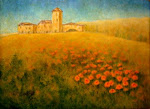
Sprinkled among the posts are: my paintings, and a few Italian proverbs and poems written by notable Italian authors for whom I work as a translator.
Please visit my website to view my original art:
http://www.pamelaallegretto-franz.com/
Giclee prints of my paintings, ranging from greeting size to poster size, can be purchased at:
http://pamela-allegretto.fineartamerica.com/
Sunday, January 30, 2011
PAINTING IN AFRICA / CAMEROON / EMMANUEL BALIYANGA
My friend Emmanuel Baliyanga painted “Food Market In Cameroon” shown above. Giclee prints from greeting card size to poster size of this painting and other colorful paintings of Africa and African life can be viewed and purchased at: http://www.emmanuel-baliyanga.fineartamerica.com/.
Emmanuel was born in the north of Rwanda where at a very young age he was admitted to an elite art school run by Belgian monks. There he learned everything about drawing, painting, and sculpture. He obtained with honors his arts diploma 6 years later.
In 1994, his parents and his eight siblings perished in the Rwanda Genocide. Emmanuel fled to Zaire. In 1995, to escape the tough life and epidemics of the refugee camps, he and other refugees tried to flee to the French Congo, but were forced to retreat. Back in Zaire, a Nun’s charity organization helped them to reach Cameroon, where he now lives.
Having won an art competition for AIDS awareness, he used the prize money to put himself through art school in Yaounde’.
In viewing Emmanuel’s vibrant, joyful art, one would never imagine that his life has been wrought with unthinkable hardships and sorrow.
Sadly, Africa is not a good market for selling fine art; however now, thanks to the kindness and assistance of French artist Miki Fonvielle, Emmanuel has his art on the Internet for the world to enjoy and purchase.
Please take time to visit Emmanuel’s site. In addition to depictions of African life, he paints remarkable portraits of African American celebrities, and his wood sculptures are breathtaking.
BON VOYAGE!
Labels:
Cameroon,
Emmanuel Baliyanga,
Painting In Africa
Friday, January 21, 2011
PAINTING IN ITALY / TUSCANY / FLORENCE / PIAZZALE MICHELANGELO / SAN MINIATO AL MONTE
When you’re ready to paint your personal interpretation of the Florentine view seen in many a Renaissance painting, travel up the Viale dei Colli to Piazzale Michelangelo, one of the best known and most popular of the vantage points offering a view over the city and its basin. The Viale dei Colli was specifically laid with the intention of offering Florentines and visitors an incomparable scenic route. The road curves along the slopes of the hills with some sections cloaked by lush vegetation. If you aren’t driving and aren’t up to the steep walk up from the city, you can reach Piazzale Michelangelo via bus #13.
The best time to visit the Piazzale Michelangelo is at dusk, when the purple-fringed Tuscan hills frame Giotto’s bell tower, Brunelleschi’s dome, and Palazzo Vecchio. Certainly, at various times of the day the Piazzale can be overcrowded with tour buses, usually midday during the summer months, but it’s rare that you can’t find a place to park your car, and there’s always space to set up an easel; and most importantly, the view of Florence will make you forget about any hubbub going on around you.
In the center of Piazzale Michelangelo is an impressive replica of the David. Speaking of the David, here’s a great little story regarding the nose of David. According to art historian Giorgio Vasari (1511-74), after Michelangelo had finished the David and was working on the scaffolding, the Gonfalonier, Pier Soderini, the highest authority of the Republic and therefore the patron of the sculpture, praised Michelangelo but added that ‘it seemed to him that the nose was too big.’ Michelangelo, who understood the patience necessary when working with a client, took a handful of marble dust and pretended to chisel away at the nose of David, allowing dust to trickle out of his hand. After the supposed finishing touch was complete, the Gonfalonier said ‘it pleases me more, you have given him life.’
From Piazzale Michelangelo you can continue on foot up to San Miniato al Monte. This clearly must be one of the best-loved churches in Italy: for it’s dramatically placed hilltop location overlooking Florence, for that same position as an eye-catcher up from the Florentine center, and for its brilliant black, green, and white marble façade. The church is dedicated to Saint Minias of whom legend has it that after martyrdom by decapitation the saint’s corpse was seen to carry his severed head over the river and up the hill (no, not to grandma’s house) to this spot. Look up the Church of San Miniato al Monte in your travel guide and take time to go inside. It is the oldest surviving church building in Florence after the Baptistery and it’s like no other church in the city. From the church grounds you’ll find many convenient vantage points for painting the Florentine vista.
Buon Viaggio!
Wednesday, January 19, 2011
PAINTING IN ITALY / TUSCANY / FLORENCE / FIRENZE / BOBOLI GARDENS
I lived in Florence for two years and believe that I still only scratched the surface of “paint-worthy” locations.
Certainly, before you even pick up a brush, you’ll want to visit the “heavy hitters”: Michelangelo’s David, Il Duomo, The Baptistery, The Uffizi, Palazzo Vecchio, Palazzo Pitti, The Ponte Vecchio, etc., etc. There are a whole host of guidebooks available that offer in depth information on these sites and the multitude of piazzas that are all worthy of your attention and your paint time. My purpose is to tell you about my favorite, lesser-known sites where you can set up your easel or sit with your sketch pad.
Florence’s city center is situated on the “Right Bank” of the Arno River. On the “Left Bank,” known as the Oltrarno, and behind the Palazzo Pitti, you’ll find the Giardini Boboli. It is said that the Marquis de Sade preferred the enchanting Boboli Gardens to Florence’s women whom he considered “arrogant, impertinent, ugly, dirty, and gluttonous.” Well, given his reputation, I suppose the Florentine women should have counted themselves fortunate to have been able to keep the Marquis at a safe distance.
The Boboli Gardens extend over eleven acres and occupy a hilltop position with awesome views over the city and its surroundings. The Boboli Gardens offer an overall impression of a refined integration of art and nature. Secluded paths lead to numerous resting places equipped with stone benches for sitting with a sketchpad or Pochade box. Surrounding these little tranquil pockets you’ll find grottos, fountains, and statues in close harmony with the emerald backdrop of cypresses, pines, laurel hedges, and lemon trees. Take time to visit the Grotta del Buontalenti where it’s fountains, frescos, and statues (Giambologna’s Venus in particular), are guaranteed to inspire you.
At the top of the gardens is the Giardino del Cavaliere with incredible views and more than enough convenient places to set up. You shouldn’t miss the fountain island, Isolotto, at the far end of the gardens. The most dramatic approach is along the central cypress avenue, Viottolone. Be aware that many of the statues along this path are Roman originals.
If you neglected to pack a picnic or drinks, don’t despair. There’s a charming little snack bar at the top of the gardens with lots of tables to sit and eat and drink and drink in the spectacular panorama. It’s also a great place to sketch or paint. But unlike other bars where you can get away with sitting and painting for hours for the price of one espresso, if you’re there on a busy day you’ll be encouraged to buy something more to eat or drink, or else pack up that Pochade Box and move on down the line. You can’t blame them. Given the plethora of artists who visit the city, the bar would quickly go belly up if every artist who sat at its tables only ordered one coffee and then proceeded to sit for four hours.
Buon Viaggio!
Tuesday, January 18, 2011
PAINTING IN ITALY / TUSCANY / FLORENCE / FIESOLE
About a 25-minute drive from Piazza San Marco in Florence will take you to the hill town of Fiesole. As you take this panoramic drive you’ll pass fountains, statuary, and lush gardens. If you prefer to not drive, you can take the #7. However, if you take the bus, you won’t be able to pull off along the way and sketch the amazing views, which I highly recommend. Piazza Mino da Fiesole, Fiesole’s main square, is a great place to sit and have an espresso or sip Campari while you sketch the ochre-colored buildings with their charming green shutters. Character studies abound as visitors from around the world gather in this little slice of heaven.
When you’re ready for a short but steep hike, take Via San Francesco, which parallels a terrace that offers a show-stopping view of Florence. At the end of the goat trail, you’ll reach the Convent of San Francesco and the church of Sant’Alessandro. From behind the churches there is an idea spot to set up and paint another grandstand view of Florence. Do take a break from painting to visit the two churches, where you’ll find works by Piero di Cosimo and some gorgeous marmorino cipollino (onion marble) columns. From the front of San Francesco go through the gate that opens into a charming, wooded public park that makes for an enjoyable descent back to Piazza Mino. If you’re a nature painter, you’ll want to set up for a while in this delightful locale.
Back in the main part of town beyond the Duomo, in Via Marini you’ll find the entrance to the Teatro Romano. Built in the first century BC, this amphitheater is equipped to seat three thousand spectators. It was excavated at the end of the last century and is in such a good state of repair that it’s used for various theatrical and musical performances. As you arrive at the theater, you are at the top looking down onto the stage. Also from these upper seats there are views that beg to be painted. It’s an ideal spot to easily set up and paint the theater stage and the panorama behind it. Can you imagine anything much more remarkable than sitting in the same seat as Roman spectators sat over 2,000 years ago and drawing or painting the same view they witnessed? Okay, so maybe the trees have grown a bit higher on the distant hills during these past 2,000 years, but let’s not allow trivial details to spoil the mood.
Take time for a picturesque stroll to the outskirts of Fiesole and wander down the narrow Via Vecchia Fiesolana to the hamlet of San Domenico. This is another “must stop to paint” location, not only for it’s charm and amazing views, but also the local folks love artists who venture outside Florence to paint its environs. You will no sooner open your sketchpad or set up your easel, than a mini crowd will form to see what has caught your fancy. No matter what you have decided upon, there will be at least four or five other opinions on what you should have chosen. It’s always all in good fun and offers of wine, soda, water, cheese, panini, and etc. will no doubt abound. You may not get much painted, but you will have a wonderfully memorable experience.
Buon Viaggio!
Friday, January 14, 2011
Siena
The painting above is a scene from a back street in Siena. The original watercolor painting can be purchased at my website: http://www.PamelaAllegretto-Franz.com. Giclee prints can be viewed and purchased at: http://pamela-allegretto.fineartamerica.com.
Labels:
Italian Tourism,
Italian Travel,
Original Art,
Painting In Italy,
Siena,
Tuscany
PAINTING IN ITALY / TUSCANY / SIENA
PAINTING IN ITALY/TUSCANY/SIENA/ CHIANTI COUNTRY
On three sienna-colored hills in the center of Tuscany lies the walled city of Siena (Sena Vetus). Planted solidly back in the Middle Ages, this show place of Italian Gothic preserves its original character perhaps more strikingly than any other city in Italy.
In the heart of Siena sits Piazza del Campo. This concave piazza makes for perfect viewing and sketching of the infamous Palio delle Contrade held each summer on July 2 and August 16. If you’re in Siena at this time, it’s impossible to not get caught up in the grip of Palio fever. For those unfamiliar with Il Palio: it’s a wild and thrilling horse race dating back to the Middle Ages and it maintains all the pageantry, costumes, and celebrations of that specific period. It’s a “no rules” event where even a horse with no rider can win the race. (Yes, riders do get knocked off their mounts. Try suggesting that scenario at the Kentucky Derby.) Personally, I find the race itself to be cruel to the horses, but the pre-race pomp and ritual with heralds, child drummers, flag-bearers, and Renaissance costumes make great quick-sketch muses for future paintings. Hang onto your hat, your sketchpad, and your wallet, as the rowdy crowd can swell to uncomfortable numbers.
Clearly, your guidebooks will lead you to all the big-hitter, must-see museums, galleries, and churches, so let me lead you off the beaten path, especially if you have survived intact a day at the Palio. If you’re a fan of painting architecture, Siena will fill your cup to over flowing. At each turn of the city’s undulating streets you will find a paint-worthy scene. And don’t forget the streets themselves, which are all brick-paved, and that imitate the dominant building material of brick at it’s very warmest and most subtly toned. Stairways lead to more stairways and arches frame spectacular views.
One of my favorite sites to sit and paint and drink wine (what else could one ask for?) is at the Enoteca Italica Permanente. Located at the Fortezza Medicea, Viale Maccari, this Italian government owned and operated establishment lies just outside the entrance to an old fortress. Here, you’ll find several sunny terraces for outdoor wine tasting. You can sit at a table, order a glass, and paint undisturbed for hours. The out-laying vistas will knock your socks off. Just don’t let that wine do it first.
Buon Viaggio!
Labels:
Italian Tourism,
Italian Travel,
Painting In Italy,
Palio,
Siena,
Tuscany
Saturday, January 1, 2011
Italian Poetry / PRIMO GENNAIO/ Luciano Somma
In “January 1st” Luciano Somma carefully selects a minimum amount of words to create a maximum punch for this thought-provoking poem.
You can find Luciano Somma at:
http://www.partecipiamo.it/Poesie/Luciano_Somma/1.htm
http://www.scolastica2000.it/MUSICALMENTE/somma/somma.htm
Nella poema “PRIMO GENNAIO” Luciano Somma sceglie attentamente la minima quantità delle parole a creare il massimo pugno per questa poema stimolante.
Si può trovare Luciano Somma a:
http://www.partecipiamo.it/Poesie/Luciano_Somma/1.htm
http://www.scolastica2000.it/MUSICALMENTE/somma/somma.htm
PRIMO GENNAIO
Ancora storditada
tanto frastuonola
notte sbadiglia
perchè è già domani.
Avrà il volto nuovo
quest'alba che spunta
neonata speranza
d'un anno sereno?
Laggiù all'orizzonte
Io vedo una luce
più intensa e più chiara
sarà forse inganno?
Soltanto chimera?
Oppure aria pura
è questo l'augurio
per tutti quaggiù
Vogliamoci bene
la vita è una solteniamola cara
vivendo in amore
Con tutte le razze
da veri fratelli
sarà un'utopia?
Può darsi, chissà!
Luciano Somma
JANUARY 1st
Still dazed
from so much racket
the night yawns
as it's already tomorrow.
Will it have a new face
this sunrise that awakens
newborn hope
for a peaceful year?
There on the horizon
I see a light
powerful and radiant
Will it be a fraud?
Only illusion?
If not, this greeting
is a pure manifestation
for everyone on earth
to love each other
life is unique
we hold it dear
living in love
with all races
from true brothers
will it be utopia?
It's possible, I wonder!
Pamela Allegretto Franz (translation)
Labels:
Italian Poetry,
Luciano Somma,
Poetry Translation
Monday, December 27, 2010
PAINTING IN MEXICO / Mexican SERENADE
Here's a quick detour from Italy to Mexico. In the painting above, I wanted to keep the background in the muted adobe hues so the colors on the guitarist would "Pop."
The original painting can be purchased on my art website: http://www.pamelaallegretto-franz.com/ Giclee prints can be purchased at: http://pamela-allegretto.fineartamerica.com/
Sunday, November 28, 2010
BLUE ODYSSEY / KEV MOORE
While I’ve been busy traveling to and writing about Italy, my good friend from the UK, Kev Moore, recently completed a two-month journey through the southern states of the U.S. His goal: seek out and be inspired by the music heartland of America and then return to his home in Spain and compose a killer music CD.
Kev’s CD: Blue Odyssey, is a masterful blend of jazz, blues, rock, soul, and even gospel. Kev not only captured the heart of the music heartland, he seized its soul.
I recommend checking out Kev’s website: http://mooremusic.biz to learn more about his journey and to find out how to purchase this amazing CD.
While Kev jammed with jazz and blues greats in New Orleans and Nashville, his partner, French artist Miki, sketched and painted these southern music legends. You can see her wonderful music paintings at: http://www.paintingthemusic.com
Labels:
band,
bass player,
blue grass,
blues,
gospel,
jazz,
Kev Moore,
Moore Music,
music,
musician,
Nashvilles,
New Orlean,
rock,
soul
Friday, November 19, 2010
Bongo Man
This painting above has nothing to do with painting in Italy but it is all about my love for music and bold colors. You can veiw the original acrylic on canvas painting on my website: http://www.pamelaallegretto-franz.com/ or purchase a giclee print at: http://pamela-allegretto.fineartamerica.com/ Other music paintings can be viewed at: http://www.paintingthemusic.com Questo quadro mostra mio passione dei colori vivaci e la musica. Si puo` vedere il quadro originale dipinto con acrilico sul mio website: http://www.pamelaallegretto-franz.com/ Oppure si puo` comprare delle stampe a: http://pamela-allegretto.fineartamerica.com/
Labels:
bongo drums,
drummer,
music,
musician,
Original Art
Wednesday, November 10, 2010
PAINTING IN ITALY / TUSCANY / SAN MINIATO
If you’re driving from Florence to Pisa, plan to stop and set up your easel for a few hours at San Miniato, which is about midway between these two popular cities.
Climb the hill from the Prato Del Duomo, (wear sensible shoes, no flip-flops), the vistas are outstanding, and on clear days the view extends from the hills of Fiesole to the sea, and from the Apuan Alps to the cliffs of Volterra. You can set up next to the tower, which is a post-WW2 reconstruction of the last remnant of a fort Emperor Frederick II built in 1240. How’s that for “Painting on Location?”
Bread, cheese, prosciuto, fruit, water, and wine are available in town if you want to enjoy a Tuscan-style picnic while you paint. Try to catch either a sunrise or sunset; you will not be disappointed.
As usual, pack smart (translation = pack light).
San Miniato has an exciting and colorful Kite-flying festival the first Sunday after Easter. If you are in Tuscany during the Easter time, you should make a point to catch this event. At that time of the year he countryside is ablaze in spring colors which add to the vibrant colored kites.
Buon Viaggio!
Monday, November 8, 2010
PAINTING IN ITALY / TUSCANY / VERSILIA / CARRARA / VIAREGGIO
In addition to the Alpi Apuane, there are various other reasons to visit the Riviera Della Versilia. One reason is the beach resorts that run unbroken between Viareggio and Forte dei Marmi. Much of the sand is leased to various hotels and establishments who rent out chairs and umbrellas. But you needn’t be sucked in; there are numerous public access areas where you can sit and paint seascapes all day without paying rent on a lounge chair.
My favorite town for people watching and sketching is Viareggio. Passeggiata Margherita, the long, palm lined seafront promenade presents an air of elegance without being pretentious. Numerous bars and restaurants offer outdoor seating. For the price of an espresso or limonata, you can sit undisturbed for hours and sketch or paint.
I don’t often recommend restaurants, but here I will make an exception. Grab a bite in the pergola at Ristorante Michele. While you’re enjoying your meal, you can sketch or painting the vine-choked trellises that enclose the patio and hover overhead. If you have one too many glasses of their marvelous, and cheap, house wine, you may envision the broad twisted vines as tree snakes, threatening to drop into your minestrone. Now there’s a great idea for a painting.
Certainly, you can’t possibly be in the area without a trip to Carrara, the “Marble Capital.” Set in the hills, the town offers many prime locations to set up and paint, not only the excellent seascapes below, but also the town itself. Peeling pastel stucco houses and side streets lined with green shutters make excellent subjects.
And then of course there are the marble quarries. One of the more accessible is the site at Colonnata, the Cave di Colonnata. If you’re driving, follow the yellow signs from town up to the twisting road. Don’t worry; you can’t miss it. You’ll see a huge, blindingly white marble basin. It’s floor and sides are perfectly squared by the enormous wire saws used to cut the blocks that are scattered about.
Michelangelo spent eight months in Carrara. So while you’re setting up to paint in the village, on the convenient outlooks to the sea, or at the quarry, you’re likely to be standing in a spot where Michelangelo stood to contemplate his next sculpture or to chose his next block of marble. Does it get any better than that?
Buon Viaggio!
Sunday, November 7, 2010
PAINTING IN ITALY/TUSCANY/VERSILIA/ALPI APUANE
On the northern coast of Tuscany, the Alpi Apuane Mountains dominate the Riviera della Versilia. Well-marked footpaths that offer huge rewards for plein air artists crisscross the mountains, a forty-kilometer span of indisputably alpine spectacle.
Due to their location and elevation, the Apuane are an ideal blend of assorted ecological habitats, from tundra through Alpine meadow to Mediterranean grassland. An extraordinary assortment of wildflowers makes this one of the country’s richest botanic enclaves. However, the most noticeable vegetation is the vast forest of chestnut and beech, which cover nearly all the lower slopes. These trees offer shelter to many of the mountains’ three hundred species of birds. (If you like to paint birds, you may never want to climb down from this mountain.)
The main approach to the northern group of peaks is from Levigliani. Detailed trail maps are available in town. Be sure to pick one up before you head out. The best-detailed and easiest to read is the Multigraphic-Wanderkarte. Trails #9 and #126 are the most popular and have well-situated clearings for setting up to sketch and paint.
Stazzema is the best access to the southern peaks and trail #5, which is a gentle climb (the best type of climb in my mind) through chestnut woods to the Procinto, a huge tabletop crag mention by Dante. Of all the walks, I prefer this Procinto walk; not only because it’s an easy walk, which is helpful when you’re toting art supplies and food and water, but it allows time to walk up Monte Nona, have a picnic lunch and paint some out-of-this-world scenery, and return to Stazzema in time to view the sunset from an outdoor café` in the town’s charming piazza.
Even though the Alpi Apuane are on the cusp of the Versilia Riviera, don’t think the temperature will be the same. At first, it may feel like a cool relief from the blazing beach, but it can cool down quickly, so never venture up into these mountains without a jacket on hand, ditto, water and snacks.
As always, carry out what you carry in. Your reward will be the opportunity to paint scenery that few artists have the chance to paint. And the icing on the cake: Michelangelo hiked some of these same trails while visiting Carrara to select marble for his David!
Buon Viaggio!
Saturday, October 9, 2010
Jazz Drummer
This painting is all about my love for music and bold colors. You can veiw the original acrylic on canvas painting on my website: http://www.PamelaAllegretto-Franz.com or purchase a giclee print at: http://pamela-allegretto.fineartamerica.comQuesto quadro mostra mio passione dei colori vivaci e la musica. Si puo` vedere il quadro originale dipinto con acrilico sul mio website: http://www.PamelaAllegretto-Franz.com Oppure si puo` comprare delle stampe a: http://pamela-allegretto.fineartamerica.com
Subscribe to:
Posts (Atom)