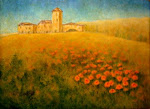
Welcome

Many artists dream about painting in Italy. Now, as retiring baby-boomers are increasingly taking up “brush and pallet knife,” more than ever, painting in Italy is the “thing.” Every day, a new “Artist’s” tour of Italy crops up in travel sections of the newspaper and on the Internet. But there still remains a majority of artists who prefer to “go it alone.” They are independent in their artistic styles, and prefer to be independent regarding their travels in Italy . This blog intends to target these free spirited artists who still need guidance to the best places to paint, especially those idyllic gems that are little known and less traveled. Certainly, independent travelers who are not artists will also benefit from this blog.

With a few exceptions, this blog is not a guide to restaurants, lodging, rental cars, or shopping, (except for art supplies.)

Sprinkled among the posts are: my paintings, and a few Italian proverbs and poems written by notable Italian authors for whom I work as a translator.


Please visit my website to view my original art:

http://www.pamelaallegretto-franz.com/

Giclee prints of my paintings, ranging from greeting size to poster size, can be purchased at:

http://pamela-allegretto.fineartamerica.com/


Showing posts with label Painting and Writing in Italy. Show all posts

Monday, May 7, 2012

PAINTING IN ITALY / PIEMONTE / LAGO D'ORTA / LAKE ORTA / ORTA SAN GIULIO / ISOLA SAN GIULIO


     Shadowed by the Matterhorn, the small, picturesque Lago D’Orta 
(Lake Orta) is surrounded by forests with a wild and melancholy beauty.  
Just eight miles long and less than two miles wide, Lake Orta is one of the smallest and least known of northern Italy's sub-Alpine lakes.  The German
 philosopher Friedrich Nietzsche, who visited the lake in 1882, believed the experience changed his life forever.  He inscribed the date "von Orta an" 
("from Orta onwards") as a preface to his masterpiece Thus Spake Zarathustra. I can’t guarantee that going to Lake Orta to paint will change your life forever, 
but I can promise you’ll come away with some of the most beautiful images 
you’ve every put down on canvas.  Other 19th-century writers enchanted by 
its quiet beauty include the French novelist Honoré de Balzac, who wrote rapturously of this "gray pearl in a green jewel-box", and Robert Browning whose 
poem "By the Fireside" contemplates the beauty of a setting where "Alp 
meets heaven in snow", describes the lakeside village of Pella as a luminous "speck of white... in the evening-glow".    
     With all this glowing praise, you might imagine Orta San Giulio, the main
 town of Lake Orta, to be swarming with tourists, but it’s not.  Many visitors ignore this little gem and flock eastwards to the nearby, much larger Lago Maggiore. Their loss is your gain, as it keeps the crowds to a minimum. 
    Parking in the town center can be a bit tricky, well okay, more than tricky: impossible, as it is traffic-free.  But there are a few small parking lots up on the main road and the walk down into town is an easy one.  Don’t try parking on the main 
road; there are blue lines on each side that indicate resident parking only.  
Parking tickets are common sites and the fines are steep and payable on site. 
     In town, you’ll find more than enough paint-worthy subjects: stone 
archways, flower-choked balconies, and courtyards tucked behind ornate iron gates.  Pastel-washed 16th and 17th-century buildings house small shops, and 
winding alleyways zigzag to a maze of narrow streets.  Piazza Motta is the 
perfect location to set up.  This broad, flagged square runs parallel to the waterfront and is partially shielded from the hustle and bustle of the jetty by an impressive row of chestnut trees.  Colorful cafés spread out across the piazza if you prefer to sketch while sipping a glass of the local wine. 
     Certainly, you must allow time to visit Isola San Giulio. From the jetty of 
Orta San Giulio, boats leave every ten minutes for the five-minute trip to the island in the middle of the lake.  Centuries-old legend says the island was home to dragons, but don’t be scared off, St Julius, the island's namesake and founder of its basilica, arrived at Lake Orta over 1,600 years ago and dispatched the dragons with his sword.  So if you were looking forward to painting dragons, I’m sorry to disappoint
 you.  But don’t worry, there’s plenty more to keep your artist’s eye excited.
     Even without dragons, the island has a magical “feel.”  Take the flagged alleyway, which flits in and out of the sunlight as it weaves around the island’s
 interior.  There are many quiet places to stop and sketch.  I emphasize “quiet,” as the alleyway is signed: “the way of silence,” in one direction and “the way of meditation” in the other.  You will also come across small signs in various 
languages that remind you this is a place for reflection such as: "If you can 
be yourself, you are everything."   And, “Listen to the water, the wind, 
your steps." 
     Lovely old palazzi, draped in wisteria and trumpet vines, ring the 
waterfront of Isola San Giulio, making it an ideal spot to sit and paint or 
sketch.  The views from the waterfront back to the mainland town of Orta San Giulio are luscious. 
     I recommend bringing along some bottled water if you plan to stay on the island for a few hours.  There is only one small gift shop where water is available. 
     Back on the mainland, Orta San Giulio’s pièce de résistance demands a 
bit of a climb (325ft above the lake if you’re counting) up to the Sacro Monte 
di San Francesco.  This hilltop plateau laid out with 20 chapels dedicated to 
the life of Saint Francis of Assisi is very cool.  All the chapels are unique in design, reflecting the fact that building took place over a 200-year period. 
     Sacro Monte was designated a National Park in 1980. The chapels are 
built like a village, amid meandering paths, woods, and a plethora of 
wildflowers, all this, plus incredible views of Lake Orta lying dreamily below 
on her mountain bed. 
     Do bring water, and I suggest a picnic.  There’s a lot to paint and you’ll 
really need at least half a day. Once you’re here, your only dilemma will be 
what to paint first.
      Since this is a National Park, be sure to follow the rules and stay on the designated paths so as not to trample nature’s balance.  If you do go off the paths, 
there are groundskeepers in the area who will quickly get you back on track.
      Buon Viaggio!


Sunday, February 5, 2012

ITALIAN POETRY / DANZANO (THEY DANCE) / BY LUCIANO SOMMA

ITALIAN POETRY / DANZANO (THEY DANCE) / by LUCIANO SOMMA

I get excited each time I begin to translate a new poem by Luciano Somma. Danzano (They Dance) has always been one of my favorites. All of us have thoughts that dance inside our heads. Sometimes they dance with feet as light as feathers, other times they dance with feet made of hot coals. In his poem “Danzano” Luciano invites us to watch the performance. “Danzano” can be found in Luciano Somma’s dual language poetry book: “L’ALBA DI DOMANI” / “TOMORROW’S SUNRISE.” It gave me great pleasure to write the English translations in this book, as well as to paint the cover art for the book and CD.
You can view more of Luciano Somma’s poetry at:
http://www.partecipiamo.it/Poesie/Luciano_Somma/1.htm
http://www.scolastica2000.it/MUSICALMENTE/somma/somma.htm
http://www.ilportaledelsud.org/luciano_somma.htm


Mi eccita ogni volta che inizio a tradurre una poema scritta da Luciano Somma. “Danzano” è stato sempre una delle mie preferite. Noi tutti ne abbiamo i pensieri che danzano intorno nelle nostre mente. Ogni tanto danzano coi piedi leggeri come piume, ed ogni tanto danzano coi piedi fatti di carboni ardenti. Nella sua poema “Danzano” Luciano Somma ci invita a guardare lo spettacolo. Si può trovare Luciano Somma a:
http://www.partecipiamo.it/Poesie/Luciano_Somma/1.htm
http://www.scolastica2000.it/MUSICALMENTE/somma/somma.htm
http://www.ilportaledelsud.org/luciano_somma.htm

DANZANO
Danzano
come ballerini i pensieri
sulla stanca pedana della mente
dispettosi fantasmi
nell’avida bocca della notte
nell’alitare silenzioso
della tenebre
danzano
sadici e indifferenti
all’agonia del tempo
al respiro affannoso di paura
danzano
con ritmo di rabbia
nell’infernale suono
tra le quattro pareti
d’una stanza
danzano
in quest’incendio mio
di solitudine.
Luciano Somma

THEY DANCE
Thoughts dance
like ballerinas
on the mind’s tired stage
spiteful spirits
in the greedy nightfall
in the silent breath
of darkness
they dance
the sadistic and indifferent
to the anguish of time
to the wearisome breath of fear
they dance
with angry rhythm
to the fiendish sound
among the room’s
four walls
they dance
in this my
fiery solitude.
Pamela Allegretto Franz (Translation)

Saturday, November 12, 2011

PAINTING IN ITALY / LIGURIA / RIVIERA DI PONENTE / SAN REMO

No artist worth his or her salt who visits Liguria should neglect the drive along the Riviera Di Ponente facing the rising sun across the Bay of Genoa. In the spring the walls of the gardens and villages in this area are draped with bougainvillea flowers in vivid hues ranging from deep pink to purple. This area on Italy’s “thigh” has long been a haven for poets and painters. It’s an eclectic mix of quaint fishing village and ancient seaports.
San Remo, my favorite town in this area, is known as the “City of Flowers.” With a name like that, no wonder it’s my favorite. In fact, San Remo is Italy’s most important flower market. So if you botanical painters can’t find something to paint in this region, I suppose you can blame it to having been blinded by beauty. In addition to the plethora of flowers, its luxuriant gardens and parks overflow with tropical plants.
If botanical painting is not you forte and you, like I, prefer painting architecture, don’t despair, the medieval center, the Pigna, climbs in concentric circles towards the Piazza Castello in a labyrinth of alleyways, flights of steps, covered passages, and little squares encircled by colorful shuttered buildings. All along this route you’ll find sufficient places to set up your easel or sit with a sketchpad. In the upper town, the Santuario della Madonna della Costa faces a terrace with a superior view, another great spot to set up. Another favorite for architectural painters is the Orthodox church of S. Basillio with its colorful onion domes. The church is in a little square by the sea, which makes for a lovely backdrop to this enchanting building.
As San Remo is a seaside resort, there is no shortage of seascapes to paint. Try a walk out onto the pier, another great place to set up, if you don’t mind curious tourists and fishermen breathing down your neck. If you’re an early riser or an insomniac don’t miss the spectacular opening of business in the flower market, at dawn, in the hall between Piazza Colombo and the Corso Garibaldi.
BUON VIAGGIO!!!

Monday, August 15, 2011

Monterosso In Riviera Di Levante


Posted by Picasa

Monterosso On Riviera Di Levante

I designed the painting above from fond memories of Monterosso on the Riviera Di Levante in the Cinque Terre region of Italy. The warm tones of the village walls, rocks, and sand are the perfect neutral background for the colorful fishing boats.
The original 11"x14" acrylic in canvas can be purchased on my art website: http://www.Pamelaallegretto-franz.com
Giclee prints from greeting card size to poster size are avalable on: http://pamela-allegretto.fineartamerica.com

Thursday, August 11, 2011

PAINTING IN ITALY / LIGURIA / CINQUE TERRE

PAINTING IN ITALY / LIGURIA / CINQUE TERRE


Although the Cinque Terre region is no longer considered “off the beaten path” it’s definitely a “must visit” for artists who hunger to capture cliff-hanging, whitewashed buildings set ablaze by ruby sunsets. This fantasy gratifying stretch of the Italian Riviera, or as the Italians call it the Riviera Di Levante, lies between Genoa and Pisa.
The Cinque Terre are five small villages at the ends of narrow valleys that cut through a steep coastal range and are backed by green-terraced slopes of ancient vineyards. Flights of steps occupy narrow alleyways and bougainvillea filled pots spill red, purple, and aubergine petals from mini balconies.
Only the outer villages of Monterosso and Riomaggiore are easily reached by car, but it is exactly this restriction that adds to the regions charm.
Each village has its own flavor. To sample them all, you can follow the fragrant trail through sunny vistas from Riomaggiore to Monterosso.
For decades, Riomaggiore has seduced artists into becoming residents. The tunnel next to the train tracks takes you to a fascinating tangle of multicolored homes. Riomaggiore's beach is a small cove that is a two-minute walk from town. The swimming isn’t the best, but on a hot day, a refreshing dip will rejuvenate your creative juices. From Riomaggiore, the Via Dell'Amore (walkway of love) leads to Manarola where rustic stairways lead to remote rocks where you can set up an easel or sit with a sketchpad. If you’re a figure artist you may be in luck, as nude sunbathing is tolerated. Picturesque Manarola ends in a rocky promontory with a harbor so tiny the boats need to be hoisted out of the water and onto a jetty.
Corniglia is the only Cinque Terre village not on the water. The town center sits on a hill atop 377 stairs (the “Ladarina”) that zigzag up to the town where the view will knock your socks right off the cliff and into the aquamarine sea below. The vista includes not only the coastline and seascape, but also all the other four villages of the Cinque Terre.

The 90-minute hike on to Vernazza is rugged but you will be rewarded with outstanding views of sun-soaked terraced vineyards that blanket the region. Secluded coves and invigorating waterfalls are tucked away along the coast between Vernazza and Monterosso al Mare and beg to have their images preserved on your canvas.
Monterosso al Mare is the most important center and the only one with a broad, sandy beach. Translation: the most tourists. However, Monterosso deserves a visit to sketch its vestiges of old walls, towers, and bastions.
When you arrive at the Cinque Terre, take time to study the footpath maps that are available in all five villages. The Cinque Terre are crossed by a dense network of coastal and interior footpaths. The "Sentiero Azzurro", Blue Path, is the coastal trail while the "Sentiero Rosso", Red Path, or High Path, climbs from Portovenere to Levanto. The "Via dei Santuari", Sanctuaries Path, is more challenging and leads to places of religious interest upon the five villages.
The panoramas from many points of the trails are amazing especially along the coast path. All the paths are of low or moderate difficulty, they say, but I never trust “they.” Who are “they” anyway? Have “they” ever hiked the trail with an easel on their back? My advice, pitch the flip-flops and tie into some sturdy shoes with healthy tread. A sudden rainstorm can make for some very slippery cliffs.
If time is not on your side, I recommend the "Sentiero Azzurro", “Blue Path” which is the most famous and evocative trail of the Cinque Terre. The course has been traced through the centuries, when it was the only way of communication for the inhabitants of the Cinque Terre. In some points, it is a real mule track that winds waterfront offering fabulous views.
As always, bring water and some snacks, an umbrella, and plenty of enthusiasm.
BUON VIAGGIO!

Thursday, June 30, 2011

TAKING TIME OFF

TAKING TIME OFF

To my loyal readers: I apologize for leaving you stranded in the Marches region of Italy (not that the Marches region would be such a bad place to be stranded).
Due to family issues, I have been away from my computer for over a month, and it’s looking like it may be another month before I can have access to a computer so that we can resume our trek up the boot.
To you new readers, please go back and enjoy our journey thus far, from Sicily up through Basilicata, Apulia, the Amalfi Coast, Capri, Naples, Campania, Rome, Latium, Florence, Umbria, and Tuscany.
When I return, we will head up North to Liguria, Piemonte and Lombardia, the lake regions, the Dolomiti, the Veneto region and of course Venezia.
Best wishes and happy painting to you all.
Tanti auguri,
Ciao, Pamela

Wednesday, November 10, 2010

PAINTING IN ITALY / TUSCANY / SAN MINIATO

If you’re driving from Florence to Pisa, plan to stop and set up your easel for a few hours at San Miniato, which is about midway between these two popular cities.
Climb the hill from the Prato Del Duomo, (wear sensible shoes, no flip-flops), the vistas are outstanding, and on clear days the view extends from the hills of Fiesole to the sea, and from the Apuan Alps to the cliffs of Volterra. You can set up next to the tower, which is a post-WW2 reconstruction of the last remnant of a fort Emperor Frederick II built in 1240. How’s that for “Painting on Location?”
Bread, cheese, prosciuto, fruit, water, and wine are available in town if you want to enjoy a Tuscan-style picnic while you paint. Try to catch either a sunrise or sunset; you will not be disappointed.
As usual, pack smart (translation = pack light).
San Miniato has an exciting and colorful Kite-flying festival the first Sunday after Easter. If you are in Tuscany during the Easter time, you should make a point to catch this event. At that time of the year he countryside is ablaze in spring colors which add to the vibrant colored kites.
Buon Viaggio!

Monday, November 8, 2010

PAINTING IN ITALY / TUSCANY / VERSILIA / CARRARA / VIAREGGIO

In addition to the Alpi Apuane, there are various other reasons to visit the Riviera Della Versilia. One reason is the beach resorts that run unbroken between Viareggio and Forte dei Marmi. Much of the sand is leased to various hotels and establishments who rent out chairs and umbrellas. But you needn’t be sucked in; there are numerous public access areas where you can sit and paint seascapes all day without paying rent on a lounge chair.
My favorite town for people watching and sketching is Viareggio. Passeggiata Margherita, the long, palm lined seafront promenade presents an air of elegance without being pretentious. Numerous bars and restaurants offer outdoor seating. For the price of an espresso or limonata, you can sit undisturbed for hours and sketch or paint.
I don’t often recommend restaurants, but here I will make an exception. Grab a bite in the pergola at Ristorante Michele. While you’re enjoying your meal, you can sketch or painting the vine-choked trellises that enclose the patio and hover overhead. If you have one too many glasses of their marvelous, and cheap, house wine, you may envision the broad twisted vines as tree snakes, threatening to drop into your minestrone. Now there’s a great idea for a painting.
Certainly, you can’t possibly be in the area without a trip to Carrara, the “Marble Capital.” Set in the hills, the town offers many prime locations to set up and paint, not only the excellent seascapes below, but also the town itself. Peeling pastel stucco houses and side streets lined with green shutters make excellent subjects.
And then of course there are the marble quarries. One of the more accessible is the site at Colonnata, the Cave di Colonnata. If you’re driving, follow the yellow signs from town up to the twisting road. Don’t worry; you can’t miss it. You’ll see a huge, blindingly white marble basin. It’s floor and sides are perfectly squared by the enormous wire saws used to cut the blocks that are scattered about.
Michelangelo spent eight months in Carrara. So while you’re setting up to paint in the village, on the convenient outlooks to the sea, or at the quarry, you’re likely to be standing in a spot where Michelangelo stood to contemplate his next sculpture or to chose his next block of marble. Does it get any better than that?
Buon Viaggio!

Sunday, November 7, 2010

PAINTING IN ITALY/TUSCANY/VERSILIA/ALPI APUANE

On the northern coast of Tuscany, the Alpi Apuane Mountains dominate the Riviera della Versilia. Well-marked footpaths that offer huge rewards for plein air artists crisscross the mountains, a forty-kilometer span of indisputably alpine spectacle.
Due to their location and elevation, the Apuane are an ideal blend of assorted ecological habitats, from tundra through Alpine meadow to Mediterranean grassland. An extraordinary assortment of wildflowers makes this one of the country’s richest botanic enclaves. However, the most noticeable vegetation is the vast forest of chestnut and beech, which cover nearly all the lower slopes. These trees offer shelter to many of the mountains’ three hundred species of birds. (If you like to paint birds, you may never want to climb down from this mountain.)
The main approach to the northern group of peaks is from Levigliani. Detailed trail maps are available in town. Be sure to pick one up before you head out. The best-detailed and easiest to read is the Multigraphic-Wanderkarte. Trails #9 and #126 are the most popular and have well-situated clearings for setting up to sketch and paint.
Stazzema is the best access to the southern peaks and trail #5, which is a gentle climb (the best type of climb in my mind) through chestnut woods to the Procinto, a huge tabletop crag mention by Dante. Of all the walks, I prefer this Procinto walk; not only because it’s an easy walk, which is helpful when you’re toting art supplies and food and water, but it allows time to walk up Monte Nona, have a picnic lunch and paint some out-of-this-world scenery, and return to Stazzema in time to view the sunset from an outdoor café` in the town’s charming piazza.
Even though the Alpi Apuane are on the cusp of the Versilia Riviera, don’t think the temperature will be the same. At first, it may feel like a cool relief from the blazing beach, but it can cool down quickly, so never venture up into these mountains without a jacket on hand, ditto, water and snacks.
As always, carry out what you carry in. Your reward will be the opportunity to paint scenery that few artists have the chance to paint. And the icing on the cake: Michelangelo hiked some of these same trails while visiting Carrara to select marble for his David!
Buon Viaggio!

Friday, October 1, 2010

To Market

This painting is all about bold island colors. You can veiw the original acrylic on canvas painting on my website: http://www.PamelaAllegretto-Franz.com or purchase a giclee print at: http://pamela-allegretto.fineartamerica.com
Questo quadro mostra mio passione dei colori vivaci. Si puo` vedere il quadro originale dipinto con acrilico sul mio website: http://www.PamelaAllegretto-Franz.com Oppure si puo` comprare delle stampe a: http://pamela-allegretto.fineartamerica.com

Piano Man

This is Guido, one hot pianista. He rocks Jazz and wails the Blues on his funky purple piano. You can veiw this original 20"x20" acrylic on canvas painting on my website: http://www.PamelaAllegretto-Franz.com or purchase a giclee print at: http://pamela-allegretto.fineartamerica.com
Ecco Guido. Lui suona il Jazz con brio sul pioanoforte violetto. Si puo` vedere il quadro originale dipinto con acrilico sul mio website: http://www.PamelaAllegretto-Franz.com Oppure si puo` comprare delle stampe a: http://pamela-allegretto.fineartamerica.com

Saturday, March 21, 2009

WRITING IN ITALY/BASILICATA

Yesterday I wrote about painting in the Basilicata region. I’d like to suggest that it’s also an area that has enlightened numerous well-known authors. I already mentioned Carlo Levi and his stirring narrative: Christ Stopped At Eboli. It was his painting and his writing that carried him through the hardships during his exile in this primitive and desolate land. Another author who lived and worked in the region and wrote vividly about the landscape, people, and customs is, Ann Cornelisen. Two of her books in particular: Women Of The Shadows and Torregreca: Life, Death, And Miracles In A Southern Italian Village, are stand out examples of a writer who allows all five senses to guide her prose. In one review she wrote: “The south is still not for the easily discouraged. It is for those who can imagine living in another time, who can believe, even for a moment, in the mirage world created by light so piercing that it sears the eyes.”
Basilicata may have to take a backseat to Rome, Florence, and Venice, but don’t through it out of the car. Take the car, your Italian dictionary (very little, if any, English is spoken in most of the smaller villages), pen and paper, paints and canvas, and a strong sense of adventure, and travel south to chronicle for yourself this unique region and its engaging people.
Buon Viaggio!

Monday, March 9, 2009

PORTRAITURE & CHARACTER DESCRIPTION

PORTRAITURE AND CHARACTER DESCRIPTION

What do portrait painters and fiction writers have in common? Portrait painters not only have to get the features exact, but the reason some portrait painters excel and others falter is the ability to capture the essence of the subject. It may sound cliché, okay, it does sound cliché, but the eyes speak volumes to an artist with the ability to tune into the spirit behind the visage. A good portrait is not just a canvas and paint substitute for a photograph; it’s a glimpse into inner-self.

In fiction, the reader wants to not only visualize the characters, but also see into the characters. For example, which of these men seems more menacing? "He was a mean man with big teeth." (Yawn, mean man, big teeth, big deal.) Or, "He sneered through a mouth crowded with teeth so large they could devour an entire leg of lamb in a manner of minutes." (Now that’s one angry dude you don’t want to cross on a day he’s skipped lunch.)

My trompe l’oeil painting of Pinocchio is as close as I will ever get to painting a portrait. I’ll leave that to the pros.
Pinocchio is “My Guy.” His devotion to his father and his inquisitive spirit delight me. You can view this painting on my art website at:
http://www.PamelaAllegretto-Franz.com/