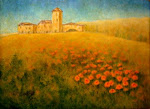
Welcome

Many artists dream about painting in Italy. Now, as retiring baby-boomers are increasingly taking up “brush and pallet knife,” more than ever, painting in Italy is the “thing.” Every day, a new “Artist’s” tour of Italy crops up in travel sections of the newspaper and on the Internet. But there still remains a majority of artists who prefer to “go it alone.” They are independent in their artistic styles, and prefer to be independent regarding their travels in Italy . This blog intends to target these free spirited artists who still need guidance to the best places to paint, especially those idyllic gems that are little known and less traveled. Certainly, independent travelers who are not artists will also benefit from this blog.

With a few exceptions, this blog is not a guide to restaurants, lodging, rental cars, or shopping, (except for art supplies.)

Sprinkled among the posts are: my paintings, and a few Italian proverbs and poems written by notable Italian authors for whom I work as a translator.


Please visit my website to view my original art:

http://www.pamelaallegretto-franz.com/

Giclee prints of my paintings, ranging from greeting size to poster size, can be purchased at:

http://pamela-allegretto.fineartamerica.com/


Showing posts with label Italian villages. Show all posts

Monday, May 7, 2012

PAINTING IN ITALY / PIEMONTE / LAGO D'ORTA / LAKE ORTA / ORTA SAN GIULIO / ISOLA SAN GIULIO


     Shadowed by the Matterhorn, the small, picturesque Lago D’Orta 
(Lake Orta) is surrounded by forests with a wild and melancholy beauty.  
Just eight miles long and less than two miles wide, Lake Orta is one of the smallest and least known of northern Italy's sub-Alpine lakes.  The German
 philosopher Friedrich Nietzsche, who visited the lake in 1882, believed the experience changed his life forever.  He inscribed the date "von Orta an" 
("from Orta onwards") as a preface to his masterpiece Thus Spake Zarathustra. I can’t guarantee that going to Lake Orta to paint will change your life forever, 
but I can promise you’ll come away with some of the most beautiful images 
you’ve every put down on canvas.  Other 19th-century writers enchanted by 
its quiet beauty include the French novelist Honoré de Balzac, who wrote rapturously of this "gray pearl in a green jewel-box", and Robert Browning whose 
poem "By the Fireside" contemplates the beauty of a setting where "Alp 
meets heaven in snow", describes the lakeside village of Pella as a luminous "speck of white... in the evening-glow".    
     With all this glowing praise, you might imagine Orta San Giulio, the main
 town of Lake Orta, to be swarming with tourists, but it’s not.  Many visitors ignore this little gem and flock eastwards to the nearby, much larger Lago Maggiore. Their loss is your gain, as it keeps the crowds to a minimum. 
    Parking in the town center can be a bit tricky, well okay, more than tricky: impossible, as it is traffic-free.  But there are a few small parking lots up on the main road and the walk down into town is an easy one.  Don’t try parking on the main 
road; there are blue lines on each side that indicate resident parking only.  
Parking tickets are common sites and the fines are steep and payable on site. 
     In town, you’ll find more than enough paint-worthy subjects: stone 
archways, flower-choked balconies, and courtyards tucked behind ornate iron gates.  Pastel-washed 16th and 17th-century buildings house small shops, and 
winding alleyways zigzag to a maze of narrow streets.  Piazza Motta is the 
perfect location to set up.  This broad, flagged square runs parallel to the waterfront and is partially shielded from the hustle and bustle of the jetty by an impressive row of chestnut trees.  Colorful cafés spread out across the piazza if you prefer to sketch while sipping a glass of the local wine. 
     Certainly, you must allow time to visit Isola San Giulio. From the jetty of 
Orta San Giulio, boats leave every ten minutes for the five-minute trip to the island in the middle of the lake.  Centuries-old legend says the island was home to dragons, but don’t be scared off, St Julius, the island's namesake and founder of its basilica, arrived at Lake Orta over 1,600 years ago and dispatched the dragons with his sword.  So if you were looking forward to painting dragons, I’m sorry to disappoint
 you.  But don’t worry, there’s plenty more to keep your artist’s eye excited.
     Even without dragons, the island has a magical “feel.”  Take the flagged alleyway, which flits in and out of the sunlight as it weaves around the island’s
 interior.  There are many quiet places to stop and sketch.  I emphasize “quiet,” as the alleyway is signed: “the way of silence,” in one direction and “the way of meditation” in the other.  You will also come across small signs in various 
languages that remind you this is a place for reflection such as: "If you can 
be yourself, you are everything."   And, “Listen to the water, the wind, 
your steps." 
     Lovely old palazzi, draped in wisteria and trumpet vines, ring the 
waterfront of Isola San Giulio, making it an ideal spot to sit and paint or 
sketch.  The views from the waterfront back to the mainland town of Orta San Giulio are luscious. 
     I recommend bringing along some bottled water if you plan to stay on the island for a few hours.  There is only one small gift shop where water is available. 
     Back on the mainland, Orta San Giulio’s pièce de résistance demands a 
bit of a climb (325ft above the lake if you’re counting) up to the Sacro Monte 
di San Francesco.  This hilltop plateau laid out with 20 chapels dedicated to 
the life of Saint Francis of Assisi is very cool.  All the chapels are unique in design, reflecting the fact that building took place over a 200-year period. 
     Sacro Monte was designated a National Park in 1980. The chapels are 
built like a village, amid meandering paths, woods, and a plethora of 
wildflowers, all this, plus incredible views of Lake Orta lying dreamily below 
on her mountain bed. 
     Do bring water, and I suggest a picnic.  There’s a lot to paint and you’ll 
really need at least half a day. Once you’re here, your only dilemma will be 
what to paint first.
      Since this is a National Park, be sure to follow the rules and stay on the designated paths so as not to trample nature’s balance.  If you do go off the paths, 
there are groundskeepers in the area who will quickly get you back on track.
      Buon Viaggio!


Saturday, November 12, 2011

PAINTING IN ITALY / LIGURIA / RIVIERA DI PONENTE / SAN REMO

No artist worth his or her salt who visits Liguria should neglect the drive along the Riviera Di Ponente facing the rising sun across the Bay of Genoa. In the spring the walls of the gardens and villages in this area are draped with bougainvillea flowers in vivid hues ranging from deep pink to purple. This area on Italy’s “thigh” has long been a haven for poets and painters. It’s an eclectic mix of quaint fishing village and ancient seaports.
San Remo, my favorite town in this area, is known as the “City of Flowers.” With a name like that, no wonder it’s my favorite. In fact, San Remo is Italy’s most important flower market. So if you botanical painters can’t find something to paint in this region, I suppose you can blame it to having been blinded by beauty. In addition to the plethora of flowers, its luxuriant gardens and parks overflow with tropical plants.
If botanical painting is not you forte and you, like I, prefer painting architecture, don’t despair, the medieval center, the Pigna, climbs in concentric circles towards the Piazza Castello in a labyrinth of alleyways, flights of steps, covered passages, and little squares encircled by colorful shuttered buildings. All along this route you’ll find sufficient places to set up your easel or sit with a sketchpad. In the upper town, the Santuario della Madonna della Costa faces a terrace with a superior view, another great spot to set up. Another favorite for architectural painters is the Orthodox church of S. Basillio with its colorful onion domes. The church is in a little square by the sea, which makes for a lovely backdrop to this enchanting building.
As San Remo is a seaside resort, there is no shortage of seascapes to paint. Try a walk out onto the pier, another great place to set up, if you don’t mind curious tourists and fishermen breathing down your neck. If you’re an early riser or an insomniac don’t miss the spectacular opening of business in the flower market, at dawn, in the hall between Piazza Colombo and the Corso Garibaldi.
BUON VIAGGIO!!!

Monday, August 15, 2011

Monterosso In Riviera Di Levante


Posted by Picasa

Monterosso On Riviera Di Levante

I designed the painting above from fond memories of Monterosso on the Riviera Di Levante in the Cinque Terre region of Italy. The warm tones of the village walls, rocks, and sand are the perfect neutral background for the colorful fishing boats.
The original 11"x14" acrylic in canvas can be purchased on my art website: http://www.Pamelaallegretto-franz.com
Giclee prints from greeting card size to poster size are avalable on: http://pamela-allegretto.fineartamerica.com

Thursday, August 11, 2011

PAINTING IN ITALY / LIGURIA / CINQUE TERRE

PAINTING IN ITALY / LIGURIA / CINQUE TERRE


Although the Cinque Terre region is no longer considered “off the beaten path” it’s definitely a “must visit” for artists who hunger to capture cliff-hanging, whitewashed buildings set ablaze by ruby sunsets. This fantasy gratifying stretch of the Italian Riviera, or as the Italians call it the Riviera Di Levante, lies between Genoa and Pisa.
The Cinque Terre are five small villages at the ends of narrow valleys that cut through a steep coastal range and are backed by green-terraced slopes of ancient vineyards. Flights of steps occupy narrow alleyways and bougainvillea filled pots spill red, purple, and aubergine petals from mini balconies.
Only the outer villages of Monterosso and Riomaggiore are easily reached by car, but it is exactly this restriction that adds to the regions charm.
Each village has its own flavor. To sample them all, you can follow the fragrant trail through sunny vistas from Riomaggiore to Monterosso.
For decades, Riomaggiore has seduced artists into becoming residents. The tunnel next to the train tracks takes you to a fascinating tangle of multicolored homes. Riomaggiore's beach is a small cove that is a two-minute walk from town. The swimming isn’t the best, but on a hot day, a refreshing dip will rejuvenate your creative juices. From Riomaggiore, the Via Dell'Amore (walkway of love) leads to Manarola where rustic stairways lead to remote rocks where you can set up an easel or sit with a sketchpad. If you’re a figure artist you may be in luck, as nude sunbathing is tolerated. Picturesque Manarola ends in a rocky promontory with a harbor so tiny the boats need to be hoisted out of the water and onto a jetty.
Corniglia is the only Cinque Terre village not on the water. The town center sits on a hill atop 377 stairs (the “Ladarina”) that zigzag up to the town where the view will knock your socks right off the cliff and into the aquamarine sea below. The vista includes not only the coastline and seascape, but also all the other four villages of the Cinque Terre.

The 90-minute hike on to Vernazza is rugged but you will be rewarded with outstanding views of sun-soaked terraced vineyards that blanket the region. Secluded coves and invigorating waterfalls are tucked away along the coast between Vernazza and Monterosso al Mare and beg to have their images preserved on your canvas.
Monterosso al Mare is the most important center and the only one with a broad, sandy beach. Translation: the most tourists. However, Monterosso deserves a visit to sketch its vestiges of old walls, towers, and bastions.
When you arrive at the Cinque Terre, take time to study the footpath maps that are available in all five villages. The Cinque Terre are crossed by a dense network of coastal and interior footpaths. The "Sentiero Azzurro", Blue Path, is the coastal trail while the "Sentiero Rosso", Red Path, or High Path, climbs from Portovenere to Levanto. The "Via dei Santuari", Sanctuaries Path, is more challenging and leads to places of religious interest upon the five villages.
The panoramas from many points of the trails are amazing especially along the coast path. All the paths are of low or moderate difficulty, they say, but I never trust “they.” Who are “they” anyway? Have “they” ever hiked the trail with an easel on their back? My advice, pitch the flip-flops and tie into some sturdy shoes with healthy tread. A sudden rainstorm can make for some very slippery cliffs.
If time is not on your side, I recommend the "Sentiero Azzurro", “Blue Path” which is the most famous and evocative trail of the Cinque Terre. The course has been traced through the centuries, when it was the only way of communication for the inhabitants of the Cinque Terre. In some points, it is a real mule track that winds waterfront offering fabulous views.
As always, bring water and some snacks, an umbrella, and plenty of enthusiasm.
BUON VIAGGIO!

Friday, August 21, 2009

PAINTING IN SICILY / MONREALE

Homer told the story of the Lotophagi who once inhabited the island of Sicily. All new arrivals were required to eat of the lotus tree and at once forgot their homes and lost all desire to return to their native lands. When you’re in Sicily it won’t take a bite from the lotus tree to cloud your dreams of home and hearth, just stand outside and look in any direction. The inhabitants claim you need four eyes to fully appreciate Sicily’s beauty. I say six!
Goethe praised the road that leads from Palermo to Monreale. “It is,” he wrote, “a wide road, lined with trees, sloping gently, full of fountains, some with jets, others flowing, but all beautifully decorated with ornaments and friezes.” Monreale is such an idyllic spot that the Palermans have a saying: Chi va a Palermo e non vede Monreale, asino va e asino torna. (Whoever goes to Palermo without seeing Monreale – goes as an ass, and returns an ass.) So don’t be an ass. Spend a day painting at Monreale.
Visit the cathedral, built in 1174; it is one of the wonders of the medieval world. Don’t be fooled by the relatively drab façade, the interior is covered throughout with shimmering gold mosaics.
After you’ve caught your breath and still have that glitter of “gold” on your mind, you can set up and incorporate those rich golden hues on your canvas, inspired by sweeping rooftop scenes, valley landscapes, or coastline views.
As always, carry out what you bring in. If you’re an oil painter, don’t dump your mediums. Yes, the Mafia is alive and well and living in Sicily, especially in the vicinity of Palermo. But don’t let that deter you. The Mafia families are great lovers of art and artists, but they don’t like anyone despoiling their beautiful island. Go to Sicily to paint the fish, not sleep with them.
BUON VIAGGIO!!!