Welcome
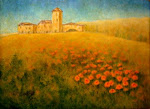
Many artists dream about painting in Italy. Now, as retiring baby-boomers are increasingly taking up “brush and pallet knife,” more than ever, painting in Italy is the “thing.” Every day, a new “Artist’s” tour of Italy crops up in travel sections of the newspaper and on the Internet. But there still remains a majority of artists who prefer to “go it alone.” They are independent in their artistic styles, and prefer to be independent regarding their travels in Italy . This blog intends to target these free spirited artists who still need guidance to the best places to paint, especially those idyllic gems that are little known and less traveled. Certainly, independent travelers who are not artists will also benefit from this blog.
With a few exceptions, this blog is not a guide to restaurants, lodging, rental cars, or shopping, (except for art supplies.)
Sprinkled among the posts are: my paintings, and a few Italian proverbs and poems written by notable Italian authors for whom I work as a translator.
Please visit my website to view my original art:
http://www.pamelaallegretto-franz.com/
Giclee prints of my paintings, ranging from greeting size to poster size, can be purchased at:
http://pamela-allegretto.fineartamerica.com/
With a few exceptions, this blog is not a guide to restaurants, lodging, rental cars, or shopping, (except for art supplies.)
Sprinkled among the posts are: my paintings, and a few Italian proverbs and poems written by notable Italian authors for whom I work as a translator.
Please visit my website to view my original art:
http://www.pamelaallegretto-franz.com/
Giclee prints of my paintings, ranging from greeting size to poster size, can be purchased at:
http://pamela-allegretto.fineartamerica.com/
Showing posts with label Writing and Painting. Show all posts
Monday, December 27, 2010
PAINTING IN MEXICO / Mexican SERENADE
Here's a quick detour from Italy to Mexico. In the painting above, I wanted to keep the background in the muted adobe hues so the colors on the guitarist would "Pop."
The original painting can be purchased on my art website: http://www.pamelaallegretto-franz.com/ Giclee prints can be purchased at: http://pamela-allegretto.fineartamerica.com/
Tuesday, August 4, 2009
Importance Of An Artist's Website
I recently returned from a visit to my home state of Colorado. (Yes, that’s the reason for the gap in blog-postings) While there, I had the pleasure of attending an art festival in the mountain town of Breckenridge. The art, which was primarily southwestern, reminded me of the importance of an artist’s website.
Here in Connecticut, the majority of art exhibited in galleries and festivals is New England landscapes and seascapes. When I lived in Kailua-Kona, Hawaii, tropical art was the preferred art form. Clearly, regional art is the preferred subject matter at most galleries and art festivals.
But what if your taste in art fluctuates? What if you, like me, get easily bored? Can you eke out a living painting New England landscapes in Colorado? Can you survive trying to sell tropical paintings in Connecticut? Is there a large market for Italian landscapes in Massachusetts? Probably not. So what can you do to keep coins in your pocket and creative juices flowing? Create a website.
Now, this is not a “paid for programming” ad for the host website in which I belong. But I do advocate a website if you want to reach art-lovers around the country and around the world. Selling via the Internet allows artists the freedom of diversity. No longer will you be constrained to a limited subject. Your only restrictions are those you inflict on yourselves.
My advice: Set up an art website and paint what you love.
My art can be viewed at: http://www.pamelaallegretto-franz.com/ the host site is ArtMajeur. If you go to this site, you can click on “home” and follow the instructions to setting up a website. It can be free, or if you want a few perks, it’s a minimal amount. There are numerous other artist websites available. Check them out and get connected. Don’t limit yourself to the few visitors each day in a gallery or the one-time art festival shoppers. Of course they are important, but their numbers are miniscule to the visitors you’ll get on the Internet.
Happy painting!!!
Here in Connecticut, the majority of art exhibited in galleries and festivals is New England landscapes and seascapes. When I lived in Kailua-Kona, Hawaii, tropical art was the preferred art form. Clearly, regional art is the preferred subject matter at most galleries and art festivals.
But what if your taste in art fluctuates? What if you, like me, get easily bored? Can you eke out a living painting New England landscapes in Colorado? Can you survive trying to sell tropical paintings in Connecticut? Is there a large market for Italian landscapes in Massachusetts? Probably not. So what can you do to keep coins in your pocket and creative juices flowing? Create a website.
Now, this is not a “paid for programming” ad for the host website in which I belong. But I do advocate a website if you want to reach art-lovers around the country and around the world. Selling via the Internet allows artists the freedom of diversity. No longer will you be constrained to a limited subject. Your only restrictions are those you inflict on yourselves.
My advice: Set up an art website and paint what you love.
My art can be viewed at: http://www.pamelaallegretto-franz.com/ the host site is ArtMajeur. If you go to this site, you can click on “home” and follow the instructions to setting up a website. It can be free, or if you want a few perks, it’s a minimal amount. There are numerous other artist websites available. Check them out and get connected. Don’t limit yourself to the few visitors each day in a gallery or the one-time art festival shoppers. Of course they are important, but their numbers are miniscule to the visitors you’ll get on the Internet.
Happy painting!!!
Labels:
Writing and Painting
Friday, June 26, 2009
FUN ART
Whenever I get painter’s block (that’s what I call it when my mind hits a snag and can’t come up with a subject for my next painting) I revert to what I call fun art. I use the term fun art because aside from layout and pathways, there are no rules to follow. I’m free to use my imagination with the subject and color pallet.
In “VINNY AND THE VAN GO’S (PIANO MAN)” I combined my love of music and art with a playful nod to Vincent Van Gogh.
The above painting can be purchased on my art website:
http://PamelaAllegretto-Franz.com
Nel quadro sopra: “VINNY AND THE VAN GO’S (PIANO MAN)” ho unito mia passione d'arte e l'artista preferito, Vincent Van Gogh, con mia passione di musica.
Si può comprare il quadro sul mio website d’arte:
http://PamelaAllegretto-Franz.com
In “VINNY AND THE VAN GO’S (PIANO MAN)” I combined my love of music and art with a playful nod to Vincent Van Gogh.
The above painting can be purchased on my art website:
http://PamelaAllegretto-Franz.com
Nel quadro sopra: “VINNY AND THE VAN GO’S (PIANO MAN)” ho unito mia passione d'arte e l'artista preferito, Vincent Van Gogh, con mia passione di musica.
Si può comprare il quadro sul mio website d’arte:
http://PamelaAllegretto-Franz.com
Labels:
Writing and Painting
Saturday, May 16, 2009
ART & WRITING / COLOR
We all know the importance of color to a painting. Whether it’s an abstract, a still life, or a landscape, color sets the mood. Color also sets a mood in writing. I don’t mean the “word” color, as in: “The color drained from her face,” “The colors of autumn,” “colorful language,” etc. I’m talking about specific colors. Here are some examples of colorful descriptions, including a few in which the colors seem more like nouns than adjectives:
Green with envy
Saw Red
Blue mood
White fear
Black despair
Rosy disposition
Blond mentality
Redhead temperament
White knuckle
Crimson faced
Greenbacks
In the Pink
Still Green at the job
Golden years
Grey day
Black cloud
Sky Blue (Here's an example of a noun "sky" and an adjective "blue" trading roles.)
Emerald sea
Turquoise sea
Ashen faced
White heat
We visualize the Devil in a Red cape and angels with White wings. We mourn in Black and wed in White. Baby boys are wrapped in Blue and girls are swathed in Pink. We try to keep our White teeth from turning Yellow and tint our Gray roots. We fertilize to turn our Brown lawns Green.
The “girl-next-door” has Honey Blond hair; the "sex kitten" is a Bleached Blond; the “surfer-girl” is a Sun-kissed Blond; and the "waif " is a Dishwater Blond or Dirty Blond.
The next time “writers block” has you sitting Ashen-faced in front of that blank White page and wondering where the next Greenback is coming from, blow away that negative Black cloud of doom and think PINK!
Ciao!
Green with envy
Saw Red
Blue mood
White fear
Black despair
Rosy disposition
Blond mentality
Redhead temperament
White knuckle
Crimson faced
Greenbacks
In the Pink
Still Green at the job
Golden years
Grey day
Black cloud
Sky Blue (Here's an example of a noun "sky" and an adjective "blue" trading roles.)
Emerald sea
Turquoise sea
Ashen faced
White heat
We visualize the Devil in a Red cape and angels with White wings. We mourn in Black and wed in White. Baby boys are wrapped in Blue and girls are swathed in Pink. We try to keep our White teeth from turning Yellow and tint our Gray roots. We fertilize to turn our Brown lawns Green.
The “girl-next-door” has Honey Blond hair; the "sex kitten" is a Bleached Blond; the “surfer-girl” is a Sun-kissed Blond; and the "waif " is a Dishwater Blond or Dirty Blond.
The next time “writers block” has you sitting Ashen-faced in front of that blank White page and wondering where the next Greenback is coming from, blow away that negative Black cloud of doom and think PINK!
Ciao!
Labels:
Writing and Painting
Saturday, April 18, 2009
ART & WRITING / FINE-TUNING
Fine-tuning a manuscript or a painting can present needless aggravation if the writer or artist doesn’t know when to stop.
In a TV interview, an artist was asked why none of his paintings were hung in his home. He replied: “I would go mad. I would never stop finding flaws and touching them up.”
Oh boy, talk about being able to “relate.”
I know a writer who finished her novel 5 years ago, but considers herself still in the “revision” process.
Once again, I can “relate.”
So when can artists and writers “move on”? Obviously, there must be a point when an artist or a writer says, “Basta! Enough!”
For writers: maybe you’ve revised to the point where your story is becoming weaker, or perhaps the manuscript you’re revising ad infinitum is flawed and beyond revision. What to do? Seek out feedback from your writer’s group, and in the meantime, get out of your rut and write something else.
For artists: the same rules apply as for writers. Maybe you’ve dabbled so many times you’ve lost the unique “life” of the painting. Perhaps your original drawing or layout wasn’t what it should have been.
Or maybe you all need a shot of tequila and to get the hell over it and move on.
In a TV interview, an artist was asked why none of his paintings were hung in his home. He replied: “I would go mad. I would never stop finding flaws and touching them up.”
Oh boy, talk about being able to “relate.”
I know a writer who finished her novel 5 years ago, but considers herself still in the “revision” process.
Once again, I can “relate.”
So when can artists and writers “move on”? Obviously, there must be a point when an artist or a writer says, “Basta! Enough!”
For writers: maybe you’ve revised to the point where your story is becoming weaker, or perhaps the manuscript you’re revising ad infinitum is flawed and beyond revision. What to do? Seek out feedback from your writer’s group, and in the meantime, get out of your rut and write something else.
For artists: the same rules apply as for writers. Maybe you’ve dabbled so many times you’ve lost the unique “life” of the painting. Perhaps your original drawing or layout wasn’t what it should have been.
Or maybe you all need a shot of tequila and to get the hell over it and move on.
Labels:
Writing and Painting
Tuesday, April 7, 2009
ART & WRITING / CROWD SCENES
Art and writing parallel each other in many ways. Today I want to highlight a “crowd scene.” I’m not talking about a painting that depicts a crowd or a crowd scene written into a story.
In a painting, a crowd scene could be: a painting with too much going on, no pathway to lead the viewer in and around and out, no focal point, and no value changes. These paintings are too much “in your face,” and more often than not chase the viewer away from the chaos and on to another canvas.
A crowd scene, or more appropriately a crowded scene in a story can happen when there are too many characters jabbering on the same page and the reader ends up dropping the book so he can cup his hands over his ears to stifle the din.
My biggest pet peeve crowded scene is when the author refers to his characters sometimes by their first name and other times by their last name. This occurs in the book I’m presently reading, which happens to be a best seller written by a best selling author. He regularly flip-flops first and last names on the same page and often in the same paragraph. Last night I read a scene with a conversation between two men, but with the first and last name switcheroo going on, it was as though there were four characters in the scene rather than two.
My advice, whether you're a renowned artist, a best selling author, a dabbler, a scribbler, or anyone in-between: stick to the basic rules and avoid crowds.
In a painting, a crowd scene could be: a painting with too much going on, no pathway to lead the viewer in and around and out, no focal point, and no value changes. These paintings are too much “in your face,” and more often than not chase the viewer away from the chaos and on to another canvas.
A crowd scene, or more appropriately a crowded scene in a story can happen when there are too many characters jabbering on the same page and the reader ends up dropping the book so he can cup his hands over his ears to stifle the din.
My biggest pet peeve crowded scene is when the author refers to his characters sometimes by their first name and other times by their last name. This occurs in the book I’m presently reading, which happens to be a best seller written by a best selling author. He regularly flip-flops first and last names on the same page and often in the same paragraph. Last night I read a scene with a conversation between two men, but with the first and last name switcheroo going on, it was as though there were four characters in the scene rather than two.
My advice, whether you're a renowned artist, a best selling author, a dabbler, a scribbler, or anyone in-between: stick to the basic rules and avoid crowds.
Labels:
Writing and Painting
Sunday, March 22, 2009
WRITING GROUPS / PAINTING GROUPS
Writing groups and painting groups share the same goals: to improve your work. A good writing group doesn’t take time to edit spelling, comas, and semi-colons. Briefly, their job is to read your work and determine: if your characters are interesting and believable, if your plot moves forward, if your style suits the content, if a phrase or paragraph interrupts the suspension of disbelief, and if there is a cohesive beginning, middle, and end.
Artists in a good painting group don’t impose their individual style or medium. Their job is to study your painting and determine: are your color values correct, is you placement appealing, do you have a pathway leading the eye into, around, and out of the painting, and are your shadows as dark as they need to be and appropriately positioned.
These are just a few of many responsibilities of good writing and painting groups. I highlighted the ones I feel should be at the top of each list to illustrate the correlation between the two.
A good group that offers a positive, constructive critique can be invaluable to a writer or an artist. A group that focuses only on the negative should be written out of your script or painted out of your canvas.
Artists in a good painting group don’t impose their individual style or medium. Their job is to study your painting and determine: are your color values correct, is you placement appealing, do you have a pathway leading the eye into, around, and out of the painting, and are your shadows as dark as they need to be and appropriately positioned.
These are just a few of many responsibilities of good writing and painting groups. I highlighted the ones I feel should be at the top of each list to illustrate the correlation between the two.
A good group that offers a positive, constructive critique can be invaluable to a writer or an artist. A group that focuses only on the negative should be written out of your script or painted out of your canvas.
Labels:
Writing and Painting
Wednesday, March 18, 2009
STILL LIFE WORKSHOP/ROMAN TABLE
ROMAN TABLE
I recently completed the above still life painting in my winter art workshop conducted by Elizabeth Sennett. Once again, her expert advice saved me from pulling the cloth out from under the pears and pitching the lot into the trash heap. In my opinion, anyone who says that the more you paint, the easier it gets, is living on another planet. You can view this painting in the Trompe L'oeil Gallery on my website at: http://www.pamelaallegretto-franz.com/
Mi piacciono tanto i colori in questo quadro che ho dipinto nella classe di “Still Life” con la maestra Elizabeth Sennett. Senza la sua direzione, avrei gettato il quadro nel bidone della spazzatura. Secondo me, chiunque che dice che con ogni quadro che dipinge diventerà più facile, abita su un altro pianeta. Si puo` vedere il quadro nella galleria di Trompe L'oeil sul mio website:
http://www.pamelaallegretto-franz.com/
I recently completed the above still life painting in my winter art workshop conducted by Elizabeth Sennett. Once again, her expert advice saved me from pulling the cloth out from under the pears and pitching the lot into the trash heap. In my opinion, anyone who says that the more you paint, the easier it gets, is living on another planet. You can view this painting in the Trompe L'oeil Gallery on my website at: http://www.pamelaallegretto-franz.com/
Mi piacciono tanto i colori in questo quadro che ho dipinto nella classe di “Still Life” con la maestra Elizabeth Sennett. Senza la sua direzione, avrei gettato il quadro nel bidone della spazzatura. Secondo me, chiunque che dice che con ogni quadro che dipinge diventerà più facile, abita su un altro pianeta. Si puo` vedere il quadro nella galleria di Trompe L'oeil sul mio website:
http://www.pamelaallegretto-franz.com/
Labels:
Writing and Painting
Monday, March 9, 2009
Subscribe to:
Comments (Atom)