

 Posts
Posts


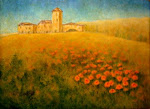
Calabria forms the toe of the Italian “boot.” Most travelers consider the region of Calabria to be uncivilized and dangerous, and to be used only as a stepping block to and from Sicily. That’s a gross error in judgment, and these folks need to get their heads out of their Mario Puzzo novels.
First of all, the Calabrian people are as warm and inviting as the June sun that splashes across their tiled rooftops. If you’re an artist, you’re really in for a treat. Artists at any level are venerated and fussed over. If you’re sitting in the piazza barely doodling, you’ll get the “Look” (the nod and the smile) that says: “I’m honored to be in the presence of such artistic genius.”
Seascape artists can enjoy the beaches, pristine, golden, and aquamarine, around the Tropea Peninsula, while plein air artists may prefer the scenic hinterland. The charming village of Tropea huddled on a cliff above the sea, won’t disappoint artists who are drawn to architecture. The Calabrians call the town: “Nobile Tropea,” as it is considered to be one of the most picturesque in all of Southern Italy.
The only uncivilized and dangerous things I’ve ever encountered in Calabria are the two unexploded American bombs, left over from WW2, that hang in the back of the Cathedral in Tropea.
BUON VIAGGIO!
Monday, October 19, 2009

Sunday, October 18, 2009
PAINTING & WRITING IN SICILY
For artists and writers (or anyone for that matter) who hesitate to travel to Sicily because of the Mafia “Thing”, get over it. Not everyone who lives in Las Vegas is a gambler nor is every New Yorker a mugger; and likewise, not every Sicilian belongs to the Mafia. If you ignore Sicily, you miss Italy. If you don’t want to take my advice, take the advice of Goethe who wrote: “To have seen Italy without seeing Sicily, is not to have seen Italy at all. For Sicily is the key to everything.”
Writers doing research on the Italian consciousness would do well to spend time in Sicily. For as Luigi Barzini wrote in The Italians: “Sicily is the schoolroom model of Italy for beginners, with every Italian quality and defect magnified, exasperated, and brightly colored...Everywhere in Italy, life is more or less slowed down by the exuberant intelligence of the inhabitants: In Sicily it is practically paralyzed by it.”
I consider the Sicilian sensitivity to be a fascinating subject to research. I mean, come on, here’s a land where, in the local dialects, there is no future tense for the verb “to be”, and where a distinctly joyful expression states: “Finchè c’è morte c’è speranza.” (Where there’s death there’s hope.) Say what? Lay that one out on Freud’s couch!
For artists, Sicily’s unique natural beauty challenges your brain to make that seemingly impossible decision of what to paint first: rugged mountains, vine and olive-clad slopes, fields of daisies and sunflowers, countless lemon, lime, and orange orchards, craggy sea-cliffs, sandy coves, Mount Etna. If Sicily’s natural beauty doesn’t totally thrust your brain into overdrive, certainly Sicily’s man-made wonders will finish the job: The Baroque façades on Campania’s churches, Apulia’s Romanesque cathedrals, the ancient Greek ruins in Calabria, the castles, palaces, and churches built all over Southern Italy by Norman, Aragonese, and Spanish invaders – all of these are found on the microcosm island of Sicily.
BUON VIAGGIO!
Writers doing research on the Italian consciousness would do well to spend time in Sicily. For as Luigi Barzini wrote in The Italians: “Sicily is the schoolroom model of Italy for beginners, with every Italian quality and defect magnified, exasperated, and brightly colored...Everywhere in Italy, life is more or less slowed down by the exuberant intelligence of the inhabitants: In Sicily it is practically paralyzed by it.”
I consider the Sicilian sensitivity to be a fascinating subject to research. I mean, come on, here’s a land where, in the local dialects, there is no future tense for the verb “to be”, and where a distinctly joyful expression states: “Finchè c’è morte c’è speranza.” (Where there’s death there’s hope.) Say what? Lay that one out on Freud’s couch!
For artists, Sicily’s unique natural beauty challenges your brain to make that seemingly impossible decision of what to paint first: rugged mountains, vine and olive-clad slopes, fields of daisies and sunflowers, countless lemon, lime, and orange orchards, craggy sea-cliffs, sandy coves, Mount Etna. If Sicily’s natural beauty doesn’t totally thrust your brain into overdrive, certainly Sicily’s man-made wonders will finish the job: The Baroque façades on Campania’s churches, Apulia’s Romanesque cathedrals, the ancient Greek ruins in Calabria, the castles, palaces, and churches built all over Southern Italy by Norman, Aragonese, and Spanish invaders – all of these are found on the microcosm island of Sicily.
BUON VIAGGIO!
Friday, October 9, 2009
ITALIAN POETRY / I COLORI DELL'AUTUNNO by LUCIANO SOMMA
In THE COLORS OF AUTUMN, Luciano Somma’s words are like delicate brushstrokes that paint a rich, mental image. THE COLORS OF AUTUMN is an excerpt from Luciano’s dual-language poetry book: “L’ALBA DI DOMANI/TOMORROW’S SUNRISE” You can find Luciano Somma at:
http://www.partecipiamo.it/Poesie/Luciano_Somma/1.htm http://www.scolastica2000.it/MUSICALMENTE/somma/somma.htm
Nella poema: I COLORI DELL’AUTUNNO le parole di Luciano Somma sono come pennellate delicate che dipingono nelle menti gli immagini intensi. I COLORI DELL’AUTUNNO è un brano dal suo libro di doppia lingua: “L’ALBA DI DOMANI/TOMORROW’S SUNRISE.”
Si può trovare Luciano Somma a: http://www.partecipiamo.it/Poesie/Luciano_Somma/1.htm
http://www.scolastica2000.it/MUSICALMENTE/somma/somma.htm
I COLORI DELL’AUTUNNO
L’ultimo palpitare
delle foglie
che qui in montagna
assumono colori
dai toni accesi
vivi come lampe
portano l’eco assurda
della tua voce padre
duro come una roccia
muscoloso
tu da generazioni taglialegna
sembravi senza tempo.
Ero legato a te
come un ramo alla quercia
ed ora sono solo
nella foresta
del tuo ieri vissuto
in questo immenso.
Ma parleremo ancora
ti sentirò
nell’aria immacolata
presente
tra i colori dell’autunno
nel nostro paradiso
di silenzio.
Luciano Somma
THE COLORS OF AUTUMN
The last fluttering
of leaves
that here in the mountains
assume colors
in vivid tones
alive like lightening
they carry the absurd echo
of your voice father
hard like a rock
muscular
you from woodcutter
seemed timeless.
I was bound to you
like a branch to the oak
and now I’m alone
in the forest
of your yesterdays lived
in this vastness.
But we will speak again
I will feel you
in the pure air
present
among the colors of autumn
in our paradise
of silence.
Pamela Allegretto Franz (Translation)
http://www.partecipiamo.it/Poesie/Luciano_Somma/1.htm http://www.scolastica2000.it/MUSICALMENTE/somma/somma.htm
Nella poema: I COLORI DELL’AUTUNNO le parole di Luciano Somma sono come pennellate delicate che dipingono nelle menti gli immagini intensi. I COLORI DELL’AUTUNNO è un brano dal suo libro di doppia lingua: “L’ALBA DI DOMANI/TOMORROW’S SUNRISE.”
Si può trovare Luciano Somma a: http://www.partecipiamo.it/Poesie/Luciano_Somma/1.htm
http://www.scolastica2000.it/MUSICALMENTE/somma/somma.htm
I COLORI DELL’AUTUNNO
L’ultimo palpitare
delle foglie
che qui in montagna
assumono colori
dai toni accesi
vivi come lampe
portano l’eco assurda
della tua voce padre
duro come una roccia
muscoloso
tu da generazioni taglialegna
sembravi senza tempo.
Ero legato a te
come un ramo alla quercia
ed ora sono solo
nella foresta
del tuo ieri vissuto
in questo immenso.
Ma parleremo ancora
ti sentirò
nell’aria immacolata
presente
tra i colori dell’autunno
nel nostro paradiso
di silenzio.
Luciano Somma
THE COLORS OF AUTUMN
The last fluttering
of leaves
that here in the mountains
assume colors
in vivid tones
alive like lightening
they carry the absurd echo
of your voice father
hard like a rock
muscular
you from woodcutter
seemed timeless.
I was bound to you
like a branch to the oak
and now I’m alone
in the forest
of your yesterdays lived
in this vastness.
But we will speak again
I will feel you
in the pure air
present
among the colors of autumn
in our paradise
of silence.
Pamela Allegretto Franz (Translation)
Saturday, October 3, 2009
PAINTING IN SICILY / CATANIA
Situated at the foot of Mount Etna, Catania’s fate has always been at the mercy of the Volcano. The eruption in April 1983 lasted seven weeks, with the lava flow licking at the heels and toes of the city. Some refer to Catania as the Pompeii of modern times. Should this fiery threat stop you from painting in the Catania region? Not at all. Just wear good running shoes, keep your ears peeled, eyes opened, and paint fast.
A nice place to set up your easel is in the Piazza del Duomo, one of the most beautiful squares in Sicily. In the center, is the Fontana dell’Elefante: the Elephant Fountain. It’s carved from black volcanic rock and is surmounted by an Egyptian obelisk of granite. The magnificent Duomo looms at one end of the piazza. Six of the granite columns that adorn its Baroque façade were stolen from a Roman theatre: I never could “get” vandalism in the name of Christianity.
The remains of the Roman Amphitheatre, made entirely out of black lava, are absolutely sketch-worthy. The theatre dates from the 2nd century AD and its arena is one of the largest after the Colosseum in Rome.
Botanical and plein air artists should enjoy painting in the Giardino Bellini. In addition to a myriad variety of flowering vegetation, these public gardens are filled with palm, banana, and Ficus trees. From the heights of this luscious garden you are provided an outstanding panorama of Mount Etna.
3 kilometers south of town, seascape artists can set up on the Lido Plaia, a long, sandy beach lined with pine trees. For non-seascape artists, you may still want to keep this Ionian Sea beach destination in mind should Mount Etna decide to wake up.
Buon Viaggio!
A nice place to set up your easel is in the Piazza del Duomo, one of the most beautiful squares in Sicily. In the center, is the Fontana dell’Elefante: the Elephant Fountain. It’s carved from black volcanic rock and is surmounted by an Egyptian obelisk of granite. The magnificent Duomo looms at one end of the piazza. Six of the granite columns that adorn its Baroque façade were stolen from a Roman theatre: I never could “get” vandalism in the name of Christianity.
The remains of the Roman Amphitheatre, made entirely out of black lava, are absolutely sketch-worthy. The theatre dates from the 2nd century AD and its arena is one of the largest after the Colosseum in Rome.
Botanical and plein air artists should enjoy painting in the Giardino Bellini. In addition to a myriad variety of flowering vegetation, these public gardens are filled with palm, banana, and Ficus trees. From the heights of this luscious garden you are provided an outstanding panorama of Mount Etna.
3 kilometers south of town, seascape artists can set up on the Lido Plaia, a long, sandy beach lined with pine trees. For non-seascape artists, you may still want to keep this Ionian Sea beach destination in mind should Mount Etna decide to wake up.
Buon Viaggio!
Friday, October 2, 2009
PAINTING IN SICILY / SYRACUSE
If you happen to be an artist/history buff, you won’t want to miss painting for a few hours in Syracuse and it’s environs. En route to the Greek Theater you’ll pass the 3rd century BC, Hieron’s Altar, which is said to be the largest man-made altar. They say (whoever “they” are) that up to 450 bulls were sacrificed on these stones every day. In my mind, that’s a lot of bulls and a lot of bull, but nevertheless, worthy of a visit and at least a quick sketch.
This Greek Theater is hewn entirely out of rock and considered to be the largest Greek Theater in Europe. The view from the theater, (the town, the harbor, the Ionian Sea) especially at sunset, is magnificent.
If you’re a fan of Caravaggio, (and what artist isn’t and if you’re an artist and you’re not, you should be) visit the grotto, Orrechio di Dionisi. Caravaggio was struck by the cave’s resemblance to an ear and gave it this name. (In Italian, Orrechio=ear)
If you’re a plein air artist, you might enjoy the southern stretch between Syracuse and Noto. This stretch of citrus groves and olive trees passes the scenic Anapo and Ciane Rivers. If you don’t speak Italian, be sure to have a good dual-language dictionary handy in case you get lost. Americans who “assume” everyone in the world speaks English always amaze me.
Buon Viaggio!
This Greek Theater is hewn entirely out of rock and considered to be the largest Greek Theater in Europe. The view from the theater, (the town, the harbor, the Ionian Sea) especially at sunset, is magnificent.
If you’re a fan of Caravaggio, (and what artist isn’t and if you’re an artist and you’re not, you should be) visit the grotto, Orrechio di Dionisi. Caravaggio was struck by the cave’s resemblance to an ear and gave it this name. (In Italian, Orrechio=ear)
If you’re a plein air artist, you might enjoy the southern stretch between Syracuse and Noto. This stretch of citrus groves and olive trees passes the scenic Anapo and Ciane Rivers. If you don’t speak Italian, be sure to have a good dual-language dictionary handy in case you get lost. Americans who “assume” everyone in the world speaks English always amaze me.
Buon Viaggio!
Saturday, September 26, 2009
PAINTING IN SICILY / AGRIGENTO
No painting excursion in Sicily is complete without a visit to Agrigento. Don’t ignore the modern city; But if your time is limited, at least focus on The Valley of the Temples, which is the most important archaeological site on the island. The site is best viewed in the early morning, not only because of the light, but also, it’s before the crowds descend and impede your artistic concentration. The site boasts no fewer than twenty temples, each worthy of a painting.
The surrounding landscape is replete with grain farms and there are few trees in sight. The colors range from green or yellow, depending on the season. Poets of ancient times, like Pindar and Virgil have praised the beauty of the region. And modern poets, like Salvatore Quasimodo deemed it “idyllic.” Pindar wrote: “Agrigento, loveliest of mortal cites.” Pirandello, A native of Agrigento wrote: “Agrigento is where people eat as if they were having their last meal on earth and they build their houses as if they were going to live in them forever. In other cities, between December and February you have fog, ice, and at best, a pale ray of sunshine; here the almond trees are in full bloom, warmed by the breath of the African Sea.”
Okay, so tell me you’re not interested in painting this region!
Buon Viaggio!
The surrounding landscape is replete with grain farms and there are few trees in sight. The colors range from green or yellow, depending on the season. Poets of ancient times, like Pindar and Virgil have praised the beauty of the region. And modern poets, like Salvatore Quasimodo deemed it “idyllic.” Pindar wrote: “Agrigento, loveliest of mortal cites.” Pirandello, A native of Agrigento wrote: “Agrigento is where people eat as if they were having their last meal on earth and they build their houses as if they were going to live in them forever. In other cities, between December and February you have fog, ice, and at best, a pale ray of sunshine; here the almond trees are in full bloom, warmed by the breath of the African Sea.”
Okay, so tell me you’re not interested in painting this region!
Buon Viaggio!
Saturday, September 5, 2009


PAINTING IN SICILY / THE COLORS OF SICILY
When I think of Sicily the first color that comes to mind is gold. The Sun God must have a special place in Her heart for the island; why else would She so generously lavish every field, mountaintop, building, monument, pillar, and ruin with Her precious golden kisses?
Another color would be gold’s kissing cousin, yellow. Not only do yellow sunflowers and daisies sparkle against one of the bluest skies you’ll ever see, but the profusion of lemon trees, with fruit the size of baseballs, scent this sunlit island with an aroma that will make your head spin (in a good way). And when that lemony smell finally triggers your taste buds, yellow drinks are where it’s at. Fresh-squeezed lemonade is served in every bar and pasticeria and it’s guaranteed to spoil you forever to only drink Sicilian lemonade. If you’re looking for a little more “kick” order a Limoncello, that wonderful lemon liquor made from the zest of those amazing Sicilian lemons.
My recommendation for ending a day painting in Sicily would be to sit outside, sip some liquid gold i.e. Limoncello, and watch the Sun paint the sky golden as She settles down for the night.
I painted “SUNLIT,” the monocromatic painting above, because I wanted to capture on canvas my sensitivity to the Sun-kissed Island of Sicily.
This painting is available for purchase at my art website:
http://www.pamelaallegretto-franz.com/
Si può vedere e comprare questo quadro al mio website d’arte: http://www.pamelaallegretto-franz.com/
Another color would be gold’s kissing cousin, yellow. Not only do yellow sunflowers and daisies sparkle against one of the bluest skies you’ll ever see, but the profusion of lemon trees, with fruit the size of baseballs, scent this sunlit island with an aroma that will make your head spin (in a good way). And when that lemony smell finally triggers your taste buds, yellow drinks are where it’s at. Fresh-squeezed lemonade is served in every bar and pasticeria and it’s guaranteed to spoil you forever to only drink Sicilian lemonade. If you’re looking for a little more “kick” order a Limoncello, that wonderful lemon liquor made from the zest of those amazing Sicilian lemons.
My recommendation for ending a day painting in Sicily would be to sit outside, sip some liquid gold i.e. Limoncello, and watch the Sun paint the sky golden as She settles down for the night.
I painted “SUNLIT,” the monocromatic painting above, because I wanted to capture on canvas my sensitivity to the Sun-kissed Island of Sicily.
This painting is available for purchase at my art website:
http://www.pamelaallegretto-franz.com/
Si può vedere e comprare questo quadro al mio website d’arte: http://www.pamelaallegretto-franz.com/
Friday, September 4, 2009
PAINTING IN SICILY / ENNA
While planning one of our visits to Sicily, I did a little research on Enna. One guidebook labeled Enna as a “dreary city.” And yet further assessment indicated otherwise. I decided to find out for myself.
Well, let me tell you, Enna is anything but “dreary.” If you’re looking to paint “killer views” a trip to Enna is a must.
One of the oldest cities on the island, Enna has been called “the navel of Sicily,” by the Greek poet Callimachus, but is usually known as “the belvedere of Sicily”, which seems a better-suited title considering its stunning views. Enna is also the highest capital in Italy.
You can set up in Piazza Crispi and either paint the impressive view over Calascibetta, the Madonie Mountains, or a remarkable view of Etna.
For architecture sketchers and painters, you’ll love the Castello di Lombardia. Six of its twenty towers are still standing and it’s considered one of the most imposing buildings of it kind in Sicily. Byzantine in origin, it contains Norman and Swabian add-ons. Bring your camera and sketchpad up into the tower, called the Eagle or Pisan tower, where there is a far-reaching view over the surrounding countryside.
The public gardens on the outskirts of the city, not only burst with prismatic delights, the octagonal tower that Frederick II built in the 13th century is a must see.
Dreary city, my ass!
Buon Viaggio!
Well, let me tell you, Enna is anything but “dreary.” If you’re looking to paint “killer views” a trip to Enna is a must.
One of the oldest cities on the island, Enna has been called “the navel of Sicily,” by the Greek poet Callimachus, but is usually known as “the belvedere of Sicily”, which seems a better-suited title considering its stunning views. Enna is also the highest capital in Italy.
You can set up in Piazza Crispi and either paint the impressive view over Calascibetta, the Madonie Mountains, or a remarkable view of Etna.
For architecture sketchers and painters, you’ll love the Castello di Lombardia. Six of its twenty towers are still standing and it’s considered one of the most imposing buildings of it kind in Sicily. Byzantine in origin, it contains Norman and Swabian add-ons. Bring your camera and sketchpad up into the tower, called the Eagle or Pisan tower, where there is a far-reaching view over the surrounding countryside.
The public gardens on the outskirts of the city, not only burst with prismatic delights, the octagonal tower that Frederick II built in the 13th century is a must see.
Dreary city, my ass!
Buon Viaggio!
Wednesday, September 2, 2009
PAINTING IN SICILY / MARINELLA
If you want to spend more than one day painting the honey colored stones at the ancient site of Selinunte, you may want to book a room in the nearby seafront village of Marinella that lies about a mile east of the ancient city. This little hamlet offers up excellent beaches, and an early morning dip in the Mediterranean is guaranteed to wake up any creative juices that may still be lumbering from jet lag. When you’ve finished painting at Selinunte, I recommend setting up for at least a few hours on the beach. If you happen to be with artists of varied interests, you can all still paint together: seascape enthusiasts have the Mediterranean as their muse, while artists who prefer painting architecture can turn backs to the sea and paint the delightful sienna and yellow ochre village.
If you do spend the night in one of Marinella’s few hotels, keep the windows closed at night. Don’t worry; I’m not about to warn you of cat burglars. It’s the bats. Marinella’s bats have a tendency to pay midnight visits through opened windows and balcony doors. Do they bite? I don’t think so. But I can tell you from experience that having bats flapping overhead can spoil a good night’s sleep.
Buon Viaggio!
If you do spend the night in one of Marinella’s few hotels, keep the windows closed at night. Don’t worry; I’m not about to warn you of cat burglars. It’s the bats. Marinella’s bats have a tendency to pay midnight visits through opened windows and balcony doors. Do they bite? I don’t think so. But I can tell you from experience that having bats flapping overhead can spoil a good night’s sleep.
Buon Viaggio!
Monday, August 31, 2009
IL PRIMO SETTEMBRE/SEPTEMBER FIRST by Luciano Somma
On this last day of August and the eve of autumn, I felt it appropriate to share the poem SEPTEMBER FIRST written by Luciano Somma. As in all of Luciano’s poetry, we feel the sentimental spirit of one of Italy’s foremost poets. You can find Luciano Somma at:
http://www.partecipiamo.it/Poesie/Luciano_Somma/1.htm
http://www.scolastica2000.it/MUSICALMENTE/somma/somma.htm
In quest’ultimo giorno d’agosto e la vigilia d’autunno, ho sentito che era adatto offrire la poema IL PRIMO SETTEMBRE scritto di Luciano Somma. Come tutte delle sue poesie, sentiamo lo spirito sentimentale d’un poeta molto noto in Italia. Si può trovare Luciano Somma a:
http://www.partecipiamo.it/Poesie/Luciano_Somma/1.htm
http://www.scolastica2000.it/MUSICALMENTE/somma/somma.htm
IL PRIMO SETTEMBRE
L’ultimo sogno d’Agosto
Si sveglia col primo Settembre,
questa sera è un incanto!
Il cielo è amaranto, uno spiffero di vento
dolce come la carezza d’un bene
amaro come il fiele del pianto
mi porta una ciurma di pensieri
Che affollano la mente
e mettono in croce questo cuore.
Vorrei che piovesse e non piove…
Vorrei tante nuvole intorno
ma la luna è d’argento
Vorrei che un sogno tornasse
ma il sogno non torna.
Questo sogno è partito
sulle onde
dell’ultima sera d’Agosto
lasciandomi
un grappolo di stelle
lassù nel cielo amaranto
in questa sera incantata
del primo Settembre.
Luciano Somma
SEPTEMBER FIRST
The last dream of August
awakens with the first of September,
this evening is enchantment!
The sky bleeds red and purple, a light breeze
soft like a lover’s caress
bitter like malicious words
brings me a crew of thoughts
that crowd my mind
and crucify this heart.
I wish it were raining and not rain…
I’d like a cloud-filled sky
yet view a silver moon.
I wish the dream was ending
But the dream doesn’t end.
This dream has departed
on the waves
of the final August evening
leaving me
a cluster of stars
far-off in the bleeding sky
in this enchanted evening
of September first.
Pamela Allegretto Franz (translation)
http://www.partecipiamo.it/Poesie/Luciano_Somma/1.htm
http://www.scolastica2000.it/MUSICALMENTE/somma/somma.htm
In quest’ultimo giorno d’agosto e la vigilia d’autunno, ho sentito che era adatto offrire la poema IL PRIMO SETTEMBRE scritto di Luciano Somma. Come tutte delle sue poesie, sentiamo lo spirito sentimentale d’un poeta molto noto in Italia. Si può trovare Luciano Somma a:
http://www.partecipiamo.it/Poesie/Luciano_Somma/1.htm
http://www.scolastica2000.it/MUSICALMENTE/somma/somma.htm
IL PRIMO SETTEMBRE
L’ultimo sogno d’Agosto
Si sveglia col primo Settembre,
questa sera è un incanto!
Il cielo è amaranto, uno spiffero di vento
dolce come la carezza d’un bene
amaro come il fiele del pianto
mi porta una ciurma di pensieri
Che affollano la mente
e mettono in croce questo cuore.
Vorrei che piovesse e non piove…
Vorrei tante nuvole intorno
ma la luna è d’argento
Vorrei che un sogno tornasse
ma il sogno non torna.
Questo sogno è partito
sulle onde
dell’ultima sera d’Agosto
lasciandomi
un grappolo di stelle
lassù nel cielo amaranto
in questa sera incantata
del primo Settembre.
Luciano Somma
SEPTEMBER FIRST
The last dream of August
awakens with the first of September,
this evening is enchantment!
The sky bleeds red and purple, a light breeze
soft like a lover’s caress
bitter like malicious words
brings me a crew of thoughts
that crowd my mind
and crucify this heart.
I wish it were raining and not rain…
I’d like a cloud-filled sky
yet view a silver moon.
I wish the dream was ending
But the dream doesn’t end.
This dream has departed
on the waves
of the final August evening
leaving me
a cluster of stars
far-off in the bleeding sky
in this enchanted evening
of September first.
Pamela Allegretto Franz (translation)
Thursday, August 27, 2009
PAINTING IN SICILY / SELINUNTE
Situated on a hill on the southwest coast, Selinunte, founded in 628 BC, was one of Sicily’s most important ancient towns. Within the archaeological site, “Temple G” is one of the greatest known monuments of Greek antiquity.
Fortunately, for artists like myself who like to sketch and paint ancient ruins but are distracted by hordes of tourists, Selinunte remains one of the less-frequently visited.
If you arrive promptly at the 9am opening you can usually have the entire city pretty much to yourself until the tour buses roll in around 10:30-11am. But even then, this “village of pillars” as the 11th century Arab writer, Idrisi, referred to it, is large enough to find an out of the way spot to set up. If you don’t want to waste time wandering around to locate “just the right spot,” tell the men at the main gate that you’re an artist and ask them for directions to the best sites. They are intensely proud of Selinunte and the fact that you want to paint there will bend them over backwards to accommodate you.
It can get hot there in the summer so bring water. And of course carry out what you bring in. Yes, the gatekeepers love artists; no, they won’t tolerate artists who litter. Remember what I said in my last blog about “sleeping with the fish?”
Fortunately, for artists like myself who like to sketch and paint ancient ruins but are distracted by hordes of tourists, Selinunte remains one of the less-frequently visited.
If you arrive promptly at the 9am opening you can usually have the entire city pretty much to yourself until the tour buses roll in around 10:30-11am. But even then, this “village of pillars” as the 11th century Arab writer, Idrisi, referred to it, is large enough to find an out of the way spot to set up. If you don’t want to waste time wandering around to locate “just the right spot,” tell the men at the main gate that you’re an artist and ask them for directions to the best sites. They are intensely proud of Selinunte and the fact that you want to paint there will bend them over backwards to accommodate you.
It can get hot there in the summer so bring water. And of course carry out what you bring in. Yes, the gatekeepers love artists; no, they won’t tolerate artists who litter. Remember what I said in my last blog about “sleeping with the fish?”
Friday, August 21, 2009
PAINTING IN SICILY / MONREALE
Homer told the story of the Lotophagi who once inhabited the island of Sicily. All new arrivals were required to eat of the lotus tree and at once forgot their homes and lost all desire to return to their native lands. When you’re in Sicily it won’t take a bite from the lotus tree to cloud your dreams of home and hearth, just stand outside and look in any direction. The inhabitants claim you need four eyes to fully appreciate Sicily’s beauty. I say six!
Goethe praised the road that leads from Palermo to Monreale. “It is,” he wrote, “a wide road, lined with trees, sloping gently, full of fountains, some with jets, others flowing, but all beautifully decorated with ornaments and friezes.” Monreale is such an idyllic spot that the Palermans have a saying: Chi va a Palermo e non vede Monreale, asino va e asino torna. (Whoever goes to Palermo without seeing Monreale – goes as an ass, and returns an ass.) So don’t be an ass. Spend a day painting at Monreale.
Visit the cathedral, built in 1174; it is one of the wonders of the medieval world. Don’t be fooled by the relatively drab façade, the interior is covered throughout with shimmering gold mosaics.
After you’ve caught your breath and still have that glitter of “gold” on your mind, you can set up and incorporate those rich golden hues on your canvas, inspired by sweeping rooftop scenes, valley landscapes, or coastline views.
As always, carry out what you bring in. If you’re an oil painter, don’t dump your mediums. Yes, the Mafia is alive and well and living in Sicily, especially in the vicinity of Palermo. But don’t let that deter you. The Mafia families are great lovers of art and artists, but they don’t like anyone despoiling their beautiful island. Go to Sicily to paint the fish, not sleep with them.
BUON VIAGGIO!!!
Goethe praised the road that leads from Palermo to Monreale. “It is,” he wrote, “a wide road, lined with trees, sloping gently, full of fountains, some with jets, others flowing, but all beautifully decorated with ornaments and friezes.” Monreale is such an idyllic spot that the Palermans have a saying: Chi va a Palermo e non vede Monreale, asino va e asino torna. (Whoever goes to Palermo without seeing Monreale – goes as an ass, and returns an ass.) So don’t be an ass. Spend a day painting at Monreale.
Visit the cathedral, built in 1174; it is one of the wonders of the medieval world. Don’t be fooled by the relatively drab façade, the interior is covered throughout with shimmering gold mosaics.
After you’ve caught your breath and still have that glitter of “gold” on your mind, you can set up and incorporate those rich golden hues on your canvas, inspired by sweeping rooftop scenes, valley landscapes, or coastline views.
As always, carry out what you bring in. If you’re an oil painter, don’t dump your mediums. Yes, the Mafia is alive and well and living in Sicily, especially in the vicinity of Palermo. But don’t let that deter you. The Mafia families are great lovers of art and artists, but they don’t like anyone despoiling their beautiful island. Go to Sicily to paint the fish, not sleep with them.
BUON VIAGGIO!!!
Tuesday, August 18, 2009

SICILIAN TABLE
Since cheese is my favorite food, I felt it was high time I painted a nice ball of aged provolone. Then I had to decide what to add to it. That was easy. What better accompaniment than wine, tomatoes, and olive oil? Buon appetito!
The above painting can be purchesed at my art website: http://www.PamelaAllegretto-Franz.com
Siccome il formaggio è il cibo che preferisco più di tutto, ho deciso è già tempo che faccio un quadro di un pallone di provolone. Poi ho deciso che non ci sta un accompagnamento meglio che vino, pomodori, ed olio di olivi. Buon appetito!
So pou` comprare il quadro al mio website d'arte: http://www.PamelaAllegretto-Franz.com
The above painting can be purchesed at my art website: http://www.PamelaAllegretto-Franz.com
Siccome il formaggio è il cibo che preferisco più di tutto, ho deciso è già tempo che faccio un quadro di un pallone di provolone. Poi ho deciso che non ci sta un accompagnamento meglio che vino, pomodori, ed olio di olivi. Buon appetito!
So pou` comprare il quadro al mio website d'arte: http://www.PamelaAllegretto-Franz.com
Sunday, August 16, 2009
PAINTING IN SICILY / TAORMINA
Rent a car if you intend to take full advantage of this color splashed island. The highway system is relatively uncluttered; and the well-maintained, secondary roads are often times traffic free especially from October through March.
Although touristy, one of my favorite sites is Taormina. (Stay as far away as possible during the month of August) Taormina’s mountaintop location is unequaled, its Greek Theater the most dramatically positioned, and its temperate climate ideal for plein air artists. If you go in the springtime it’s nearly impossible to omit the purple explosion of bougainvillea from your canvas.
Goethe said the Greek Theater commanded one of the most spectacular views in the world. I’ve not traveled the entire world, nor do I think Goethe did, but I’d wager his comment is dead on. To the right, citadels precariously perch on cliffs; to the left, the coastline stretches as far as Catania or even Syracuse; below, lies the town of Taormina awash in bougainvillea; directly ahead, the long ridge of Etna, whose mouth spews its fiery admonition. What’s not to love? Set your alarm or request a wakeup call at your hotel so you can get to the Theater at dawn, when the sun rises from the sea to plant a fat pink kiss on Etna’s snowy peak.
Buon Viaggio!
Although touristy, one of my favorite sites is Taormina. (Stay as far away as possible during the month of August) Taormina’s mountaintop location is unequaled, its Greek Theater the most dramatically positioned, and its temperate climate ideal for plein air artists. If you go in the springtime it’s nearly impossible to omit the purple explosion of bougainvillea from your canvas.
Goethe said the Greek Theater commanded one of the most spectacular views in the world. I’ve not traveled the entire world, nor do I think Goethe did, but I’d wager his comment is dead on. To the right, citadels precariously perch on cliffs; to the left, the coastline stretches as far as Catania or even Syracuse; below, lies the town of Taormina awash in bougainvillea; directly ahead, the long ridge of Etna, whose mouth spews its fiery admonition. What’s not to love? Set your alarm or request a wakeup call at your hotel so you can get to the Theater at dawn, when the sun rises from the sea to plant a fat pink kiss on Etna’s snowy peak.
Buon Viaggio!
Tuesday, August 4, 2009
Importance Of An Artist's Website
I recently returned from a visit to my home state of Colorado. (Yes, that’s the reason for the gap in blog-postings) While there, I had the pleasure of attending an art festival in the mountain town of Breckenridge. The art, which was primarily southwestern, reminded me of the importance of an artist’s website.
Here in Connecticut, the majority of art exhibited in galleries and festivals is New England landscapes and seascapes. When I lived in Kailua-Kona, Hawaii, tropical art was the preferred art form. Clearly, regional art is the preferred subject matter at most galleries and art festivals.
But what if your taste in art fluctuates? What if you, like me, get easily bored? Can you eke out a living painting New England landscapes in Colorado? Can you survive trying to sell tropical paintings in Connecticut? Is there a large market for Italian landscapes in Massachusetts? Probably not. So what can you do to keep coins in your pocket and creative juices flowing? Create a website.
Now, this is not a “paid for programming” ad for the host website in which I belong. But I do advocate a website if you want to reach art-lovers around the country and around the world. Selling via the Internet allows artists the freedom of diversity. No longer will you be constrained to a limited subject. Your only restrictions are those you inflict on yourselves.
My advice: Set up an art website and paint what you love.
My art can be viewed at: http://www.pamelaallegretto-franz.com/ the host site is ArtMajeur. If you go to this site, you can click on “home” and follow the instructions to setting up a website. It can be free, or if you want a few perks, it’s a minimal amount. There are numerous other artist websites available. Check them out and get connected. Don’t limit yourself to the few visitors each day in a gallery or the one-time art festival shoppers. Of course they are important, but their numbers are miniscule to the visitors you’ll get on the Internet.
Happy painting!!!
Here in Connecticut, the majority of art exhibited in galleries and festivals is New England landscapes and seascapes. When I lived in Kailua-Kona, Hawaii, tropical art was the preferred art form. Clearly, regional art is the preferred subject matter at most galleries and art festivals.
But what if your taste in art fluctuates? What if you, like me, get easily bored? Can you eke out a living painting New England landscapes in Colorado? Can you survive trying to sell tropical paintings in Connecticut? Is there a large market for Italian landscapes in Massachusetts? Probably not. So what can you do to keep coins in your pocket and creative juices flowing? Create a website.
Now, this is not a “paid for programming” ad for the host website in which I belong. But I do advocate a website if you want to reach art-lovers around the country and around the world. Selling via the Internet allows artists the freedom of diversity. No longer will you be constrained to a limited subject. Your only restrictions are those you inflict on yourselves.
My advice: Set up an art website and paint what you love.
My art can be viewed at: http://www.pamelaallegretto-franz.com/ the host site is ArtMajeur. If you go to this site, you can click on “home” and follow the instructions to setting up a website. It can be free, or if you want a few perks, it’s a minimal amount. There are numerous other artist websites available. Check them out and get connected. Don’t limit yourself to the few visitors each day in a gallery or the one-time art festival shoppers. Of course they are important, but their numbers are miniscule to the visitors you’ll get on the Internet.
Happy painting!!!
Saturday, July 11, 2009
PAINTING IN ITALY / LAGO DI COMO
Lake Como (Larius, as it was known to the Romans) has been called “the looking glass of Venus,” and Virgil pronounced it “our greatest lake.” Not to be out quoted, Stendhal characterized Lake Como as “everything noble, everything evoking love.” With these dazzling recommendations, how can any artist resist this idyllic local?
I recommend not setting up in the town of Como, as it is a busy industrial town. It’s not that there isn’t a plethora of squares and charming buildings to paint within the town, but if your time is limited you may prefer the smaller, more picturesque villages that line the lake.
Bellagio, which is labeled the “pearl of Larius,” and has also been called “the prettiest town in Europe,” is the perfect spot to set up for a day. Be sure to clamp down your canvas as a gust off the lake can kick up unexpectedly. If your canvas ends up face down in your pallet, don’t say I didn’t warn you.
My personal favorite is Tremezzo, on the west shore of the lake. Landscape artists will love the luxuriant vegetation that includes citrus trees, palms, cypresses, and magnolias.
Buon Viaggio!
I recommend not setting up in the town of Como, as it is a busy industrial town. It’s not that there isn’t a plethora of squares and charming buildings to paint within the town, but if your time is limited you may prefer the smaller, more picturesque villages that line the lake.
Bellagio, which is labeled the “pearl of Larius,” and has also been called “the prettiest town in Europe,” is the perfect spot to set up for a day. Be sure to clamp down your canvas as a gust off the lake can kick up unexpectedly. If your canvas ends up face down in your pallet, don’t say I didn’t warn you.
My personal favorite is Tremezzo, on the west shore of the lake. Landscape artists will love the luxuriant vegetation that includes citrus trees, palms, cypresses, and magnolias.
Buon Viaggio!
Tuesday, July 7, 2009

PAINTING IN ITALY / CHIANTI REGION
The Chianti Region in Italy runs along the state highway SS222 between Florence and Siena. The Chianti region not only boasts rolling hills and mountain top villages, but a wealth of castles. Some of the towns to look for:
Verrazzano (You might recognize the name as Giovanni "da" Verrazzano discovered the NY Harbor and the Island of Manhattan. The Verrazzano Bridge that runs to Staten Island was named after him.) Castello di Verrazzano, Giovanni’s birthplace is an ideal location to set up an easel, (just make sure to ask permission first). If you get thirsty while painting, you can sample and buy wine here.
The medieval town of Greve, which is the capital of Chianti, is one of the more colorful towns in Tuscany. Set up your easel in the Piazza del Mercatale and have a blast painting and smoozing with art-loving locals.
If painting gardens is your forte, don’t miss Vignamaggio where you’ll find the Renaissance villa that was once the home of La Gioconda, who sat for Da Vinci’s Mona Lisa. The gardens, replete with classical stautes and towering hedges, were featured in Kenneth Branagh’s film, Much Ado About Nothing.
If painting architecture is your preference, visit Castellina in Chianti. This hilltop village still has its fortified walls intact with little houses constructed into the walls and nesting on top of them.
Don’t let the seemingly tortuous, winding roads keep you from setting up in the village of Radda in Chianti. The main piazza is an ideal location to capture on canvas a village unchanged from the Middle Ages.
I have only touched on a small number of villages in this Chianti Region that are worthy of a painting outing; certainly there are many other villages: Badia a Coltibuono, San Sano, Castello di Brolio, and Gaiole, to name a few more.
Don’t forget to always take out what you bring in when painting en plein air. Not all open space is public land; so whenever you’re in doubt, ask first before setting up; trespassing is against the law and fines can be steep. I’ve never know an artist who’s been turned off private land when they asked permission first.
The painting above, La Sera, is an original watercolor and acrylic 12”x16” on 140 pound paper. This is my whimsical version of shop and bar lights spilling into an Italian piazza at dusk. The original painting and limited edition prints can be purchased at my art website:
http://www.PamelaAllegretto-Franz.com
Il quadro sopra, La Sera, è un’originale acquerello e acrilico 31x41cm dipinto sulla carta di 300g/m2.
La mia idea di sogno d’una piazza Italiana al tramonte, quando le luce si riversarono fuori dei negozi.
Si può comprare l’originale oppure le stampe al mio website d’arte:
http://www.PamelaAllegretto-Franz.com
Verrazzano (You might recognize the name as Giovanni "da" Verrazzano discovered the NY Harbor and the Island of Manhattan. The Verrazzano Bridge that runs to Staten Island was named after him.) Castello di Verrazzano, Giovanni’s birthplace is an ideal location to set up an easel, (just make sure to ask permission first). If you get thirsty while painting, you can sample and buy wine here.
The medieval town of Greve, which is the capital of Chianti, is one of the more colorful towns in Tuscany. Set up your easel in the Piazza del Mercatale and have a blast painting and smoozing with art-loving locals.
If painting gardens is your forte, don’t miss Vignamaggio where you’ll find the Renaissance villa that was once the home of La Gioconda, who sat for Da Vinci’s Mona Lisa. The gardens, replete with classical stautes and towering hedges, were featured in Kenneth Branagh’s film, Much Ado About Nothing.
If painting architecture is your preference, visit Castellina in Chianti. This hilltop village still has its fortified walls intact with little houses constructed into the walls and nesting on top of them.
Don’t let the seemingly tortuous, winding roads keep you from setting up in the village of Radda in Chianti. The main piazza is an ideal location to capture on canvas a village unchanged from the Middle Ages.
I have only touched on a small number of villages in this Chianti Region that are worthy of a painting outing; certainly there are many other villages: Badia a Coltibuono, San Sano, Castello di Brolio, and Gaiole, to name a few more.
Don’t forget to always take out what you bring in when painting en plein air. Not all open space is public land; so whenever you’re in doubt, ask first before setting up; trespassing is against the law and fines can be steep. I’ve never know an artist who’s been turned off private land when they asked permission first.
The painting above, La Sera, is an original watercolor and acrylic 12”x16” on 140 pound paper. This is my whimsical version of shop and bar lights spilling into an Italian piazza at dusk. The original painting and limited edition prints can be purchased at my art website:
http://www.PamelaAllegretto-Franz.com
Il quadro sopra, La Sera, è un’originale acquerello e acrilico 31x41cm dipinto sulla carta di 300g/m2.
La mia idea di sogno d’una piazza Italiana al tramonte, quando le luce si riversarono fuori dei negozi.
Si può comprare l’originale oppure le stampe al mio website d’arte:
http://www.PamelaAllegretto-Franz.com
Friday, June 26, 2009

FUN ART
Whenever I get painter’s block (that’s what I call it when my mind hits a snag and can’t come up with a subject for my next painting) I revert to what I call fun art. I use the term fun art because aside from layout and pathways, there are no rules to follow. I’m free to use my imagination with the subject and color pallet.
In “VINNY AND THE VAN GO’S (PIANO MAN)” I combined my love of music and art with a playful nod to Vincent Van Gogh.
The above painting can be purchased on my art website:
http://PamelaAllegretto-Franz.com
Nel quadro sopra: “VINNY AND THE VAN GO’S (PIANO MAN)” ho unito mia passione d'arte e l'artista preferito, Vincent Van Gogh, con mia passione di musica.
Si può comprare il quadro sul mio website d’arte:
http://PamelaAllegretto-Franz.com
In “VINNY AND THE VAN GO’S (PIANO MAN)” I combined my love of music and art with a playful nod to Vincent Van Gogh.
The above painting can be purchased on my art website:
http://PamelaAllegretto-Franz.com
Nel quadro sopra: “VINNY AND THE VAN GO’S (PIANO MAN)” ho unito mia passione d'arte e l'artista preferito, Vincent Van Gogh, con mia passione di musica.
Si può comprare il quadro sul mio website d’arte:
http://PamelaAllegretto-Franz.com
Tuesday, June 23, 2009

ITALIAN POETRY/DA DOMANI IN DOMANI by Luciano Somma
In the poem, “DA DOMANI IN DOMANI,” written by Luciano Somma, we feel the sentimental spirit of one of Italy’s foremost poets. You can find Luciano Somma at:
http://www.partecipiamo.it/Poesie/Luciano_Somma/1.htm
http://www.scolastica2000.it/MUSICALMENTE/somma/somma.htm
The painting above: “Fishing At Gay Park,” can be purchased at my art website:
http://www.PamelaAllegretto-Franz.com
Nella poema, “DA DOMANI IN DOMANI,” scritto di Luciano Somma, sentiamo lo spirito sentimentale d’un poeta molto noto in Italia. Si può trovare Luciano Somma a:
http://www.partecipiamo.it/Poesie/Luciano_Somma/1.htm
http://www.scolastica2000.it/MUSICALMENTE/somma/somma.htm
Si può comprare il quadro sopra: “Fishing At Gay Park,” al mio website d’arte:
http://www.PamelaAllegretto-Franz.com
DA DOMANI IN DOMANI
A togliere il fiato
al mio cuore bambino
è stata l’attesa
di giorni monelli
e le arrampicate
lassù tra i cancelli
a darmi paura
di tutti e di tutto
donandomi un’alba
vestita di lutto
domani in domani
speranze sospese
cadute nel mare
ne ho fatto le spese
la vita che corre
sul filo di seta
laggiù all’orizzonte
s’è accesa una luce
ancora un’attesa
ma qual è la meta?
Luciano Somma
FROM TOMORROW INTO TOMORROW
To take away the breath
to my child’s heart
that’s been lingering
on impish days
of scrambling
up and over gates
to make me afraid
of everything and everyone
bequeathing to me a sunrise
dressed in mourning
from tomorrow into tomorrow
suspended hopes
fell into the sea
I paid the price
the life that runs
on silk thread
there at the horizon
a light ignites
once more a pause
but to which finale?
Pamela Allegretto Franz (translation)
http://www.partecipiamo.it/Poesie/Luciano_Somma/1.htm
http://www.scolastica2000.it/MUSICALMENTE/somma/somma.htm
The painting above: “Fishing At Gay Park,” can be purchased at my art website:
http://www.PamelaAllegretto-Franz.com
Nella poema, “DA DOMANI IN DOMANI,” scritto di Luciano Somma, sentiamo lo spirito sentimentale d’un poeta molto noto in Italia. Si può trovare Luciano Somma a:
http://www.partecipiamo.it/Poesie/Luciano_Somma/1.htm
http://www.scolastica2000.it/MUSICALMENTE/somma/somma.htm
Si può comprare il quadro sopra: “Fishing At Gay Park,” al mio website d’arte:
http://www.PamelaAllegretto-Franz.com
DA DOMANI IN DOMANI
A togliere il fiato
al mio cuore bambino
è stata l’attesa
di giorni monelli
e le arrampicate
lassù tra i cancelli
a darmi paura
di tutti e di tutto
donandomi un’alba
vestita di lutto
domani in domani
speranze sospese
cadute nel mare
ne ho fatto le spese
la vita che corre
sul filo di seta
laggiù all’orizzonte
s’è accesa una luce
ancora un’attesa
ma qual è la meta?
Luciano Somma
FROM TOMORROW INTO TOMORROW
To take away the breath
to my child’s heart
that’s been lingering
on impish days
of scrambling
up and over gates
to make me afraid
of everything and everyone
bequeathing to me a sunrise
dressed in mourning
from tomorrow into tomorrow
suspended hopes
fell into the sea
I paid the price
the life that runs
on silk thread
there at the horizon
a light ignites
once more a pause
but to which finale?
Pamela Allegretto Franz (translation)
Wednesday, June 17, 2009

PAINTING IN NEW ENGLAND / ST. CLEMENT'S CASTLE
In May, under the expert tutelage of Artist Elizabeth Sennett, our plein air class was granted special permission to spend two painting sessions at St. Clement’s Castle in Portland, CT.
The name “Saint Clement” was chosen for the date of the manor home’s completion, November 23, the Feast of St. Clement. An early bishop of Rome, Clement became the patron saint of mariners and ironworkers, especially blacksmiths, because he was martyred by being tied to an iron anchor and drowned at sea. In his honor, elaborate ironworks decorate the castle gardens.
In a wisteria-bordered courtyard, I was enticed by a stone gazebo that frames a charming well. Since I love painting stonework, this gazebo was too fun to pass up.
The castle can be found off RT66 in Portland, CT
The painting above, St. Clement’s Castle, is an 11”x14” original acrylic on canvas board and can be purchased on my art website:
http://www.PamelaAllegretto-Franz.com
Si può comprare il quadro in sopra, Il Castello di San Clemente, (l’originale acrilico su tela di 28x36cm, senza cornice) al mio website d’arte:
http://www.PamelaAllegretto-Franz.com
The name “Saint Clement” was chosen for the date of the manor home’s completion, November 23, the Feast of St. Clement. An early bishop of Rome, Clement became the patron saint of mariners and ironworkers, especially blacksmiths, because he was martyred by being tied to an iron anchor and drowned at sea. In his honor, elaborate ironworks decorate the castle gardens.
In a wisteria-bordered courtyard, I was enticed by a stone gazebo that frames a charming well. Since I love painting stonework, this gazebo was too fun to pass up.
The castle can be found off RT66 in Portland, CT
The painting above, St. Clement’s Castle, is an 11”x14” original acrylic on canvas board and can be purchased on my art website:
http://www.PamelaAllegretto-Franz.com
Si può comprare il quadro in sopra, Il Castello di San Clemente, (l’originale acrilico su tela di 28x36cm, senza cornice) al mio website d’arte:
http://www.PamelaAllegretto-Franz.com
Sunday, June 14, 2009

Plein Air Painting With Acrylics
For plein air artists who are new to acrylics I’d like to offer a few suggestions gleaned from many a frustrating outing. Someone recently asked if I recommend painting en plein air with acrylics. My response was, “yes and no.”
I know that sounds like a lame answer, but let me explain.
A few of the pros to painting en plein air with acrylics are: They dry fast, the brushes clean up easily with water, there are no toxic mediums to discard, and quick color washes can be applied to capture tone on days beset with fast moving clouds.
Some cons to painting en plein air with acrylics are: They dry fast not only on the canvas but also on the pallet. Drying retarders can help, but I find them to be gooey and leave an unnatural sheen on the canvas. And if you use the retarder on some areas but not on others, your canvas ends up spotted with glossy patches. Flo-aid is a must for a wetting solution and works better than retarders to keep the paint on the pallet moist. But be careful not to get too heavy handed with the flo-aid or your paint won’t grab properly to the surface of the canvas and a subsequent wash will pull that underlying color off the canvas.
Whether painting with acrylic, oils, or watercolor, painting en plein air can be fun. I don’t claim to call myself a plein air artist; I refer to myself as a "fair-weather" plein air artist. As long as the day is warm, dry, sunny, and wind-free, I’m all for it. If it’s cold, windy, or damp, I’m content to sip hot chocolate and schnapps while painting in my heated studio.
My favorite acrylic paint: Brerra by Maimare (Italian made of course.)
The bicycle painting above is an unframed 11”x14” acrylic on canvas board that can be purchased on my art website:
http://www.pamelaAllegretto-Franz.com
It was such fun painting my first bicycle scene, and just as much fun selling it, that I decided to paint it again. This time the background hues are a bit warmer and the stones are slightly rearranged, so as not to be identical to the first painting.
La bicicletta in sopra è un’originale acrilico su tela 28x36cm senza cornice. Si può comprarlo sul mio website d’arte:
http://www.pamelaAllegretto-Franz.com
Mi ha piaciuti cosi tanto dipingere il primo quadro con la bicicletta, ed ho piaciuto anche vendere il primo quadro, che ho deciso dipingere un altro. I colori sono un pò diverso siccome non volevo averli uguali.
I know that sounds like a lame answer, but let me explain.
A few of the pros to painting en plein air with acrylics are: They dry fast, the brushes clean up easily with water, there are no toxic mediums to discard, and quick color washes can be applied to capture tone on days beset with fast moving clouds.
Some cons to painting en plein air with acrylics are: They dry fast not only on the canvas but also on the pallet. Drying retarders can help, but I find them to be gooey and leave an unnatural sheen on the canvas. And if you use the retarder on some areas but not on others, your canvas ends up spotted with glossy patches. Flo-aid is a must for a wetting solution and works better than retarders to keep the paint on the pallet moist. But be careful not to get too heavy handed with the flo-aid or your paint won’t grab properly to the surface of the canvas and a subsequent wash will pull that underlying color off the canvas.
Whether painting with acrylic, oils, or watercolor, painting en plein air can be fun. I don’t claim to call myself a plein air artist; I refer to myself as a "fair-weather" plein air artist. As long as the day is warm, dry, sunny, and wind-free, I’m all for it. If it’s cold, windy, or damp, I’m content to sip hot chocolate and schnapps while painting in my heated studio.
My favorite acrylic paint: Brerra by Maimare (Italian made of course.)
The bicycle painting above is an unframed 11”x14” acrylic on canvas board that can be purchased on my art website:
http://www.pamelaAllegretto-Franz.com
It was such fun painting my first bicycle scene, and just as much fun selling it, that I decided to paint it again. This time the background hues are a bit warmer and the stones are slightly rearranged, so as not to be identical to the first painting.
La bicicletta in sopra è un’originale acrilico su tela 28x36cm senza cornice. Si può comprarlo sul mio website d’arte:
http://www.pamelaAllegretto-Franz.com
Mi ha piaciuti cosi tanto dipingere il primo quadro con la bicicletta, ed ho piaciuto anche vendere il primo quadro, che ho deciso dipingere un altro. I colori sono un pò diverso siccome non volevo averli uguali.
Thursday, June 11, 2009
ISCHIA, UN'ISOLA D'AMORE
In May, two of my Italian village paintings were reproduced in the anthology “Ischia, Un’Isola d’Amore.” This compilation of Italian poetry, photographs, and paintings was assembled to commemorate the eighth anniversary of the “Festa del Delfino” on the Island of Ischia. The festival, sponsored by the Delphis Mediterranean Dolphin Conservation Association, also paid tribute to the organization founder and president, Katia Massaro.
One function of the organization is to educate the Ischitani about the presence of sea mammals in the vicinity of the Island of Ischia and to conserve this key area for the Mediterranean dolphins.
The protection of the dolphins’ natural habitat allows the dolphins to swim freely, rather than be rounded up and herded into over-crowded tanks for water park visitors to gawk at. When the dolphins’ natural environment is protected, the money-grabbing water parks can’t use their lame excuse that they have the dolphins’ best interest in mind. I believe the United States can learn a lesson from the Ischitani.
If you find yourself swimming among dolphins, look but don’t touch. Would you like some stranger swimming up and putting his hands all over you?
“Ischia, Un'Isola d'Amore" è un’antologia di autori di poesia, con i loro versi accorati e ricchi di pathos, si alternano a dipinti, fotografie, e disegni.
Il libro è sposorizzata da Katia Massaro, la fondatrice e presidentessa dell’associazione Delphis. (Delphis Mediterranean Dolphin Conservation Association) Tale associazione opera allo scopo di divulgare e proteggere la presenza dei cetacei nelle acque dell’isola ed a sostegno e conservazione di quest’area chiave per i delfini del Mediterraneo.
Vi consiglio, non nuotate con i delfini! Non è gentile cercare di toccarli. Ci piace uno sconosciuto appena arrivato cercasse di allungare le mani sul nostro corpo?
Ischia, Un’Isola d’Amore (con pubblicità Delphis)http://www.lulu.com/commerce/index.php?fBuyContent=666976 9http://www.lulu.com/services/buy_now_buttons/images/blue.gif
Ischia, Un’Isola d’Amore (senza pubblicità) http://www.lulu.com/commerce/index.php?fBuyContent=6722426 http://www.lulu.com/services/buy_now_buttons/images/book_blue.gif
One function of the organization is to educate the Ischitani about the presence of sea mammals in the vicinity of the Island of Ischia and to conserve this key area for the Mediterranean dolphins.
The protection of the dolphins’ natural habitat allows the dolphins to swim freely, rather than be rounded up and herded into over-crowded tanks for water park visitors to gawk at. When the dolphins’ natural environment is protected, the money-grabbing water parks can’t use their lame excuse that they have the dolphins’ best interest in mind. I believe the United States can learn a lesson from the Ischitani.
If you find yourself swimming among dolphins, look but don’t touch. Would you like some stranger swimming up and putting his hands all over you?
“Ischia, Un'Isola d'Amore" è un’antologia di autori di poesia, con i loro versi accorati e ricchi di pathos, si alternano a dipinti, fotografie, e disegni.
Il libro è sposorizzata da Katia Massaro, la fondatrice e presidentessa dell’associazione Delphis. (Delphis Mediterranean Dolphin Conservation Association) Tale associazione opera allo scopo di divulgare e proteggere la presenza dei cetacei nelle acque dell’isola ed a sostegno e conservazione di quest’area chiave per i delfini del Mediterraneo.
Vi consiglio, non nuotate con i delfini! Non è gentile cercare di toccarli. Ci piace uno sconosciuto appena arrivato cercasse di allungare le mani sul nostro corpo?
Ischia, Un’Isola d’Amore (con pubblicità Delphis)http://www.lulu.com/commerce/index.php?fBuyContent=666976 9http://www.lulu.com/services/buy_now_buttons/images/blue.gif
Ischia, Un’Isola d’Amore (senza pubblicità) http://www.lulu.com/commerce/index.php?fBuyContent=6722426 http://www.lulu.com/services/buy_now_buttons/images/book_blue.gif
Tuesday, June 9, 2009

PAINTING IN ITALY - GETTING AROUND ROME
A while back, I wrote about my preference for painting the architecture in Rome’s back streets rather than some of the heavy hitters, i.e. Trajan’s forum, Caracalla’s Baths, the Colosseum, and Hadrian’s Pantheon. But let’s face it; if you’ve made the journey to Rome to paint, it would be unforgivable to not capture at least one of these gems on canvas.
Even though these monuments are all within walking distance of each other, it can be an unpleasant trek if you’re hoisting a paint box, easel, and canvas.
Bus service is available, but you could waste precious sun light while standing at a bus stop. And I don’t recommend climbing onto a crowded bus with all your art paraphernalia. Roman bus commuters love artists, but loathe sharing their cramped space with excess baggage.
Driving a car in Rome is not as harrowing as it seems. The problem comes when you need to find a parking place close to your destination. So then, what’s the logical alternative?
A motor scooter! Preferably a Vespa, and if you’re going to do it, you might as well go all the way and rent a Red Vespa. (There’s something about the color red that makes it more exhilarating.) Parking is easy and you can strap all you equipment on the back rack. You’ll spend more time painting, less time getting to and from your chosen locations, and it’s way too much fun!
Buon Viaggio!
The Red Vespa painting above can be purchased on my art website:
http://www.pamelaallegretto-franz.com/
Si può comprare il quadro della Vespa rossa al mio website artistica:
http://www.pamelaallegretto-franz.com/
Even though these monuments are all within walking distance of each other, it can be an unpleasant trek if you’re hoisting a paint box, easel, and canvas.
Bus service is available, but you could waste precious sun light while standing at a bus stop. And I don’t recommend climbing onto a crowded bus with all your art paraphernalia. Roman bus commuters love artists, but loathe sharing their cramped space with excess baggage.
Driving a car in Rome is not as harrowing as it seems. The problem comes when you need to find a parking place close to your destination. So then, what’s the logical alternative?
A motor scooter! Preferably a Vespa, and if you’re going to do it, you might as well go all the way and rent a Red Vespa. (There’s something about the color red that makes it more exhilarating.) Parking is easy and you can strap all you equipment on the back rack. You’ll spend more time painting, less time getting to and from your chosen locations, and it’s way too much fun!
Buon Viaggio!
The Red Vespa painting above can be purchased on my art website:
http://www.pamelaallegretto-franz.com/
Si può comprare il quadro della Vespa rossa al mio website artistica:
http://www.pamelaallegretto-franz.com/
Saturday, May 23, 2009

PAINTING IN ITALY / VAL D’ORCIA
If you’re searching for medieval villages to paint, set aside several days and drive south of Siena to the hill towns of Montalcino, Montepulciano, and Montecchiello. These hilltop villages in the Val d’Orcia offer innumerable vistas in all directions. If it’s medieval architecture that intrigues you, each village is replete with Renaissance palaces and steep cobblestone alleys that run beneath vaults and arches.
In this region, my favorite spot to lay down my brush at the end of the day is the Castello di Ripa d’Orcia. Ripa d’Orcia is a medieval hamlet that has remained just as it was during the Middle Ages. To get there, leave the road at San Quirico (you’ll see a road sign) and drive into the countryside for about 5 kilometers. The road isn’t in the best condition but the Castello makes the bone-jangling ride worthwhile when you see it rising up from behind a wall of cypress trees. The Castello offers 6 rooms and 7 apartments, each with a view guaranteed to knock your socks off. If you decide to stay here, I recommend drinking a large brandy at bedtime and sleeping with earplugs so the “otherworldly” moans and groans and footsteps across the room don’t scare your socks off.
Buon Viaggio!
While driving through Italy’s Val D’Orcia region, we spied the cart in the above painting overflowing with flowers, the colors of which mirrored the explosive sunset. Or was it the other way around? Hmmm...
A limited number of 8”x10” matted prints of this original acrylic on 140-pound watercolor paper can be purchased from my art website:
http://www.PamelaAllegretto-Franz.com
Val D’Orcia:
Nel regione di Val D’Orcia, ho visto la scena nel disegno sopra, dove il tramonto si specchia nei fiori. Oppure, i fiori si specchiano nel tramonte? Hmmm...
L’originale di acrilico è nella collezione d’artista. Si può comprarne delle stampe di 21x26cm al mio website d’arte:
http://www.PamelaAllegretto-Franz.com
In this region, my favorite spot to lay down my brush at the end of the day is the Castello di Ripa d’Orcia. Ripa d’Orcia is a medieval hamlet that has remained just as it was during the Middle Ages. To get there, leave the road at San Quirico (you’ll see a road sign) and drive into the countryside for about 5 kilometers. The road isn’t in the best condition but the Castello makes the bone-jangling ride worthwhile when you see it rising up from behind a wall of cypress trees. The Castello offers 6 rooms and 7 apartments, each with a view guaranteed to knock your socks off. If you decide to stay here, I recommend drinking a large brandy at bedtime and sleeping with earplugs so the “otherworldly” moans and groans and footsteps across the room don’t scare your socks off.
Buon Viaggio!
While driving through Italy’s Val D’Orcia region, we spied the cart in the above painting overflowing with flowers, the colors of which mirrored the explosive sunset. Or was it the other way around? Hmmm...
A limited number of 8”x10” matted prints of this original acrylic on 140-pound watercolor paper can be purchased from my art website:
http://www.PamelaAllegretto-Franz.com
Val D’Orcia:
Nel regione di Val D’Orcia, ho visto la scena nel disegno sopra, dove il tramonto si specchia nei fiori. Oppure, i fiori si specchiano nel tramonte? Hmmm...
L’originale di acrilico è nella collezione d’artista. Si può comprarne delle stampe di 21x26cm al mio website d’arte:
http://www.PamelaAllegretto-Franz.com
Saturday, May 16, 2009
ART & WRITING / COLOR
We all know the importance of color to a painting. Whether it’s an abstract, a still life, or a landscape, color sets the mood. Color also sets a mood in writing. I don’t mean the “word” color, as in: “The color drained from her face,” “The colors of autumn,” “colorful language,” etc. I’m talking about specific colors. Here are some examples of colorful descriptions, including a few in which the colors seem more like nouns than adjectives:
Green with envy
Saw Red
Blue mood
White fear
Black despair
Rosy disposition
Blond mentality
Redhead temperament
White knuckle
Crimson faced
Greenbacks
In the Pink
Still Green at the job
Golden years
Grey day
Black cloud
Sky Blue (Here's an example of a noun "sky" and an adjective "blue" trading roles.)
Emerald sea
Turquoise sea
Ashen faced
White heat
We visualize the Devil in a Red cape and angels with White wings. We mourn in Black and wed in White. Baby boys are wrapped in Blue and girls are swathed in Pink. We try to keep our White teeth from turning Yellow and tint our Gray roots. We fertilize to turn our Brown lawns Green.
The “girl-next-door” has Honey Blond hair; the "sex kitten" is a Bleached Blond; the “surfer-girl” is a Sun-kissed Blond; and the "waif " is a Dishwater Blond or Dirty Blond.
The next time “writers block” has you sitting Ashen-faced in front of that blank White page and wondering where the next Greenback is coming from, blow away that negative Black cloud of doom and think PINK!
Ciao!
Green with envy
Saw Red
Blue mood
White fear
Black despair
Rosy disposition
Blond mentality
Redhead temperament
White knuckle
Crimson faced
Greenbacks
In the Pink
Still Green at the job
Golden years
Grey day
Black cloud
Sky Blue (Here's an example of a noun "sky" and an adjective "blue" trading roles.)
Emerald sea
Turquoise sea
Ashen faced
White heat
We visualize the Devil in a Red cape and angels with White wings. We mourn in Black and wed in White. Baby boys are wrapped in Blue and girls are swathed in Pink. We try to keep our White teeth from turning Yellow and tint our Gray roots. We fertilize to turn our Brown lawns Green.
The “girl-next-door” has Honey Blond hair; the "sex kitten" is a Bleached Blond; the “surfer-girl” is a Sun-kissed Blond; and the "waif " is a Dishwater Blond or Dirty Blond.
The next time “writers block” has you sitting Ashen-faced in front of that blank White page and wondering where the next Greenback is coming from, blow away that negative Black cloud of doom and think PINK!
Ciao!
Sunday, May 10, 2009

ITALIAN POETRY / FIGLI by Luciano Somma
Happy Mother’s Day!
On Mother’s Day, rather than posting a poem about Mothers, I decided to post this poem:
FIGLI / SONS & DAUGHTERS, because let’s face it, without sons and daughters there would be no Mothers.
In SONS & DAUGHTERS, Luciano Somma’s words are like delicate brushstrokes that paint a rich, mental image. FIGLI is an excerpt from Luciano’s dual-language poetry book: “L’ALBA DI DOMANI/TOMORROW’S SUNRISE.”
You can find Luciano Somma at:
http://www.partecipiamo.it/Poesie/Luciano_Somma/1.htm
http://www.scolastica2000.it/MUSICALMENTE/somma/somma.htm
You can purchase prints from the above watercolor: LA MAMMA, at my art website:
http://www.PamelaAllegretto-Franz.com
Buona Festa di Madri!
Invece di una poema sulle madri, ho deciso publicare:
FIGLI / SONS & DAUGHTERS, perchè diciamocelo chiaramente, senza i figli non ci sono madri.
Nella poema FIGLI, le parole di Luciano Somma sono come pennellate delicate che dipingono nelle menti gli immagini intensi. FIGLI è un brano dal suo libro di doppia lingua: “L’ALBA DI DOMANI/TOMORROW’S SUNRISE.”
Si può trovare Luciano Somma a:
http://www.partecipiamo.it/Poesie/Luciano_Somma/1.htm
http://www.scolastica2000.it/MUSICALMENTE/somma/somma.htm
Si puo` comprare le stampe dell'acquarella in sopra LA MAMMA, al mio website d'arte:
http://www.PamelaAllegretto-Franz.com
FIGLI
Non eravate ancora materia
eppure vi sentivo ondivaghi
venire su questa spiaggia
della mia vita
ad un breve intervallo
v’incontrai
polposi frutti
della nostra carne
palpitanti
al ritmico pulsare d’un amore
ora debbo alzarmi sulle punte
per baciarvi
miei piccoli giganti
che a vostra volta
avete generato
e sento ancor più forte
il palpitare
al grido d’un miracolo
la vita.
Luciano Somma
SONS AND DAUGHTERS
They were not yet present
even so I felt their waves
rise up and spill over onto
my life’s beach
for a moment
I would meet them
meaty fruits
of our flesh
trembling
with the rhythmic beat of love
now I must raise myself on tiptoe
to kiss them
my little giants
that our union
produced
and I hear even louder
the pounding in my heart
at the first wail from a miracle
life.
Pamela Allegretto Franz (Translation)
On Mother’s Day, rather than posting a poem about Mothers, I decided to post this poem:
FIGLI / SONS & DAUGHTERS, because let’s face it, without sons and daughters there would be no Mothers.
In SONS & DAUGHTERS, Luciano Somma’s words are like delicate brushstrokes that paint a rich, mental image. FIGLI is an excerpt from Luciano’s dual-language poetry book: “L’ALBA DI DOMANI/TOMORROW’S SUNRISE.”
You can find Luciano Somma at:
http://www.partecipiamo.it/Poesie/Luciano_Somma/1.htm
http://www.scolastica2000.it/MUSICALMENTE/somma/somma.htm
You can purchase prints from the above watercolor: LA MAMMA, at my art website:
http://www.PamelaAllegretto-Franz.com
Buona Festa di Madri!
Invece di una poema sulle madri, ho deciso publicare:
FIGLI / SONS & DAUGHTERS, perchè diciamocelo chiaramente, senza i figli non ci sono madri.
Nella poema FIGLI, le parole di Luciano Somma sono come pennellate delicate che dipingono nelle menti gli immagini intensi. FIGLI è un brano dal suo libro di doppia lingua: “L’ALBA DI DOMANI/TOMORROW’S SUNRISE.”
Si può trovare Luciano Somma a:
http://www.partecipiamo.it/Poesie/Luciano_Somma/1.htm
http://www.scolastica2000.it/MUSICALMENTE/somma/somma.htm
Si puo` comprare le stampe dell'acquarella in sopra LA MAMMA, al mio website d'arte:
http://www.PamelaAllegretto-Franz.com
FIGLI
Non eravate ancora materia
eppure vi sentivo ondivaghi
venire su questa spiaggia
della mia vita
ad un breve intervallo
v’incontrai
polposi frutti
della nostra carne
palpitanti
al ritmico pulsare d’un amore
ora debbo alzarmi sulle punte
per baciarvi
miei piccoli giganti
che a vostra volta
avete generato
e sento ancor più forte
il palpitare
al grido d’un miracolo
la vita.
Luciano Somma
SONS AND DAUGHTERS
They were not yet present
even so I felt their waves
rise up and spill over onto
my life’s beach
for a moment
I would meet them
meaty fruits
of our flesh
trembling
with the rhythmic beat of love
now I must raise myself on tiptoe
to kiss them
my little giants
that our union
produced
and I hear even louder
the pounding in my heart
at the first wail from a miracle
life.
Pamela Allegretto Franz (Translation)
Thursday, May 7, 2009
PRESIDENT / EAST HAMPTON ART ASSOCIATION
Long before Hilary, I’ve always pushed for a woman President (yes, I was a Hilary supporter), but I never thought I would be that President. No, I’m not talking US President or Italian President or the Presidency of any other country or potentate. Nor am I referring to the Presidency of any company, conglomerate, or corporation.
This is an ART & WRITING blog, so I’m referring to what’s important to me as an artist.
Three years ago, when we first moved to Connecticut from Hawaii, I barely had my meager bags unpacked before I was chomping at the bit to seek out fellow artists. What a lucky and happy surprise to have discovered the East Hampton Art Association: a lively, friendly, and educational organization practically in my back yard.
Now it’s an honor and a privilege to have been elected President of the East Hampton Art Association.
What do I hope to achieve as President? I can’t lower taxes, fix healthcare, or ban the bomb; but I can paint oceans and rivers and streams that are tax-free to contemplate. I can paint healthy children romping through a meadow. I can paint quaint villages still untouched by the ravages of war. And if I have trouble painting any of the above tax-free, healthy, and peaceful subjects, I know I can turn to members of the East Hampton Art Association to guide me, and I intend to not only offer the same courtesy, but to maintain the respect the East Hampton Art Association holds within the immediate region and throughout the state.
In past blog postings I’ve written about the benefits of a good art or writing organization. I’m lucky to have found one of the best. Now, all I have to do is check my infamous 4-letter-words at the meetinghouse door, or else I’ll become the first East Hampton Art Association President to be impeached for profanity.
Wish me luck!
This is an ART & WRITING blog, so I’m referring to what’s important to me as an artist.
Three years ago, when we first moved to Connecticut from Hawaii, I barely had my meager bags unpacked before I was chomping at the bit to seek out fellow artists. What a lucky and happy surprise to have discovered the East Hampton Art Association: a lively, friendly, and educational organization practically in my back yard.
Now it’s an honor and a privilege to have been elected President of the East Hampton Art Association.
What do I hope to achieve as President? I can’t lower taxes, fix healthcare, or ban the bomb; but I can paint oceans and rivers and streams that are tax-free to contemplate. I can paint healthy children romping through a meadow. I can paint quaint villages still untouched by the ravages of war. And if I have trouble painting any of the above tax-free, healthy, and peaceful subjects, I know I can turn to members of the East Hampton Art Association to guide me, and I intend to not only offer the same courtesy, but to maintain the respect the East Hampton Art Association holds within the immediate region and throughout the state.
In past blog postings I’ve written about the benefits of a good art or writing organization. I’m lucky to have found one of the best. Now, all I have to do is check my infamous 4-letter-words at the meetinghouse door, or else I’ll become the first East Hampton Art Association President to be impeached for profanity.
Wish me luck!
Tuesday, May 5, 2009
ITALIAN PROVERB / CONSCIENCE
As I’ve stated previously, translating proverbs can be tricky. Here are 3 Italian proverbs that relate to conscience.
The first is straightforward:
“Alla coscienza nessuno può sottrarsi.” This means: “You can’t escape your conscience.”
The next one is still easily translated: “Una buona coscienza è un buon cuscino.” Literally, this means: “A good conscience is a good cushion,” but it’s meant to imply: “A good conscience is a soft pillow.” That makes sense. If your conscience is clear, you’ll sleep without difficulty.
This third proverb, which I’m told is of Tuscan origin, is the brain-squeezer: “Lui ha la coda di paglia.”
Literally, this means: “He has the straw’s tail.” Say what?
What does having the tail of a piece of straw have to do with conscience?
In Tuscany, to be accused of having “la coda di paglia” means you have a guilty conscience. Maybe the guilty person in question is playing at drawing straws: he draws the short straw but instead of revealing this “losing” straw, he conceals the short end (tail) of the straw; however, the contrite look on his face exposes his guilty conscience. I don’t know if this conclusion is correct, but it’s the only one I could come up with. If you have a different one, let me know.
Ciao!
The first is straightforward:
“Alla coscienza nessuno può sottrarsi.” This means: “You can’t escape your conscience.”
The next one is still easily translated: “Una buona coscienza è un buon cuscino.” Literally, this means: “A good conscience is a good cushion,” but it’s meant to imply: “A good conscience is a soft pillow.” That makes sense. If your conscience is clear, you’ll sleep without difficulty.
This third proverb, which I’m told is of Tuscan origin, is the brain-squeezer: “Lui ha la coda di paglia.”
Literally, this means: “He has the straw’s tail.” Say what?
What does having the tail of a piece of straw have to do with conscience?
In Tuscany, to be accused of having “la coda di paglia” means you have a guilty conscience. Maybe the guilty person in question is playing at drawing straws: he draws the short straw but instead of revealing this “losing” straw, he conceals the short end (tail) of the straw; however, the contrite look on his face exposes his guilty conscience. I don’t know if this conclusion is correct, but it’s the only one I could come up with. If you have a different one, let me know.
Ciao!
Saturday, May 2, 2009
PAINTING & WRITING IN ITALY / MONTECATINI
Regretfully, too many artists and writers who travel to Tuscany neglect the Florentine environs. One of my favorites is Montecatini. Montecatini Terme, located 19 miles NE of Florence, is a charming Tuscan town set among the verdant hills of the Valdinievole Valley and known primarily for its thermal spas, mud baths, and the finest mineral waters in Europe.
This town is all about cleansing the body and mind, so it’s the perfect environment to get those creative juices flowing.
For an unruffled day of painting or writing drive up to Montecatini Alto. If you are without wheels, you can take the funicular cable car from Viale Diaz. The Tuscan panoramas from this scenic hillside town are hard to beat. On a clear day you can see Florence.
If landscape painting isn’t your thing, the narrow streets will lead you to the picturesque main piazza, named for the poet Giuseppe Giusti. Here you can set up and paint or sit at an outdoor café and work on that next great novel. It was in this piazza that Verdi wrote the last act of Otello / Othello so you know it’s a setting conducive to great works.
BUON VIAGGIO!
This town is all about cleansing the body and mind, so it’s the perfect environment to get those creative juices flowing.
For an unruffled day of painting or writing drive up to Montecatini Alto. If you are without wheels, you can take the funicular cable car from Viale Diaz. The Tuscan panoramas from this scenic hillside town are hard to beat. On a clear day you can see Florence.
If landscape painting isn’t your thing, the narrow streets will lead you to the picturesque main piazza, named for the poet Giuseppe Giusti. Here you can set up and paint or sit at an outdoor café and work on that next great novel. It was in this piazza that Verdi wrote the last act of Otello / Othello so you know it’s a setting conducive to great works.
BUON VIAGGIO!
Sunday, April 26, 2009
ITALIAN POETRY / CONTEMPLATION by LUCIANO SOMMA
In CONTEMPLATION, written by Luciano Somma, we feel the sentimental spirit of one of Italy’s foremost poets. You can find Luciano Somma at:
http://www.partecipiamo.it/Poesie/Luciano_Somma/1.htm
http://www.scolastica2000.it/MUSICALMENTE/somma/somma.htm
Nella poema, PENSIERO scritto di Luciano Somma, sentiamo lo spirito sentimentale d’un poeta molto noto in Italia. Si può trovare Luciano Somma a:
http://www.partecipiamo.it/Poesie/Luciano_Somma/1.htm
http://www.scolastica2000.it/MUSICALMENTE/somma/somma.htm
PENSIERO
Sulla tomba
dei miei sogni
stanotte
non ho deposto fiori
e non ho pianto.
Ma nel sepolcrale silenzio
ho udito un grido.
Era l’anima mia!
Luciano Somma
CONTEMPLATION
On the tomb
of my dreams
tonight
I didn’t place flowers
nor did I weep.
But in the silent sepulcher
I heard a wail.
It was my soul!
Pamela Allegretto Franz (translation)
http://www.partecipiamo.it/Poesie/Luciano_Somma/1.htm
http://www.scolastica2000.it/MUSICALMENTE/somma/somma.htm
Nella poema, PENSIERO scritto di Luciano Somma, sentiamo lo spirito sentimentale d’un poeta molto noto in Italia. Si può trovare Luciano Somma a:
http://www.partecipiamo.it/Poesie/Luciano_Somma/1.htm
http://www.scolastica2000.it/MUSICALMENTE/somma/somma.htm
PENSIERO
Sulla tomba
dei miei sogni
stanotte
non ho deposto fiori
e non ho pianto.
Ma nel sepolcrale silenzio
ho udito un grido.
Era l’anima mia!
Luciano Somma
CONTEMPLATION
On the tomb
of my dreams
tonight
I didn’t place flowers
nor did I weep.
But in the silent sepulcher
I heard a wail.
It was my soul!
Pamela Allegretto Franz (translation)
Thursday, April 23, 2009

PAINTING EN PLEIN AIR / NEW ENGLAND
Connecticut is a plein air artist’s paradise. In addition to the vibrant hues that dominate the fall landscape, an explosion of pink, yellow, violet, and rose proclaim spring.
Last May, I attended a plein air class taught by Elizabeth Sennett. The painting above is my attempt at painting Elizabeth’s spring garden.
Although the ability to identify most flowers by their proper name eludes me, and my lack of floristic knowledge is often times manifested when for example, I paint rose leaves on a daisy, still, I love to paint flowers and will continue to do so, be they authentic reproductions or flowers that reside only in my mind’s eye.
You can find this acrylic on canvas painting on my art website:
http://www.PamelaAllegretto-Franz.com
Lo stato di Connecticut è un paradiso per gli artisti di plein air. Oltre ai colori vivace dell’autunno, un esplosione di rosso, giallo, violetto, e rosa dichiarono la primavera.
Il maggio scorso, ho dipinto il quadro sopra durante una classe di plein air con la maestra Elizabeth Sennett.
Benchè mi elude l’abilità identificare i fiori coi nomi giusti, e si vede la mia mancanza della conoscenza floreale quando dipingo una margherita con le foglie d’una rosa, tuttavia, mi piace dipingere i fiori e li dipingerò ancora, se sono veri oppure fiori che vivono solamente nella mente.
Il quadro sopra, dipinto con l’acrilico su tela, si può trovare sul mio website:
http://www.PamelaAllegretto-Franz.com
Last May, I attended a plein air class taught by Elizabeth Sennett. The painting above is my attempt at painting Elizabeth’s spring garden.
Although the ability to identify most flowers by their proper name eludes me, and my lack of floristic knowledge is often times manifested when for example, I paint rose leaves on a daisy, still, I love to paint flowers and will continue to do so, be they authentic reproductions or flowers that reside only in my mind’s eye.
You can find this acrylic on canvas painting on my art website:
http://www.PamelaAllegretto-Franz.com
Lo stato di Connecticut è un paradiso per gli artisti di plein air. Oltre ai colori vivace dell’autunno, un esplosione di rosso, giallo, violetto, e rosa dichiarono la primavera.
Il maggio scorso, ho dipinto il quadro sopra durante una classe di plein air con la maestra Elizabeth Sennett.
Benchè mi elude l’abilità identificare i fiori coi nomi giusti, e si vede la mia mancanza della conoscenza floreale quando dipingo una margherita con le foglie d’una rosa, tuttavia, mi piace dipingere i fiori e li dipingerò ancora, se sono veri oppure fiori che vivono solamente nella mente.
Il quadro sopra, dipinto con l’acrilico su tela, si può trovare sul mio website:
http://www.PamelaAllegretto-Franz.com
Tuesday, April 21, 2009

PAINTING IN HAWAII / LEI DAY
I know May Day is still more than a week away, but it’s pouring outside and I’m dreaming of all those beautiful May flowers these rains will bring.
During my ten years in Kona, on the Big Island of Hawaii, I had the good fortune to devote myself full-time to painting. Guided by “Auntie Carol” at the Kona Art Center, I followed my inner-artist’s voice to paint what I loved. Artist, Roseanne Ng, taught me to “kiss” each painting with a splash of red. And without critiques from fellow artists: Nicolina Rinaldi, Barbara Gleason, Lisa Bunge, Christina Elliston, and Carmela Brooks, I would still be dabbling in the dark.
In the painting above, titled LEI DAY, I chose a whimsical style to portray the aloha spirit of the May 1st holiday.
Limited edition prints of this watercolor can be purchased on my art website:
http://www.pamelaallegretto-franz.com/
Lo so che ci sta ancora più d’una settimana prima che la festa di 1 maggio, ma il piove d’oggi mi fa i sogni d’oro dei fiori di maggio.
Durante i miei dieci anni in Hawaii, ho avuto la buona fortuna dedicarmi a dipingere. Coi consigli di “Zia Carol” alla Kona Art Center, ho seguito la mia voce di artista interna a dipingere quello che amavo. L’artista, Roseanne Ng mi ha insegnato di “baciare” ogni quadro con una pennellata di rosso. E senza le critiche delle artiste: Nicolina Rinaldi, Barbara Gleason, Lisa Bunge, Christina Elliston, e Carmela Brooks, sarei ancora dipingendo nel buio.
Nel quadro di sopra, ho dipinto lo spirito di aloha quando tutti festeggiano Lei Day (1 Maggio).
Si può comprarne delle stampe sul mio website d’arte:
http://www.pamelaallegretto-franz.com/
During my ten years in Kona, on the Big Island of Hawaii, I had the good fortune to devote myself full-time to painting. Guided by “Auntie Carol” at the Kona Art Center, I followed my inner-artist’s voice to paint what I loved. Artist, Roseanne Ng, taught me to “kiss” each painting with a splash of red. And without critiques from fellow artists: Nicolina Rinaldi, Barbara Gleason, Lisa Bunge, Christina Elliston, and Carmela Brooks, I would still be dabbling in the dark.
In the painting above, titled LEI DAY, I chose a whimsical style to portray the aloha spirit of the May 1st holiday.
Limited edition prints of this watercolor can be purchased on my art website:
http://www.pamelaallegretto-franz.com/
Lo so che ci sta ancora più d’una settimana prima che la festa di 1 maggio, ma il piove d’oggi mi fa i sogni d’oro dei fiori di maggio.
Durante i miei dieci anni in Hawaii, ho avuto la buona fortuna dedicarmi a dipingere. Coi consigli di “Zia Carol” alla Kona Art Center, ho seguito la mia voce di artista interna a dipingere quello che amavo. L’artista, Roseanne Ng mi ha insegnato di “baciare” ogni quadro con una pennellata di rosso. E senza le critiche delle artiste: Nicolina Rinaldi, Barbara Gleason, Lisa Bunge, Christina Elliston, e Carmela Brooks, sarei ancora dipingendo nel buio.
Nel quadro di sopra, ho dipinto lo spirito di aloha quando tutti festeggiano Lei Day (1 Maggio).
Si può comprarne delle stampe sul mio website d’arte:
http://www.pamelaallegretto-franz.com/
Monday, April 20, 2009
ITALIAN POETRY / BRUNO MANCINI
Poet Bruno Mancini, who lives on the Island of Ischia, alleges that his poetic inspiration originated from ancestral impulse and was nurtured by the rich history and raw beauty of his beloved island.
You can find Bruno Mancini at: http://emmegiischia.googlepages.com/
Bruno Mancini risiede ad Ischia dall’età di tre anni. A lui piace dire che l’origine della sua ispirazione o forse solo un iniziale impulso ancestrale ed istintivo, il vero basilare momento poetico della sua vita, si è concretizzato nell’incontro, propriamente fisico, tra i suoi sensi acerbi, infantili, e le secolari, immutate, tentazioni autoctone dell’Isola d’Ischia, dove le leggi della natura sembravano fluire ancora difese da valori di primitive protezioni.
Si puo` trovare Bruno Mancini a: http://emmegiischia.googlepages.com/
NON RUBATE LA MIA VITA
Un sorriso di mare smeraldo
un profumo di ortensia maculata
lo scampanare di turisti pascolanti
lo sciacquio di graniti biancastri,
TEMPO,
la sposa non mi chiede altro
i miei ingorghi pazienteranno ancora
tra un’onda senza fine al tramonto
nel poggio di agrumi e di ninfee.
non rubate la mia vita,
prendete i sogni.
Bruno Mancini
DON’T STEAL MY LIFE
The smile of an emerald sea
a scent of speckled hydrangea
the swell of grazing tourists
the splash on whitewashed granite,
TIME,
my wife asks nothing more
my inner quarrels remain serene
on an endless wave to sunset
where citrus and water lilies convene
don’t steal my life,
take my dreams.
Pamela Allegretto Franz (traduzione)
You can find Bruno Mancini at: http://emmegiischia.googlepages.com/
Bruno Mancini risiede ad Ischia dall’età di tre anni. A lui piace dire che l’origine della sua ispirazione o forse solo un iniziale impulso ancestrale ed istintivo, il vero basilare momento poetico della sua vita, si è concretizzato nell’incontro, propriamente fisico, tra i suoi sensi acerbi, infantili, e le secolari, immutate, tentazioni autoctone dell’Isola d’Ischia, dove le leggi della natura sembravano fluire ancora difese da valori di primitive protezioni.
Si puo` trovare Bruno Mancini a: http://emmegiischia.googlepages.com/
NON RUBATE LA MIA VITA
Un sorriso di mare smeraldo
un profumo di ortensia maculata
lo scampanare di turisti pascolanti
lo sciacquio di graniti biancastri,
TEMPO,
la sposa non mi chiede altro
i miei ingorghi pazienteranno ancora
tra un’onda senza fine al tramonto
nel poggio di agrumi e di ninfee.
non rubate la mia vita,
prendete i sogni.
Bruno Mancini
DON’T STEAL MY LIFE
The smile of an emerald sea
a scent of speckled hydrangea
the swell of grazing tourists
the splash on whitewashed granite,
TIME,
my wife asks nothing more
my inner quarrels remain serene
on an endless wave to sunset
where citrus and water lilies convene
don’t steal my life,
take my dreams.
Pamela Allegretto Franz (traduzione)
Sunday, April 19, 2009
PAINTING IN ITALY / CAMPANIA
My family lives in Faicchio a province of Benevento, which is one of the oldest towns in Italy. The region has been said to be "paradise on earth." The Roman writer Pliny, a victim of Vesuvius, described the Campania countryside as “so blest with natural beauties and riches, it is clear that when nature formed it she took delight in accumulating all her blessings in a single spot”. I am lucky to spend regular visits in such an idyllic location. And you will be equally fortunate to visit and paint this slice of heaven.
In addition to the countryside, the Campania Region includes the Amalfi Coast. My suggestion is to drive south on the Amalfi Coast, (believe me, it’s not as harrowing a drive as guidebooks describe, especially now that those oversized tourist buses are prohibited). Take the turn-off to the medieval town of Ravello, set high on a mountainside above Amalfi. Andrè Gide wrote that Ravello is “closer to the sky than it is to the seashore.”
If this wild and romantic locale doesn’t get your artistic juices boiling, then I suggest you shred that canvas, pitch those brushes off the nearest cliff, and go drink a liter of vino; you’re not an artist.
Buon Viaggio!
In addition to the countryside, the Campania Region includes the Amalfi Coast. My suggestion is to drive south on the Amalfi Coast, (believe me, it’s not as harrowing a drive as guidebooks describe, especially now that those oversized tourist buses are prohibited). Take the turn-off to the medieval town of Ravello, set high on a mountainside above Amalfi. Andrè Gide wrote that Ravello is “closer to the sky than it is to the seashore.”
If this wild and romantic locale doesn’t get your artistic juices boiling, then I suggest you shred that canvas, pitch those brushes off the nearest cliff, and go drink a liter of vino; you’re not an artist.
Buon Viaggio!
Saturday, April 18, 2009
ART & WRITING / FINE-TUNING
Fine-tuning a manuscript or a painting can present needless aggravation if the writer or artist doesn’t know when to stop.
In a TV interview, an artist was asked why none of his paintings were hung in his home. He replied: “I would go mad. I would never stop finding flaws and touching them up.”
Oh boy, talk about being able to “relate.”
I know a writer who finished her novel 5 years ago, but considers herself still in the “revision” process.
Once again, I can “relate.”
So when can artists and writers “move on”? Obviously, there must be a point when an artist or a writer says, “Basta! Enough!”
For writers: maybe you’ve revised to the point where your story is becoming weaker, or perhaps the manuscript you’re revising ad infinitum is flawed and beyond revision. What to do? Seek out feedback from your writer’s group, and in the meantime, get out of your rut and write something else.
For artists: the same rules apply as for writers. Maybe you’ve dabbled so many times you’ve lost the unique “life” of the painting. Perhaps your original drawing or layout wasn’t what it should have been.
Or maybe you all need a shot of tequila and to get the hell over it and move on.
In a TV interview, an artist was asked why none of his paintings were hung in his home. He replied: “I would go mad. I would never stop finding flaws and touching them up.”
Oh boy, talk about being able to “relate.”
I know a writer who finished her novel 5 years ago, but considers herself still in the “revision” process.
Once again, I can “relate.”
So when can artists and writers “move on”? Obviously, there must be a point when an artist or a writer says, “Basta! Enough!”
For writers: maybe you’ve revised to the point where your story is becoming weaker, or perhaps the manuscript you’re revising ad infinitum is flawed and beyond revision. What to do? Seek out feedback from your writer’s group, and in the meantime, get out of your rut and write something else.
For artists: the same rules apply as for writers. Maybe you’ve dabbled so many times you’ve lost the unique “life” of the painting. Perhaps your original drawing or layout wasn’t what it should have been.
Or maybe you all need a shot of tequila and to get the hell over it and move on.
Monday, April 13, 2009
PAINTING IN ITALY - SAN MINIATO
If you’re driving from Florence toward Pisa, plan to stop and set up your easel for a few hours at San Miniato, which is about midway between these two popular cities.
Climb the hill from the Prato Del Duomo, (wear sensible shoes, no flip-flops), the vistas are outstanding, and on clear days the view extends from the hills of Fiesole to the sea, and from the Apuan Alps to the cliffs of Volterra. You can set up next to the tower, which is a post-WW2 reconstruction of the last remnant of a fort Emperor Frederick II built in 1240. How’s that for “Painting on Location?”
Bread, cheese, prosciuto, fruit, water, and wine are available in town if you want to enjoy a Tuscan-style picnic while you paint. Try to catch either a sunrise or sunset; you will not be disappointed.
As usual, pack smart (translation = pack light).
San Miniato has an exciting and colorful Kite-flying festival the first Sunday after Easter; so there's still 6 days left for you to make it this year. Go for it!
Buon Viaggio
Climb the hill from the Prato Del Duomo, (wear sensible shoes, no flip-flops), the vistas are outstanding, and on clear days the view extends from the hills of Fiesole to the sea, and from the Apuan Alps to the cliffs of Volterra. You can set up next to the tower, which is a post-WW2 reconstruction of the last remnant of a fort Emperor Frederick II built in 1240. How’s that for “Painting on Location?”
Bread, cheese, prosciuto, fruit, water, and wine are available in town if you want to enjoy a Tuscan-style picnic while you paint. Try to catch either a sunrise or sunset; you will not be disappointed.
As usual, pack smart (translation = pack light).
San Miniato has an exciting and colorful Kite-flying festival the first Sunday after Easter; so there's still 6 days left for you to make it this year. Go for it!
Buon Viaggio
Sunday, April 12, 2009
L'AQUILA EARTHQUAKE / THE POPE
Okay, I’ve decided to utilize my subtitle: “Now and then, my two cents on just about everything else.”
I don’t mean to rain on the Pope’s Easter Parade, but I read that the Pontiff sent a vial of holy oil to L’Aquila. Give me a break! These people have lost everything. They need food, water, clothing, housing, jobs, etc., etc., etc. For starters, why not send a vat, not a vial, of olive oil? (Extra virgin if that would make him feel better) How about reaching deep into those gold-lined pockets and sending some cash to buy food to cook in that oil? These people have plugged the collection plates for centuries; it’s high time for the “Church” to give back. If the “Church” can spend millions to defend predatory priests, then they can spend millions to help the followers who fund their responsibility-free lifestyle.
I suspect my letter of excommunication is in the mail.
Happy Easter!
I don’t mean to rain on the Pope’s Easter Parade, but I read that the Pontiff sent a vial of holy oil to L’Aquila. Give me a break! These people have lost everything. They need food, water, clothing, housing, jobs, etc., etc., etc. For starters, why not send a vat, not a vial, of olive oil? (Extra virgin if that would make him feel better) How about reaching deep into those gold-lined pockets and sending some cash to buy food to cook in that oil? These people have plugged the collection plates for centuries; it’s high time for the “Church” to give back. If the “Church” can spend millions to defend predatory priests, then they can spend millions to help the followers who fund their responsibility-free lifestyle.
I suspect my letter of excommunication is in the mail.
Happy Easter!
Saturday, April 11, 2009
L'AQUILA EARTHQUAKE
The earthquake at L’Aquila in the Abruzzo Region of Italy stunned the world. And for those of us with friends and family in Italy the anguish bites a little deeper.
This morning, my friend, Poet Luciano Somma, sent me this thought-provoking poem:
"6 APRILE 2009"
You can find Luciano Somma at:
http://www.partecipiamo.it/Poesie/Luciano_Somma/1.htm
http://www.scolastica2000.it/MUSICALMENTE/somma/somma.htm
Il terremoto a L’Aquila nel Regione d’Abruzzo sbalordì tutto il mondo. E per noi con gli amici e le famiglie in Italia l’angoscia ci morde più profondo.
Stamani, mio amico, il Poeta Luciano Somma, mi ha inviato questa poema, "6 APRILE 2009," che spinge i pensieri.
Si può trovare Luciano Somma a:
http://www.partecipiamo.it/Poesie/Luciano_Somma/1.htm
http://www.scolastica2000.it/MUSICALMENTE/somma/somma.htm
6 APRILE 2009
L’aria profumava di primavera
Con Pasqua alle porte
La terra che già da tempo tremava
S’aprì
Per inghiottire
Uomini donne bambini
(e secoli di storia)
Anche il ciliegio
S’inginocchiò
Coi frutti perduti
Non bastarono “gloria al padre”
Ed “Avemaria”
Per l’Abruzzo non ci fu pietà.
L’eco di quelle urla
Chissà
Se arrivò fino al cielo.
La distesa
Di azzurro
Una beffa
Di vite lontane…
Luciano Somma
6 APRIL 2009
Springtime scented the air
with Easter at the door
the ground that for a time had trembled
opened itself
to swallow
Men Women and Children
(and centuries of history)
even the cherry tree
was swallowed
with the lost fruits
the hymns “Glory to God” and “Avemaria”
weren’t enough
for Abruzzo there was no pity.
The echo of that scream
who knows
if it reached to heaven.
The expanse
of blue
a farce
to distant lives…
Pamela Allegretto Franz (translation)
This morning, my friend, Poet Luciano Somma, sent me this thought-provoking poem:
"6 APRILE 2009"
You can find Luciano Somma at:
http://www.partecipiamo.it/Poesie/Luciano_Somma/1.htm
http://www.scolastica2000.it/MUSICALMENTE/somma/somma.htm
Il terremoto a L’Aquila nel Regione d’Abruzzo sbalordì tutto il mondo. E per noi con gli amici e le famiglie in Italia l’angoscia ci morde più profondo.
Stamani, mio amico, il Poeta Luciano Somma, mi ha inviato questa poema, "6 APRILE 2009," che spinge i pensieri.
Si può trovare Luciano Somma a:
http://www.partecipiamo.it/Poesie/Luciano_Somma/1.htm
http://www.scolastica2000.it/MUSICALMENTE/somma/somma.htm
6 APRILE 2009
L’aria profumava di primavera
Con Pasqua alle porte
La terra che già da tempo tremava
S’aprì
Per inghiottire
Uomini donne bambini
(e secoli di storia)
Anche il ciliegio
S’inginocchiò
Coi frutti perduti
Non bastarono “gloria al padre”
Ed “Avemaria”
Per l’Abruzzo non ci fu pietà.
L’eco di quelle urla
Chissà
Se arrivò fino al cielo.
La distesa
Di azzurro
Una beffa
Di vite lontane…
Luciano Somma
6 APRIL 2009
Springtime scented the air
with Easter at the door
the ground that for a time had trembled
opened itself
to swallow
Men Women and Children
(and centuries of history)
even the cherry tree
was swallowed
with the lost fruits
the hymns “Glory to God” and “Avemaria”
weren’t enough
for Abruzzo there was no pity.
The echo of that scream
who knows
if it reached to heaven.
The expanse
of blue
a farce
to distant lives…
Pamela Allegretto Franz (translation)
Thursday, April 9, 2009

PAINTING IN ITALY / SAN GIMIGNANO
San Gimignano is a feast for artists who seek diversity. The views from this Tuscan hill town are breathtaking, especially the explosive red sunsets. In town, the Piazza della Cisterna and it’s connecting Piazza del Popolo are the most idyllic spots to set up easels and paint the town’s medieval architecture of towers and palaces, which are almost unchanged since the 13th century.
But if the crowds in the square become too distracting, seek out the quiet back streets where you’ll find a happy surprise at each turn. Such was the case when we stumbled upon the whimsical toy store that I depicted in the painting above. The life-sized puppeteer enchanted me, as did all the hand-carved and hand-painted toys.
Limited edition prints of this watercolor can be purchased at my art website:
http://www.PamelaAllegretto-Franz.com
Siccome mi piacciono tanto i burattini, mi ha incantato questo negozio di giocattoli nel quadro sopra. Si può comprare delle stampe al mio website d’arte:
http://www.PamelaAllegretto-Franz.com
But if the crowds in the square become too distracting, seek out the quiet back streets where you’ll find a happy surprise at each turn. Such was the case when we stumbled upon the whimsical toy store that I depicted in the painting above. The life-sized puppeteer enchanted me, as did all the hand-carved and hand-painted toys.
Limited edition prints of this watercolor can be purchased at my art website:
http://www.PamelaAllegretto-Franz.com
Siccome mi piacciono tanto i burattini, mi ha incantato questo negozio di giocattoli nel quadro sopra. Si può comprare delle stampe al mio website d’arte:
http://www.PamelaAllegretto-Franz.com
Wednesday, April 8, 2009
ITALIAN PROVERB / FAITH
I don’t mean to step on toes or ruffle feathers of any “true believers”; I’m merely writing a simple observation based on a proverb I recently translated.
“La fede sta nel credere, e non nel vedere.” Literally, this means: “faith rests in the believing, not in the seeing.”
If you want to sound more lyrical, you might say: “Faith is the vision of the heart.”
That sounds lovely, but let’s pull our heads out of the clouds and get real. When you buy a car, do you have faith in the salesman when he says, “it runs like a dream”? Or do you take it out for a spin to see for yourself? If the salesman has an oversized crucifix dangling from his neck, are his words more credible?
If you can’t see it, hear it, touch it, taste it, or smell it, do you believe whatever you’re told because your heart just had a vision?
I probed deeply into the meaning of this proverb and this what I concluded, “Faith is believing what you know isn’t so.”
This is the true meaning of the proverb.
Believe me.
“La fede sta nel credere, e non nel vedere.” Literally, this means: “faith rests in the believing, not in the seeing.”
If you want to sound more lyrical, you might say: “Faith is the vision of the heart.”
That sounds lovely, but let’s pull our heads out of the clouds and get real. When you buy a car, do you have faith in the salesman when he says, “it runs like a dream”? Or do you take it out for a spin to see for yourself? If the salesman has an oversized crucifix dangling from his neck, are his words more credible?
If you can’t see it, hear it, touch it, taste it, or smell it, do you believe whatever you’re told because your heart just had a vision?
I probed deeply into the meaning of this proverb and this what I concluded, “Faith is believing what you know isn’t so.”
This is the true meaning of the proverb.
Believe me.
Tuesday, April 7, 2009
ART & WRITING / CROWD SCENES
Art and writing parallel each other in many ways. Today I want to highlight a “crowd scene.” I’m not talking about a painting that depicts a crowd or a crowd scene written into a story.
In a painting, a crowd scene could be: a painting with too much going on, no pathway to lead the viewer in and around and out, no focal point, and no value changes. These paintings are too much “in your face,” and more often than not chase the viewer away from the chaos and on to another canvas.
A crowd scene, or more appropriately a crowded scene in a story can happen when there are too many characters jabbering on the same page and the reader ends up dropping the book so he can cup his hands over his ears to stifle the din.
My biggest pet peeve crowded scene is when the author refers to his characters sometimes by their first name and other times by their last name. This occurs in the book I’m presently reading, which happens to be a best seller written by a best selling author. He regularly flip-flops first and last names on the same page and often in the same paragraph. Last night I read a scene with a conversation between two men, but with the first and last name switcheroo going on, it was as though there were four characters in the scene rather than two.
My advice, whether you're a renowned artist, a best selling author, a dabbler, a scribbler, or anyone in-between: stick to the basic rules and avoid crowds.
In a painting, a crowd scene could be: a painting with too much going on, no pathway to lead the viewer in and around and out, no focal point, and no value changes. These paintings are too much “in your face,” and more often than not chase the viewer away from the chaos and on to another canvas.
A crowd scene, or more appropriately a crowded scene in a story can happen when there are too many characters jabbering on the same page and the reader ends up dropping the book so he can cup his hands over his ears to stifle the din.
My biggest pet peeve crowded scene is when the author refers to his characters sometimes by their first name and other times by their last name. This occurs in the book I’m presently reading, which happens to be a best seller written by a best selling author. He regularly flip-flops first and last names on the same page and often in the same paragraph. Last night I read a scene with a conversation between two men, but with the first and last name switcheroo going on, it was as though there were four characters in the scene rather than two.
My advice, whether you're a renowned artist, a best selling author, a dabbler, a scribbler, or anyone in-between: stick to the basic rules and avoid crowds.
Monday, April 6, 2009
ITALIAN POETRY / "DREAMS" by LUCIANO SOMMA
In “Dreams,” Luciano Somma carefully selects a minimum amount of words to create a maximum punch for this thought provoking poem.
You can find Luciano Somma at:
http://www.partecipiamo.it/Poesie/Luciano_Somma/1.htm
http://www.scolastica2000.it/MUSICALMENTE/somma/somma.htm
Nella poema “SOGNI,” Luciano Somma sceglie attentamente la minima quantità delle parole a creare il massimo pugno per questa poema stimolante.
Si può trovare Luciano Somma a:
http://www.partecipiamo.it/Poesie/Luciano_Somma/1.htm
http://www.scolastica2000.it/MUSICALMENTE/somma/somma.htm
SOGNI
Sogni
fette di luna
sparse
sul cuscino della vita
dove angeli e dèmoni
si alternano.
Sogni
fedeli compagni
della notte
destinati a morire
all’alba
come un giorno noi.
Luciano Somma
DREAMS
Dreams
slices of moon
disappear
on the pillow of life
where angels and demons
interchange.
Dreams
loyal companions
of the night
destined to die
at sunrise
as one day shall we.
Pamela Allegretto Franz (translation)
You can find Luciano Somma at:
http://www.partecipiamo.it/Poesie/Luciano_Somma/1.htm
http://www.scolastica2000.it/MUSICALMENTE/somma/somma.htm
Nella poema “SOGNI,” Luciano Somma sceglie attentamente la minima quantità delle parole a creare il massimo pugno per questa poema stimolante.
Si può trovare Luciano Somma a:
http://www.partecipiamo.it/Poesie/Luciano_Somma/1.htm
http://www.scolastica2000.it/MUSICALMENTE/somma/somma.htm
SOGNI
Sogni
fette di luna
sparse
sul cuscino della vita
dove angeli e dèmoni
si alternano.
Sogni
fedeli compagni
della notte
destinati a morire
all’alba
come un giorno noi.
Luciano Somma
DREAMS
Dreams
slices of moon
disappear
on the pillow of life
where angels and demons
interchange.
Dreams
loyal companions
of the night
destined to die
at sunrise
as one day shall we.
Pamela Allegretto Franz (translation)
Sunday, April 5, 2009
PAINTING IN ITALY / LAGO MAGGIORE
For botanical artists who need a massive floral fix, spend a day painting at Giardini Botanici at Villa Taranto on Lago Maggiore. The gardens are spread over more than 50 acres of the Castagnola Promontory that juts into the lake. In this remarkable setting between the mountains and the lake, you’ll find more than 20,000 species of plants from all over the world: from Dutch tulips to Japanese magnolias, giant water lilies to rare varieties of hydrangeas. If floral paintings aren’t your “thing,” don’t nix the trip to Villa Taranto, as there are more than enough ornamental fountains, statues, waterfalls, and reflection pools to keep those paintbrushes in motion.
The gardens are open from the end of March through the end of October. You can drive there or take a round-trip boat ride from Stresa, which happens to be my favorite town on the lake.
Bring water and snacks, and don’t forget the bug spray if you go during the summer months, as the mosquitoes have an insatiable appetite and are especially partial to artists.
Buon Viaggio!
The gardens are open from the end of March through the end of October. You can drive there or take a round-trip boat ride from Stresa, which happens to be my favorite town on the lake.
Bring water and snacks, and don’t forget the bug spray if you go during the summer months, as the mosquitoes have an insatiable appetite and are especially partial to artists.
Buon Viaggio!
Saturday, April 4, 2009

HAWAIIAN ART/ISLAND LOVE
Yesterday, I stepped away from Italy to honor my Hawaiian friend, Beth Cooper, who at this moment is scaling Mount Everest. In honor of Beth, I posted “Island Love,” the animated painting pictured above. We all send our most heart-felt “ALOHA” to a great artist and dear friend who lives the Aloha Spirit each day.
The original painting and limited edition prints can be purchased at my art website:
http://www.PamelaAllegretto-Franz.com
The original painting and limited edition prints can be purchased at my art website:
http://www.PamelaAllegretto-Franz.com
Friday, April 3, 2009
HAWAIIAN ARTIST CLIMBS MOUNT EVEREST
Today I want to tip my hat to a dear friend and an amazing artist, Beth Cooper. Beth, who lives in Hawaii, has temporarily stepped away from her easel, set aside her brushes, and traded her sarong and flip-flops for a parka and hiking boots. Why? Beth is climbing MOUNT EVEREST! Whoever said, “artists are all fluff,” don’t know Beth Cooper.
CHEERS TO YOU, BETH!!! Stay dry, warm, and safe.
CHEERS TO YOU, BETH!!! Stay dry, warm, and safe.
Thursday, April 2, 2009


Painting in France / Saint Paul de Vence
The acrylic on canvas painting above is from a photograph taken in the French village of Saint Paul de Vence. My artist friend Colleen Collin was kind enough to share the photograph with me. I love the contrast between the brightly colored bicycle and the ancient wall. The Painting is for sale on my Art Website:
http://www.pamelaallegretto-franz.com/
Il quadro sopra e` fatto in acrilico su tela. E` dipinto da un foto che la mia amica Colleen Collin ha fatto nel villagio di Saint Paul de Vence in Francia. Mi piace il contrasto fra la bicicletta colorato vivamente ed il muro antico. Si puo` comprarlo al mio Web Site d'Arte"
http://www.pamelaallegretto-franz.com/
http://www.pamelaallegretto-franz.com/
Il quadro sopra e` fatto in acrilico su tela. E` dipinto da un foto che la mia amica Colleen Collin ha fatto nel villagio di Saint Paul de Vence in Francia. Mi piace il contrasto fra la bicicletta colorato vivamente ed il muro antico. Si puo` comprarlo al mio Web Site d'Arte"
http://www.pamelaallegretto-franz.com/
Wednesday, April 1, 2009
APRIL FOOLS
I decided since today is April Fools Day, I would share a few Italian Proverbs regarding fools. There’s nothing tricky or food related about them, as we’ve found in other proverbs; they’re just a little fluff for a light-hearted holiday.
“I pazzi crescono senza innaffiarli.”
“Fools grow without watering.”
“I pazzi inventano la moda e I savi la adottano.”
“Fools create the fashion and the wise adopt it.”
“I pazzi per lettera sono I maggiori pazzi.”
“Learned fools are the greatest fools.”
“Quando no dice niente, non è dal savio il pazzo differente”.
“When no one speaks, the fool and the wise are equal.”
“Ognuno può far della sua pasta gnocchi.”
“Everyone can make his own recipe for pasta.”
OOPS! That doesn’t have anything to do with fools. APRIL FOOLS!
I couldn’t resist adding one of those “food-related” proverbs. What does it really mean?
“If it’s yours, you can do as you like.”
“I pazzi crescono senza innaffiarli.”
“Fools grow without watering.”
“I pazzi inventano la moda e I savi la adottano.”
“Fools create the fashion and the wise adopt it.”
“I pazzi per lettera sono I maggiori pazzi.”
“Learned fools are the greatest fools.”
“Quando no dice niente, non è dal savio il pazzo differente”.
“When no one speaks, the fool and the wise are equal.”
“Ognuno può far della sua pasta gnocchi.”
“Everyone can make his own recipe for pasta.”
OOPS! That doesn’t have anything to do with fools. APRIL FOOLS!
I couldn’t resist adding one of those “food-related” proverbs. What does it really mean?
“If it’s yours, you can do as you like.”
Subscribe to:
Posts (Atom)