

 Posts
Posts


Yesterday I wrote a short bit on translating poetry. Here in the poem, “POETS,” written by Luciano Somma, we feel the hopeful and sentimental spirit of one of Italy’s foremost poets. You can find Luciano Somma at:
http://www.partecipiamo.it/Poesie/Luciano_Somma/1.htm
http://www.scolastica2000.it/MUSICALMENTE/somma/somma.htm
Ieri, ho scritto della difficultà traddure le poesie. Qui nella poema, “I POETI,” scritto di Luciano Somma, sentiamo lo spirito ottimista e sentimentale d’un poeta molto noto in Italia. Si può trovare Luciano Somma a:
http://www.partecipiamo.it/Poesie/Luciano_Somma/1.htm
http://www.scolastica2000.it/MUSICALMENTE/somma/somma.htm
I POETI
I poeti attendono
lo sbocciare d’un fiore
spezzando
le catene di tante convenzione
pur di vedere
la libertà in un volo di gabbiani
i poeti pagano
conti salati
a banche senza fondi
urlando tutta la rabbia
scritta in fogli sparsi
i poeti soffrono
ma le loro ferite-come melograni-
restano aperte
davanti a una crudele indifferenza.
I poeti sognano
spaziando in universi
di amori irrealizzabili
isolandosi nel loro mondo
popolato da nani e da giganti
in molti li considerano pazzi
se li vedono piangere
accarezzando una conchiglia morta
e non è giusto.
Luciano Somma
POETS
Poets await
the blooming of a flower
breaking
the chains of many conventions
and yet to see
the freedom in a flight of gulls
poets pay
a high price
to heartless banks
screaming all of the anger
written on sparse leafs
poets suffer
but their wounds-like pomegranates-
remain open
facing a cruel indifference.
Poets dream
wandering in universes
of unrealized loves
isolating themselves in their world
populated by dwarfs and giants
most consider them foolish
if they are seen crying
while embracing a lifeless seashell
and it’s unfair.
Pamela Allegretto Franz (translation)
Tuesday, March 31, 2009

Monday, March 30, 2009
TRANSLATING POETRY
Translating poetry presents challenges not found when translating basic text. You arm yourself with the same essential tools: dictionary, verb book, and thesaurus, but for poetry translations you need to add creativity. Your aim is to maintain a line-for-line translation, while sustaining the author’s “voice and subtext.” Given the differences in sentence structure between languages, this can be tricky and occasionally no matter how you hard you try, a line-for-line is impossible.
Other problems occur when you overuse the thesaurus to a point where the word takes on a new meaning. This can happen when you think your word fits the “idea” better than that of the poet. A good translator has to put ego aside and keep the poet in mind at all times. If you think you can do better, write your own poetry, don’t rewrite the work of someone who has trusted you and paid you to do a worthy translation.
There are times when a poem is so encumbered in idiomatic nuance and ambiguous metaphors it can take as long, or possibly longer, to translate than it took the poet to write it. I’ve experienced this on a few occasions, where even after extensive conversations with the poet, I’m still scratching my head and wondering how he got “this” idea out of “that.”
There are some who think translating is little more than looking up each word and writing it down. If you believe that’s the case, you need only go to Babel Fish, or one of the other translating sites on line. Paste a small text in another language and then “hit” translate. Many times the translation, although in English, is almost as difficult to understand as its foreign counterpart.
Other problems occur when you overuse the thesaurus to a point where the word takes on a new meaning. This can happen when you think your word fits the “idea” better than that of the poet. A good translator has to put ego aside and keep the poet in mind at all times. If you think you can do better, write your own poetry, don’t rewrite the work of someone who has trusted you and paid you to do a worthy translation.
There are times when a poem is so encumbered in idiomatic nuance and ambiguous metaphors it can take as long, or possibly longer, to translate than it took the poet to write it. I’ve experienced this on a few occasions, where even after extensive conversations with the poet, I’m still scratching my head and wondering how he got “this” idea out of “that.”
There are some who think translating is little more than looking up each word and writing it down. If you believe that’s the case, you need only go to Babel Fish, or one of the other translating sites on line. Paste a small text in another language and then “hit” translate. Many times the translation, although in English, is almost as difficult to understand as its foreign counterpart.
Sunday, March 29, 2009


TROMPE L'OEIL "VIEWS TO GO"
I started my “Views To Go” collection while living in Hawaii. My art studio was a portion of a converted garage with one small window. I played with the idea of painting a faux window on one of the walls, but decided a canvas painting would be more practical as I could take my “view” with me when I moved. Happily, My “Views To Go” series has become quite popular. It seems most people enjoy a room with a view, whether it’s real or a whimsical trompe l’oeil. These acrylic-on-canvas paintings require no framing, as the finished sides are painted to add credibility to the illusion.
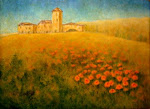
Can’t get to Italy this year? Here’s a “View” of the Chianti Region, and you don’t have to suffer jetlag. This painting can be purchased from my art website:
http://www.PamelaAllegretto-Franz.com
La mia galleria di “Vedute A Portar Via” è una collezione che ho cominciato quando abitavo in Hawaii. Mio studio d’arte è stato in un garage con una piccola finestra sola. Ho pensata dipingere una finestra sul muro, ma ho deciso che sarebbe più practicale dipingere sulla tela, così se cambierò le case potrei portare via “la veduta.” Mi fa piacere che la mia collezione di “Vedute A Portar Via” è diventato molto richiesta. Pare che la gente godono una stanza con veduta, se è reale o un trompe l’oeil. Questi quadri sono tutti dipinto con acrilico su tela, e non ce il bisogno incorniciare siccome i lati sono dipinto a far credibilità al illusione.
Il quadro sopra è una “veduta” del Regione di Chianti. Si può comprarlo al mio sito d’arte:
http://www.PamelaAllegretto-Franz.com
Can’t get to Italy this year? Here’s a “View” of the Chianti Region, and you don’t have to suffer jetlag. This painting can be purchased from my art website:
http://www.PamelaAllegretto-Franz.com
La mia galleria di “Vedute A Portar Via” è una collezione che ho cominciato quando abitavo in Hawaii. Mio studio d’arte è stato in un garage con una piccola finestra sola. Ho pensata dipingere una finestra sul muro, ma ho deciso che sarebbe più practicale dipingere sulla tela, così se cambierò le case potrei portare via “la veduta.” Mi fa piacere che la mia collezione di “Vedute A Portar Via” è diventato molto richiesta. Pare che la gente godono una stanza con veduta, se è reale o un trompe l’oeil. Questi quadri sono tutti dipinto con acrilico su tela, e non ce il bisogno incorniciare siccome i lati sono dipinto a far credibilità al illusione.
Il quadro sopra è una “veduta” del Regione di Chianti. Si può comprarlo al mio sito d’arte:
http://www.PamelaAllegretto-Franz.com
Saturday, March 28, 2009

PAINTING IN ROME / BACK STREETS
My frequent trips throughout Italy persistently spark my urge to paint. Although it’s impossible to resist an occasional Tuscan sun-drenched landscape or turquoise Mediterranean panorama, I’m primarily lured to paint Italy’s diverse architecture.
Rome is a prime example of this diversity.
Certainly when we speak of Rome and architecture, the first buildings that come to mind are Trajan’s Forum, Caracalla’s Baths, the Colosseum, and Hadrian’s Pantheon, just to mention a handful of the heavy hitters. But I like the back streets of Rome.
I like to shop in the back streets, eat in the back streets, and paint in the back streets. This is where life happens. This is where you can guess at the occupations of the inhabitants by their clothes that hang on lines that crisscross the narrow streets and alleyways. A banker’s white shirt might hang just below the street sweeper’s blue uniform. There’s no class system on the clotheslines in the back streets. This is where residents sit on wood and wicker chairs set outside on the sidewalk to discuss politics and exchange recipes, often in the same sentence. They knit, string tomatoes, read, and nap. Take away the TV’s, cell phones, ipods, and Vespas, and their every day lives mirror that of their ancestral Roman and Etruscan forefathers.
In the above painting, the lopsided shades reflect the lifestyles between ancient and modern Rome: diverse yet connected. Limited edition matted prints of this original watercolor can be purchased on my art website:
http://www.PamelaAllegretto-Franz.com
I miei viaggi frequente in tutta l’Italia accendono il mio impulso dipingere. Ogni tanto è impossibile resistere il paesaggio Toscano baciato dal sole o la vista turchese del Mediterraneo, però, principalmente mi attira dipingere l’architettura diversa.
Nell’quadro sopra, le veneziane distorte riflettono gli stili di vita fra l’antica Roma e Roma d’oggi: diversi ma collegato. Si può comprare delle stampe di questa acquerello al mio sito d’arte:
http://www.PamelaAllegretto-Franz.com
Rome is a prime example of this diversity.
Certainly when we speak of Rome and architecture, the first buildings that come to mind are Trajan’s Forum, Caracalla’s Baths, the Colosseum, and Hadrian’s Pantheon, just to mention a handful of the heavy hitters. But I like the back streets of Rome.
I like to shop in the back streets, eat in the back streets, and paint in the back streets. This is where life happens. This is where you can guess at the occupations of the inhabitants by their clothes that hang on lines that crisscross the narrow streets and alleyways. A banker’s white shirt might hang just below the street sweeper’s blue uniform. There’s no class system on the clotheslines in the back streets. This is where residents sit on wood and wicker chairs set outside on the sidewalk to discuss politics and exchange recipes, often in the same sentence. They knit, string tomatoes, read, and nap. Take away the TV’s, cell phones, ipods, and Vespas, and their every day lives mirror that of their ancestral Roman and Etruscan forefathers.
In the above painting, the lopsided shades reflect the lifestyles between ancient and modern Rome: diverse yet connected. Limited edition matted prints of this original watercolor can be purchased on my art website:
http://www.PamelaAllegretto-Franz.com
I miei viaggi frequente in tutta l’Italia accendono il mio impulso dipingere. Ogni tanto è impossibile resistere il paesaggio Toscano baciato dal sole o la vista turchese del Mediterraneo, però, principalmente mi attira dipingere l’architettura diversa.
Nell’quadro sopra, le veneziane distorte riflettono gli stili di vita fra l’antica Roma e Roma d’oggi: diversi ma collegato. Si può comprare delle stampe di questa acquerello al mio sito d’arte:
http://www.PamelaAllegretto-Franz.com
Friday, March 27, 2009
CHIAROSCURO
Chiaroscuro or Chiaro Scuro is Italian for Light/dark. In art it’s used to apply value to a two dimensional piece of artwork to achieve a heightened illusion of depth. In cinematography it’s applied to indicate distinct areas of light and darkness, especially in black and white film. In writing, chiaroscuro refers to a character or story line that shifts seamlessly between luminous moments and dark moods.
In the poem CHIARO SCURO, from the book L’Alba di Domani, by Luciano Somma, Luciano captures the essence of chiaroscuro to portray a delicate scene.
You can find Luciano Somma at:
http://www.partecipiamo.it/Poesie/Luciano_Somma/1.htm
http://www.scolastica2000.it/MUSICALMENTE/somma/somma.htm
Nella Poema, CHIARO SCURO, dal libro L'Alba di Domani, di Luciano Somma, Luciano coglie l’essenza del chiaroscuro a ritrarre una scena delicata.
Si può trovare Luciano Somma a:
http://www.partecipiamo.it/Poesie/Luciano_Somma/1.htm
http://www.scolastica2000.it/MUSICALMENTE/somma/somma.htm
CHIARO SCURO
Filtrano raggi di sole
tra gli alberi del castagneto
giochi di fate e di gnomi
innocenti di danza
profumano vita
nel divenire di memoria
sogno
col chiaro scuro
della mia esistenza.
Luciano Somma
CHIARO SCURO
Rays of sun filter
among the chestnut trees
games of fairies and gnomes
innocents of dance
sweeten life
into becoming a memory
I dream
with the chiaro scuro
of my existence.
(Translation) Pamela Allegretto Franz
In the poem CHIARO SCURO, from the book L’Alba di Domani, by Luciano Somma, Luciano captures the essence of chiaroscuro to portray a delicate scene.
You can find Luciano Somma at:
http://www.partecipiamo.it/Poesie/Luciano_Somma/1.htm
http://www.scolastica2000.it/MUSICALMENTE/somma/somma.htm
Nella Poema, CHIARO SCURO, dal libro L'Alba di Domani, di Luciano Somma, Luciano coglie l’essenza del chiaroscuro a ritrarre una scena delicata.
Si può trovare Luciano Somma a:
http://www.partecipiamo.it/Poesie/Luciano_Somma/1.htm
http://www.scolastica2000.it/MUSICALMENTE/somma/somma.htm
CHIARO SCURO
Filtrano raggi di sole
tra gli alberi del castagneto
giochi di fate e di gnomi
innocenti di danza
profumano vita
nel divenire di memoria
sogno
col chiaro scuro
della mia esistenza.
Luciano Somma
CHIARO SCURO
Rays of sun filter
among the chestnut trees
games of fairies and gnomes
innocents of dance
sweeten life
into becoming a memory
I dream
with the chiaro scuro
of my existence.
(Translation) Pamela Allegretto Franz
Wednesday, March 25, 2009
ITALIAN ARTISTS / CIMABUE & GIOTTO
Certainly, when we think Renaissance we think da Vinci, Michelangelo, Donatello, etc. But those Byzantium rebels, Cimabue and his student, Giotto, are seldom ascribed their proper respect as trailblazers for the Renaissance. What was so special about Cimabue and Giotto?
Cimabue broke with the rigidity of Byzantine Art and expressed, in realistic detail, emotion in his subjects, as opposed to the Church’s symbolic terms. This doesn’t sound like any big deal, but in the days when the Church had a strangle hold on every aspect of the do’s and don’ts of everyday life, believe me, it was one giant step for future artists to follow.
Giotto’s paintings continued to explore Christian themes, but they did so figured with people who walked and talked equally with Christ. This was another big leap toward the Renaissance, when artists began to celebrate “human” feats and accomplishments, not just those of an invisible God.
So let’s tip our hats to Cimabue and Giotto for stepping on more than a few Catholic toes and leading the way to the Renaissance, which is considered the greatest art movement in the history of the world.
The Basilica di San Francesco in Assisi includes frescoes by these two pre-Renaissance giants. Two of the most celebrated frescos are: St Francis Preaching to the Birds, by Giotto, and Virgin and Child, by Cimabue.
Cimabue broke with the rigidity of Byzantine Art and expressed, in realistic detail, emotion in his subjects, as opposed to the Church’s symbolic terms. This doesn’t sound like any big deal, but in the days when the Church had a strangle hold on every aspect of the do’s and don’ts of everyday life, believe me, it was one giant step for future artists to follow.
Giotto’s paintings continued to explore Christian themes, but they did so figured with people who walked and talked equally with Christ. This was another big leap toward the Renaissance, when artists began to celebrate “human” feats and accomplishments, not just those of an invisible God.
So let’s tip our hats to Cimabue and Giotto for stepping on more than a few Catholic toes and leading the way to the Renaissance, which is considered the greatest art movement in the history of the world.
The Basilica di San Francesco in Assisi includes frescoes by these two pre-Renaissance giants. Two of the most celebrated frescos are: St Francis Preaching to the Birds, by Giotto, and Virgin and Child, by Cimabue.
Tuesday, March 24, 2009

WRITING & PAINTING IN ITALY/CORTINA D'AMPEZZO
If you’re looking to get away from cities to do some writing or painting, drive north of Venice into the Dolomiti. Most Americans think of Cortina only as a ski resort. But Cortina lures throngs of nature lovers in the Spring, Summer, and Fall.
Cortina is a great place to collect character studies for both writers and painters. Sit in the piazza and you will see people of every shape and hue.
For landscape artists, Cortina has an overabundance of subject matter: the alpine flowers that blanket the surrounding Dolomiti Mountains are spectacular, as are the nearby alpine lakes that reflect the majestic Dolomiti. The colorful and fanciful Tyrolean architecture, complete with flower-laden window boxes, will make you wonder if you had driven too far north and ended up in Innsbruck.
If you want the best views, take the cable car, Freccia nel Cielo, (Arrow in the Sky). There are three stations where you can get off and have a picnic, write, paint, or daydream. I like to go to the top station, Tofana di Mezzo, at 10,543 feet. From Tofana on a clear day, you can see as far as Venice.
If you go, even in summer the weather at the top can be brisk, so bring a sweater or jacket, along with water and snacks if you plan to linger for a while. If you’re an artist, pack your supplies as light as possible.
The painting above is a house outside Cortina. We spotted the house on a previous visit and for some reason, I can’t remember what, I didn’t stop to sketch it or photograph it. The house remained in my mind, and so a year later we returned to Cortina and I photographed this little jewel and later painted it in watercolor. The painting and a few limited edition prints are for sale on my art website:
http://www.pamelaallegretto-franz.com/
Buon Viaggio
Cortina is a great place to collect character studies for both writers and painters. Sit in the piazza and you will see people of every shape and hue.
For landscape artists, Cortina has an overabundance of subject matter: the alpine flowers that blanket the surrounding Dolomiti Mountains are spectacular, as are the nearby alpine lakes that reflect the majestic Dolomiti. The colorful and fanciful Tyrolean architecture, complete with flower-laden window boxes, will make you wonder if you had driven too far north and ended up in Innsbruck.
If you want the best views, take the cable car, Freccia nel Cielo, (Arrow in the Sky). There are three stations where you can get off and have a picnic, write, paint, or daydream. I like to go to the top station, Tofana di Mezzo, at 10,543 feet. From Tofana on a clear day, you can see as far as Venice.
If you go, even in summer the weather at the top can be brisk, so bring a sweater or jacket, along with water and snacks if you plan to linger for a while. If you’re an artist, pack your supplies as light as possible.
The painting above is a house outside Cortina. We spotted the house on a previous visit and for some reason, I can’t remember what, I didn’t stop to sketch it or photograph it. The house remained in my mind, and so a year later we returned to Cortina and I photographed this little jewel and later painted it in watercolor. The painting and a few limited edition prints are for sale on my art website:
http://www.pamelaallegretto-franz.com/
Buon Viaggio
Monday, March 23, 2009
ITALIAN PROVERB/BREAD
Here’s another food-related Italian proverb:
"Il Pane diviso è la salute dei denti. "
The literal translation is: "Bread that’s broken into pieces is healthy for the teeth."
So are they advocating eating bread to prevent cavities? Maybe only bread broken into pieces prevents cavities, while biting into a larger piece of bread or a slice of bread might be harmful to your teeth. Those of you who have read earlier posts I’ve written regarding Italian proverbs and food, know that the proverb has nothing to do with bread or any other starch. Well then, that leaves newlyweds. Newlyweds? Sure, why not? If newlyweds break their bread into pieces will they or their future children have healthy teeth? Not likely, but what if newlyweds live apart (like breaking bread into pieces) from parents and in-laws? Since bread is considered the "staff of life," and since parents and in-laws "create life," then the proverb means: "A separate household for the newlyweds prevents quarrels."
"Il Pane diviso è la salute dei denti. "
The literal translation is: "Bread that’s broken into pieces is healthy for the teeth."
So are they advocating eating bread to prevent cavities? Maybe only bread broken into pieces prevents cavities, while biting into a larger piece of bread or a slice of bread might be harmful to your teeth. Those of you who have read earlier posts I’ve written regarding Italian proverbs and food, know that the proverb has nothing to do with bread or any other starch. Well then, that leaves newlyweds. Newlyweds? Sure, why not? If newlyweds break their bread into pieces will they or their future children have healthy teeth? Not likely, but what if newlyweds live apart (like breaking bread into pieces) from parents and in-laws? Since bread is considered the "staff of life," and since parents and in-laws "create life," then the proverb means: "A separate household for the newlyweds prevents quarrels."
Sunday, March 22, 2009
WRITING GROUPS / PAINTING GROUPS
Writing groups and painting groups share the same goals: to improve your work. A good writing group doesn’t take time to edit spelling, comas, and semi-colons. Briefly, their job is to read your work and determine: if your characters are interesting and believable, if your plot moves forward, if your style suits the content, if a phrase or paragraph interrupts the suspension of disbelief, and if there is a cohesive beginning, middle, and end.
Artists in a good painting group don’t impose their individual style or medium. Their job is to study your painting and determine: are your color values correct, is you placement appealing, do you have a pathway leading the eye into, around, and out of the painting, and are your shadows as dark as they need to be and appropriately positioned.
These are just a few of many responsibilities of good writing and painting groups. I highlighted the ones I feel should be at the top of each list to illustrate the correlation between the two.
A good group that offers a positive, constructive critique can be invaluable to a writer or an artist. A group that focuses only on the negative should be written out of your script or painted out of your canvas.
Artists in a good painting group don’t impose their individual style or medium. Their job is to study your painting and determine: are your color values correct, is you placement appealing, do you have a pathway leading the eye into, around, and out of the painting, and are your shadows as dark as they need to be and appropriately positioned.
These are just a few of many responsibilities of good writing and painting groups. I highlighted the ones I feel should be at the top of each list to illustrate the correlation between the two.
A good group that offers a positive, constructive critique can be invaluable to a writer or an artist. A group that focuses only on the negative should be written out of your script or painted out of your canvas.
Saturday, March 21, 2009
WRITING IN ITALY/BASILICATA
Yesterday I wrote about painting in the Basilicata region. I’d like to suggest that it’s also an area that has enlightened numerous well-known authors. I already mentioned Carlo Levi and his stirring narrative: Christ Stopped At Eboli. It was his painting and his writing that carried him through the hardships during his exile in this primitive and desolate land. Another author who lived and worked in the region and wrote vividly about the landscape, people, and customs is, Ann Cornelisen. Two of her books in particular: Women Of The Shadows and Torregreca: Life, Death, And Miracles In A Southern Italian Village, are stand out examples of a writer who allows all five senses to guide her prose. In one review she wrote: “The south is still not for the easily discouraged. It is for those who can imagine living in another time, who can believe, even for a moment, in the mirage world created by light so piercing that it sears the eyes.”
Basilicata may have to take a backseat to Rome, Florence, and Venice, but don’t through it out of the car. Take the car, your Italian dictionary (very little, if any, English is spoken in most of the smaller villages), pen and paper, paints and canvas, and a strong sense of adventure, and travel south to chronicle for yourself this unique region and its engaging people.
Buon Viaggio!
Basilicata may have to take a backseat to Rome, Florence, and Venice, but don’t through it out of the car. Take the car, your Italian dictionary (very little, if any, English is spoken in most of the smaller villages), pen and paper, paints and canvas, and a strong sense of adventure, and travel south to chronicle for yourself this unique region and its engaging people.
Buon Viaggio!
Friday, March 20, 2009

PAINTING IN ITALY/BASILICATA
For those adventurous artists who have squeezed the last drop from your yellow ochre and burnt sienna while painting Tuscan sunrises and sunsets, head south. I’m not talking Rome or Naples or Salerno, I mean the Deep South that Carlo Levi wrote about in Christ Stopped At Eboli.
In 1935, The Fascists exiled Levi to this region as a political prisoner. For those unfamiliar with this book, it has nothing to do with religion or Christ making a weekend get-away to the Basilicata region. It refers to the idea that if Christ was traveling south in Italy and doing his Godly thing along the way, then he stopped when he reached Eboli. Levi wrote : “upon my arrival, the peasants said, ‘we are not Christians, Christ stopped short of here, at Eboli.’ Christian, in their way of speaking meant human being.” This “God-forsaken" region remains today a land outside time.
So, what do I like about this earthy and primeval region? Just that. It’s earthy and primitive. And the architecture is fun and challenging to paint.
In addition to being an accomplished writer, Carlo Levi was also a doctor and a gifted painter. If you go, don’t miss the Carlo Levi Gallery in Matera, where on exhibit you’ll find some thirty or more of his oil paintings, all of them portraying scenes from Basilicata life.
I recommend traveling by car, as some of the smaller villages are without rail stations. There is a respectable bus service, but in some cases you have to transfer 3 or 4 times to get to one village. If you drive, give the right-of-way to the donkeys that are burdened with bushels of firewood and clip clop down the cobblestone streets.
The painting above is a watercolor that can be viewed at my website: http://www.pamelaallegretto-franz.com/
Buon Viaggio!
In 1935, The Fascists exiled Levi to this region as a political prisoner. For those unfamiliar with this book, it has nothing to do with religion or Christ making a weekend get-away to the Basilicata region. It refers to the idea that if Christ was traveling south in Italy and doing his Godly thing along the way, then he stopped when he reached Eboli. Levi wrote : “upon my arrival, the peasants said, ‘we are not Christians, Christ stopped short of here, at Eboli.’ Christian, in their way of speaking meant human being.” This “God-forsaken" region remains today a land outside time.
So, what do I like about this earthy and primeval region? Just that. It’s earthy and primitive. And the architecture is fun and challenging to paint.
In addition to being an accomplished writer, Carlo Levi was also a doctor and a gifted painter. If you go, don’t miss the Carlo Levi Gallery in Matera, where on exhibit you’ll find some thirty or more of his oil paintings, all of them portraying scenes from Basilicata life.
I recommend traveling by car, as some of the smaller villages are without rail stations. There is a respectable bus service, but in some cases you have to transfer 3 or 4 times to get to one village. If you drive, give the right-of-way to the donkeys that are burdened with bushels of firewood and clip clop down the cobblestone streets.
The painting above is a watercolor that can be viewed at my website: http://www.pamelaallegretto-franz.com/
Buon Viaggio!
Thursday, March 19, 2009
ITALIAN PROVERB/PEARS
I like this little Italian proverb: “La pera matura cade sola.” The English translation is simple: “The mature pear falls by itself.” But what are we really talking about here? Pears? Fruit? Trees? Is there a lesson to be learned about not getting out the ladder and climbing the tree to pick pears? Is this telling us not to risk injury for a lousy pear? Should we shake the tree to get the pears to fall? What if pears are out of season? What if we don’t like pears is the proverb still viable? Forget the pears. This proverb has nothing to do with pears. Italians hold food in high regard, and thus you’ll find food in many of their proverbs. Check back to my Monday blog on soup, as another example of how Italians utilize food in their proverbs. So what does “La pera matura cade sola” really mean? “Everything in its own time.”
Wednesday, March 18, 2009

STILL LIFE WORKSHOP/ROMAN TABLE
ROMAN TABLE
I recently completed the above still life painting in my winter art workshop conducted by Elizabeth Sennett. Once again, her expert advice saved me from pulling the cloth out from under the pears and pitching the lot into the trash heap. In my opinion, anyone who says that the more you paint, the easier it gets, is living on another planet. You can view this painting in the Trompe L'oeil Gallery on my website at: http://www.pamelaallegretto-franz.com/
Mi piacciono tanto i colori in questo quadro che ho dipinto nella classe di “Still Life” con la maestra Elizabeth Sennett. Senza la sua direzione, avrei gettato il quadro nel bidone della spazzatura. Secondo me, chiunque che dice che con ogni quadro che dipinge diventerà più facile, abita su un altro pianeta. Si puo` vedere il quadro nella galleria di Trompe L'oeil sul mio website:
http://www.pamelaallegretto-franz.com/
I recently completed the above still life painting in my winter art workshop conducted by Elizabeth Sennett. Once again, her expert advice saved me from pulling the cloth out from under the pears and pitching the lot into the trash heap. In my opinion, anyone who says that the more you paint, the easier it gets, is living on another planet. You can view this painting in the Trompe L'oeil Gallery on my website at: http://www.pamelaallegretto-franz.com/
Mi piacciono tanto i colori in questo quadro che ho dipinto nella classe di “Still Life” con la maestra Elizabeth Sennett. Senza la sua direzione, avrei gettato il quadro nel bidone della spazzatura. Secondo me, chiunque che dice che con ogni quadro che dipinge diventerà più facile, abita su un altro pianeta. Si puo` vedere il quadro nella galleria di Trompe L'oeil sul mio website:
http://www.pamelaallegretto-franz.com/
Tuesday, March 17, 2009

PAINTING IN ALBEROBELLO
Artists who relish painting the diverse Italian architecture and want to step into the pages of a children’s fairytale, should venture to Alberobello in the Deep South near Bari on the Adriatic side, (heel) of the country. The villagers are especially gracious to artists who sit with sketchpads or set up easels in the maze of cobblestone streets that curve through Italy’s most magical village. There are more than 1,000 beehive-shaped trulli, some dating back to the 13th century. These unique limestone structures with conical roofs promise to not disappoint any artist eager to capture a sliver of fantasy on his or her canvas.
Hotels in Alberobello are limited, so either book in advance, or plan to stay in nearby Bari or Taranto. Transportaion? I highly recommend renting a car, but train service is available from Bari.
The painting above is an example of a “Trullo” that I painted in watercolor. The original and limited edition prints can be found on my website:
http://www.pamelaallegretto-franz.com/
Buon Viaggio
Hotels in Alberobello are limited, so either book in advance, or plan to stay in nearby Bari or Taranto. Transportaion? I highly recommend renting a car, but train service is available from Bari.
The painting above is an example of a “Trullo” that I painted in watercolor. The original and limited edition prints can be found on my website:
http://www.pamelaallegretto-franz.com/
Buon Viaggio
Subscribe to:
Comments (Atom)