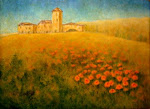
Welcome

Many artists dream about painting in Italy. Now, as retiring baby-boomers are increasingly taking up “brush and pallet knife,” more than ever, painting in Italy is the “thing.” Every day, a new “Artist’s” tour of Italy crops up in travel sections of the newspaper and on the Internet. But there still remains a majority of artists who prefer to “go it alone.” They are independent in their artistic styles, and prefer to be independent regarding their travels in Italy . This blog intends to target these free spirited artists who still need guidance to the best places to paint, especially those idyllic gems that are little known and less traveled. Certainly, independent travelers who are not artists will also benefit from this blog.

With a few exceptions, this blog is not a guide to restaurants, lodging, rental cars, or shopping, (except for art supplies.)

Sprinkled among the posts are: my paintings, and a few Italian proverbs and poems written by notable Italian authors for whom I work as a translator.


Please visit my website to view my original art:

http://www.pamelaallegretto-franz.com/

Giclee prints of my paintings, ranging from greeting size to poster size, can be purchased at:

http://pamela-allegretto.fineartamerica.com/


Sunday, November 28, 2010

KEV MOORE / BLUE ODYSSEY

Posted by Picasa

BLUE ODYSSEY / KEV MOORE

While I’ve been busy traveling to and writing about Italy, my good friend from the UK, Kev Moore, recently completed a two-month journey through the southern states of the U.S. His goal: seek out and be inspired by the music heartland of America and then return to his home in Spain and compose a killer music CD.
Kev’s CD: Blue Odyssey, is a masterful blend of jazz, blues, rock, soul, and even gospel. Kev not only captured the heart of the music heartland, he seized its soul.
I recommend checking out Kev’s website: http://mooremusic.biz to learn more about his journey and to find out how to purchase this amazing CD.
While Kev jammed with jazz and blues greats in New Orleans and Nashville, his partner, French artist Miki, sketched and painted these southern music legends. You can see her wonderful music paintings at: http://www.paintingthemusic.com

Friday, November 19, 2010

Bongo Man

Posted by Picasa

Bongo Man

This painting above has nothing to do with painting in Italy but it is all about my love for music and bold colors. You can veiw the original acrylic on canvas painting on my website: http://www.pamelaallegretto-franz.com/ or purchase a giclee print at: http://pamela-allegretto.fineartamerica.com/ Other music paintings can be viewed at: http://www.paintingthemusic.com Questo quadro mostra mio passione dei colori vivaci e la musica. Si puo` vedere il quadro originale dipinto con acrilico sul mio website: http://www.pamelaallegretto-franz.com/ Oppure si puo` comprare delle stampe a: http://pamela-allegretto.fineartamerica.com/

Wednesday, November 10, 2010

PAINTING IN ITALY / TUSCANY / SAN MINIATO

If you’re driving from Florence to Pisa, plan to stop and set up your easel for a few hours at San Miniato, which is about midway between these two popular cities.
Climb the hill from the Prato Del Duomo, (wear sensible shoes, no flip-flops), the vistas are outstanding, and on clear days the view extends from the hills of Fiesole to the sea, and from the Apuan Alps to the cliffs of Volterra. You can set up next to the tower, which is a post-WW2 reconstruction of the last remnant of a fort Emperor Frederick II built in 1240. How’s that for “Painting on Location?”
Bread, cheese, prosciuto, fruit, water, and wine are available in town if you want to enjoy a Tuscan-style picnic while you paint. Try to catch either a sunrise or sunset; you will not be disappointed.
As usual, pack smart (translation = pack light).
San Miniato has an exciting and colorful Kite-flying festival the first Sunday after Easter. If you are in Tuscany during the Easter time, you should make a point to catch this event. At that time of the year he countryside is ablaze in spring colors which add to the vibrant colored kites.
Buon Viaggio!

Monday, November 8, 2010

PAINTING IN ITALY / TUSCANY / VERSILIA / CARRARA / VIAREGGIO

In addition to the Alpi Apuane, there are various other reasons to visit the Riviera Della Versilia. One reason is the beach resorts that run unbroken between Viareggio and Forte dei Marmi. Much of the sand is leased to various hotels and establishments who rent out chairs and umbrellas. But you needn’t be sucked in; there are numerous public access areas where you can sit and paint seascapes all day without paying rent on a lounge chair.
My favorite town for people watching and sketching is Viareggio. Passeggiata Margherita, the long, palm lined seafront promenade presents an air of elegance without being pretentious. Numerous bars and restaurants offer outdoor seating. For the price of an espresso or limonata, you can sit undisturbed for hours and sketch or paint.
I don’t often recommend restaurants, but here I will make an exception. Grab a bite in the pergola at Ristorante Michele. While you’re enjoying your meal, you can sketch or painting the vine-choked trellises that enclose the patio and hover overhead. If you have one too many glasses of their marvelous, and cheap, house wine, you may envision the broad twisted vines as tree snakes, threatening to drop into your minestrone. Now there’s a great idea for a painting.
Certainly, you can’t possibly be in the area without a trip to Carrara, the “Marble Capital.” Set in the hills, the town offers many prime locations to set up and paint, not only the excellent seascapes below, but also the town itself. Peeling pastel stucco houses and side streets lined with green shutters make excellent subjects.
And then of course there are the marble quarries. One of the more accessible is the site at Colonnata, the Cave di Colonnata. If you’re driving, follow the yellow signs from town up to the twisting road. Don’t worry; you can’t miss it. You’ll see a huge, blindingly white marble basin. It’s floor and sides are perfectly squared by the enormous wire saws used to cut the blocks that are scattered about.
Michelangelo spent eight months in Carrara. So while you’re setting up to paint in the village, on the convenient outlooks to the sea, or at the quarry, you’re likely to be standing in a spot where Michelangelo stood to contemplate his next sculpture or to chose his next block of marble. Does it get any better than that?
Buon Viaggio!

Sunday, November 7, 2010

PAINTING IN ITALY/TUSCANY/VERSILIA/ALPI APUANE

On the northern coast of Tuscany, the Alpi Apuane Mountains dominate the Riviera della Versilia. Well-marked footpaths that offer huge rewards for plein air artists crisscross the mountains, a forty-kilometer span of indisputably alpine spectacle.
Due to their location and elevation, the Apuane are an ideal blend of assorted ecological habitats, from tundra through Alpine meadow to Mediterranean grassland. An extraordinary assortment of wildflowers makes this one of the country’s richest botanic enclaves. However, the most noticeable vegetation is the vast forest of chestnut and beech, which cover nearly all the lower slopes. These trees offer shelter to many of the mountains’ three hundred species of birds. (If you like to paint birds, you may never want to climb down from this mountain.)
The main approach to the northern group of peaks is from Levigliani. Detailed trail maps are available in town. Be sure to pick one up before you head out. The best-detailed and easiest to read is the Multigraphic-Wanderkarte. Trails #9 and #126 are the most popular and have well-situated clearings for setting up to sketch and paint.
Stazzema is the best access to the southern peaks and trail #5, which is a gentle climb (the best type of climb in my mind) through chestnut woods to the Procinto, a huge tabletop crag mention by Dante. Of all the walks, I prefer this Procinto walk; not only because it’s an easy walk, which is helpful when you’re toting art supplies and food and water, but it allows time to walk up Monte Nona, have a picnic lunch and paint some out-of-this-world scenery, and return to Stazzema in time to view the sunset from an outdoor café` in the town’s charming piazza.
Even though the Alpi Apuane are on the cusp of the Versilia Riviera, don’t think the temperature will be the same. At first, it may feel like a cool relief from the blazing beach, but it can cool down quickly, so never venture up into these mountains without a jacket on hand, ditto, water and snacks.
As always, carry out what you carry in. Your reward will be the opportunity to paint scenery that few artists have the chance to paint. And the icing on the cake: Michelangelo hiked some of these same trails while visiting Carrara to select marble for his David!
Buon Viaggio!

Saturday, October 9, 2010

Jazz Drummer

Posted by Picasa

Jazz Drummer

This painting is all about my love for music and bold colors. You can veiw the original acrylic on canvas painting on my website: http://www.PamelaAllegretto-Franz.com or purchase a giclee print at: http://pamela-allegretto.fineartamerica.comQuesto quadro mostra mio passione dei colori vivaci e la musica. Si puo` vedere il quadro originale dipinto con acrilico sul mio website: http://www.PamelaAllegretto-Franz.com Oppure si puo` comprare delle stampe a: http://pamela-allegretto.fineartamerica.com

Friday, October 1, 2010

To Market

Posted by Picasa

To Market

This painting is all about bold island colors. You can veiw the original acrylic on canvas painting on my website: http://www.PamelaAllegretto-Franz.com or purchase a giclee print at: http://pamela-allegretto.fineartamerica.com
Questo quadro mostra mio passione dei colori vivaci. Si puo` vedere il quadro originale dipinto con acrilico sul mio website: http://www.PamelaAllegretto-Franz.com Oppure si puo` comprare delle stampe a: http://pamela-allegretto.fineartamerica.com

Piano Man

Posted by Picasa

Piano Man

This is Guido, one hot pianista. He rocks Jazz and wails the Blues on his funky purple piano. You can veiw this original 20"x20" acrylic on canvas painting on my website: http://www.PamelaAllegretto-Franz.com or purchase a giclee print at: http://pamela-allegretto.fineartamerica.com
Ecco Guido. Lui suona il Jazz con brio sul pioanoforte violetto. Si puo` vedere il quadro originale dipinto con acrilico sul mio website: http://www.PamelaAllegretto-Franz.com Oppure si puo` comprare delle stampe a: http://pamela-allegretto.fineartamerica.com

Thursday, July 8, 2010

PAINTING IN ITALY / TUSCANY / PISA

Certainly if you’re an artist who enjoys painting architecture, Pisa should not be missed. The Campo dei Miracoli (Field of Miracles) is as spectacular today as it must have been to medieval visitors. The Duomo, Bell Tower, and Baptistery are set within a vast, meticulously manicured lawn that entices artists to set up and spend a few hours painting. If you’re a true-to-life, detailed artist, don’t get frustrated if what you see doesn’t jive in your over-analytical brain; don’t accuse your t-square of playing tricks on you; and don’t blame that second glass of wine you drank at lunch: not only does the Leaning Tower “lean,” but the Baptistery is inclined out of the vertical and the façade of the Duomo is also a few degrees out of true.
Before you leave the Campo dei Miracoli, you must take time to visit each of these magnificent buildings and definitely take time to visit Camposanto, which Ruskin described as one of the three most precious buildings in Italy, along with the Sistine Chapel and the Scuola di San Rocco in Venice. It wasn’t its tombs but rather its frescos that he praised. Unfortunately, in July of 1944, Allied planes dropped incendiary bombs that set the roof on fire and drenched the 2000 square meters of frescos in a river of molten lead. Fortunately, a few patches of the magnificent frescos remain, including works by Maestro del Trionfo della Morte (Master of the Triumph of Death); which have been detached from the wall and put on exhibit in a room opposite the entrance. Also at the entrance is a photographic display of the Camposanto before the bombing.
On the south side of the Campo, sandwiched between the tourist stalls, you’ll find the Museo delle Sinopie. I love this high-tech museum. After the Allies bombed the Camposanto, the building’s restorers removed its sinopie, the monochrome sketches for the frescos. These great plaster plates are now hung from the walls of the Museo delle Sinopie, where you have the opportunity to inspect up close the painter’s preliminary ideas.
Don’t leave Pisa until you’ve visited and sketched all “three” leaning towers. The 2nd leaning tower is at the end of Via Santa Maria. It’s the 13th century campanile of San Nicola. The base is cylindrical and changes into an octagon and then a hexagon. Inside, take a peek at the paintings by Nino and Giovanni Pisano. You can get to the 3rd leaning tower, the campanile of San Michele dei Scalzi, by walking along the riverbank upstream from Ponte di Mezzo. Everything in this building is severely out of kilter: the columns in the nave tilt this way and that, the windows in the apse are every which way but loose, and the walls set up a dizzy contrast to the tilt of the tower.
After your brain has maxed out on the crooked, tilted, and leaning don't despair, like Florence, Pisa has its Lungarno that boasts a splendid line of riverside palaces that will please every “t-square” enthusiast.
BUON VIAGGIO!

Sunday, July 4, 2010

PAINTING IN ITALY / TUSCANY / ISOLA D'ELBA

The island of Elba is a favorite among European travelers and Germans in particular. But for some reason it hasn’t yet caught on with Americans. Although it’s the third largest Italian island after Sicily and Sardinia, until about thirty years ago it was known mostly for its mineral resources (it was Elban iron in the Roman swords that conquered an empire), and as Napoleon’s place of exile. Oh, what a difference thirty years can make. Now tourists choke the island from the first of June until the first of September, with August being the most popular month. But if you can go in May or September, when the hotels and restaurants are open but the tourist traffic is down, you’ll understand why Napoleon never bemoaned being in exile.
To get there, take one of the car ferries (Toremar or Novarma) from the port at Piombino. I recommend booking in advance. When you get to the docks, you’ll see their offices. Once inside, you may be lucky and get right up to the counter, or you may walk into a crowd. If you encounter the latter, don’t be shy. The crowd is really what the Italians call a line, and if you aren’t aggressive and nudge your way to the front, you may miss the boat, (literally).
The car ferries are an ideal location for capturing on canvas the mainland and island shorelines from a sea perspective. I recommend debarking at Portoferraio, the most popular debarkation point on the island.
Before you leave Portoferraio to explore all the amazing vistas the island has to offer, take a walk up Via Garibaldi to visit Napoleon’s home in exile, the Villa dei Mulini. The villa was built especially for the ex-emperor on a site chosen for its killer views of the bay. There are multiple sites at the villa where you can set up and paint.
Elba’s landscape is rich and varied, featuring deep gulfs and long headlands. The coastline combines high, sheer cliffs, gentle bays with pebble beaches, or broad expanses of sand as white and fine as talcum powder. On the southern slops, cactus plants show that this is a Mediterranean climate; while to the east you’ll find vine-covered hills.
The water around the island is crystal clear and the most beautiful color of blue you will ever see. From the mountainous interior, Monte Capanne in particular, the views will take your breath away. Bus service is excellent, but you’ll be glad you have a car, so you can slip in and out of those out-of-the-way side roads that zigzag here and there, leading to ideal clearings to set up and paint or sketch.
You don’t want to miss west-facing Bagnaia, off the road to Rio nell’Elba, It’s famous for its sunsets and rightly so. You’ll see shades or reds, purples, oranges, and yellows that you’ve never seen before. If you have the fortitude to drive the coiling road beyond, the twin mini hamlets of Nisporto and Nisportino mark the beginning of the most unspoiled beaches and coastline on Elba’s north shore. You can hike into the hills behind, where you’ll find tiny clearings just right for setting up an easel.
If at all possible, plan to spend at least three days painting on Elba. If it’s three, you’ll wish it were four. If it’s four, you’ll wish it was five, etc., etc. In other words, once you arrive on Elba, you’ll wish you were sent there to spend time in exile.
BUON VIAGGIO!!!

Thursday, June 24, 2010

PAINTING IN ITALY / TUSCANY / VAL D'ORCIA

Posted by Picasa

PAINTING IN ITALY / TUSCANY / VAL D'ORCIA

If you’re searching for medieval villages to paint, set aside several days and drive south of Siena to the hill towns of Montalcino, Montepulciano, and Montecchiello. These hilltop villages in the Val d’Orcia offer innumerable vistas in all directions. If it’s medieval architecture that intrigues you, each village is replete with Renaissance palaces and steep cobblestone alleys that run beneath vaults and arches.
In this region, my favorite spot to lay down my brush at the end of the day is the Castello di Ripa d’Orcia. Ripa d’Orcia is a medieval hamlet that has remained just as it was during the Middle Ages. To get there, leave the road at San Quirico (you’ll see a road sign) and drive into the countryside for about 5 kilometers. The road isn’t in the best condition but the Castello makes the bone-jangling ride worthwhile when you see it rising up from behind a wall of cypress trees. The Castello offers 6 rooms and 7 apartments, each with a view guaranteed to knock your socks off. If you decide to stay here, I recommend drinking a large brandy at bedtime and sleeping with earplugs so the “otherworldly” moans and groans and footsteps across the room don’t scare your socks off.
Buon Viaggio!

While driving through Italy’s Val D’Orcia region, we spied the cart in the above painting overflowing with flowers, the colors of which mirrored the explosive sunset. Or was it the other way around? Hmmm... A limited number of 8”x10” matted prints of this original acrylic on 140-pound watercolor paper can be purchased from my art website:
http://www.PamelaAllegretto-Franz.com

Val D’Orcia:
Nel regione di Val D’Orcia, ho visto la scena nel disegno sopra, dove il tramonto si specchia nei fiori. Oppure, i fiori si specchiano nel tramonte? Hmmm... L’originale di acrilico è nella collezione d’artista. Si può comprarne delle stampe di 21x26cm al mio website d’arte:
http://www.PamelaAllegretto-Franz.com

Wednesday, June 9, 2010

PAINTING IN ITALY / TUSCANY / MONTE ARGENTARIO

If you yearn to spend time on an island but boats make you sea sick and you can’t figure out how to swim and carry your easel, canvas, and paints at the same time, then don’t despair, Tuscany has an island you can drive to: Monte Argentario. This peninsula is connected with the mainland by three dams which form two lagoons, the Laguna di Ponente on the west side and the Laguna di Levante on the east side of the middle dam. The promontory was an island in the past, but the sea currents and the Albegna River joined it with the mainland through two tomboli (sand spits, stretches of land), The Tombolo of Giannella and the Tombolo of the Feniglia.
The two main villages on Monte Argentario are Porto Santo Stefano, facing north, and Porto Ercole facing south. Drive the Strada Panoramica, which starts in Porto Santo Stefano and runs along the coast. From here there are several pull-off points where you can paint sea and mainland coastal views in addition to the fabulous views of the Tuscan Archipelago (Isola di Giglio and Isola di Giannutri). At one time, Monte Argentario was a part of this Tuscan Archipelago until this island that’s not really an island used to be an island.
Porto Santo Stefano is charming, but a bit touristy. If you enjoy painting boats and harbors, a few fishing boats still huddle in the town’s smaller harbor, while mega–yachts now choke the main port. There are many waterfront bars where for the price of a limonata or a glass of beer, you can sit and paint for hours without a hassle from the waiter. Although when you do pack it in, don’t stiff the help. Come on, no one’s going to believe that if you can spring for airfare and a rental car you can’t afford to leave a decent tip.
My preference is Porto Ercole, with its charming old quarter and a more authentic fishing-village atmosphere. Although the Romans founded it, the principal historical monuments are two Spanish fortresses, Forte Filippo and Forte Stella, which face each other on opposing sides of the harbor. Most days you will see artists set up along the docks, painting the fortresses, or the weathered fishing boats, or the quaint village from a sea vantage point. My favorite part of town to paint is the lower town (old town), where steep flights of steps are cut into rock, with low arches and dark passages that end with breathtaking views of the turquoise Mediterranean Sea.
At the entrance to the old town, look for a plaque on the stone gate that commemorates Caravaggio, who in 1610 keeled over with sunstroke on a nearby beach, taken to a local tavern, and soon after died of a fever. He’s buried in the parish church of Sant’Ersmo. I guess he should have stuck to painting in Venice.
Take a drive up to the summit, Punta Telegrafo (635m). Coming from the sandy beaches and fishing ports, this interior portion is an unexpected mix of mountainous terrain and the 360-degree views are spectacular.
Avoid going to Monte Argentario on weekends, since the access is limited, traffic jam are typical. If you plan to stay for a few days, which I highly recommend, book a room early if you’re going during the summer months.
Buon Viaggio!

Wednesday, May 26, 2010

PAITNING IN ITALY / TUSCANY / CHIANTI REGION / SAN FEDELE

The Chianti Region in Italy runs along the state highway SS222 between Florence and Siena. The Chianti Region not only boasts rolling hills and mountain top villages, but a wealth of castles. Some of the towns to look for:
Verrazzano (You might recognize the name as Giovanni "da" Verrazzano discovered the NY Harbor and the Island of Manhattan. The Verrazzano Bridge that runs to Staten Island was named after him.) Castello di Verrazzano, Giovanni’s birthplace is an ideal location to set up an easel, (just make sure to ask permission first). If you get thirsty while painting, you can sample and buy wine here.
The medieval town of Greve, which is the capital of Chianti, is one of the more colorful towns in Tuscany. Set up your easel in the Piazza del Mercatale and have a blast painting and smoozing with art-loving locals.
If painting gardens is your forte, don’t miss Vignamaggio where you’ll find the Renaissance villa that was once the home of La Gioconda, who sat for Da Vinci’s Mona Lisa. The gardens, replete with classical stautes and towering hedges, were featured in Kenneth Branagh’s film, Much Ado About Nothing.
If painting architecture is your preference, visit Castellina in Chianti. This hilltop village still has its fortified walls intact with little houses constructed into the walls and nesting on top of them.
Don’t let the seemingly tortuous, winding roads keep you from setting up in the village of Radda in Chianti. The main piazza is an ideal location to capture on canvas a village unchanged from the Middle Ages.
I have only touched on a small number of villages in this Chianti Region that are worthy of a painting outing; certainly there are many other villages: Badia a Coltibuono, San Sano, Castello di Brolio, and Gaiole, to name a few more.
Don’t forget to always take out what you bring in when painting en plein air. Not all open space is public land; so whenever you’re in doubt, ask first before setting up; trespassing is against the law and fines can be steep. I’ve never know an artist who’s been turned off private land when they asked permission first.
If you would rather not travel up and down the boot and prefer to concentrate your Italian painting experience in one region, then you may be interested in checking out The Tuscan Renaissance Center at Borgo San Fedele. This ex-monastery dating back to the 12th century is situated in the Chianti hills, 12km north of Siena. Owners Nicolò and Renata, lovingly restored San Fedele, spending six years to its resurrection. They employed traditional Tuscan building methods and used all original building materials to restore, rather than refurbish the structure.
The views from the large terrace are outstanding, the architecture unique, and the gardens are impeccably maintained. You can even enjoy a refreshing dip in the outdoor pool after a day at the easel.
For complete information on San Fedele, including help with hosting an artist’s workshop or how to sign up for the many exceptional artist’s workshops that are listed on their website, visit:
http://www.tuscanrc.com

http://www.borgosanfedele.com

BUON VIAGGIO!