

 Posts


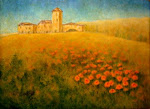
The Chianti Region in Italy runs along the state highway SS222 between Florence and Siena. The Chianti Region not only boasts rolling hills and mountain top villages, but a wealth of castles. Some of the towns to look for:
Verrazzano (You might recognize the name as Giovanni "da" Verrazzano discovered the NY Harbor and the Island of Manhattan. The Verrazzano Bridge that runs to Staten Island was named after him.) Castello di Verrazzano, Giovanni’s birthplace is an ideal location to set up an easel, (just make sure to ask permission first). If you get thirsty while painting, you can sample and buy wine here.
The medieval town of Greve, which is the capital of Chianti, is one of the more colorful towns in Tuscany. Set up your easel in the Piazza del Mercatale and have a blast painting and smoozing with art-loving locals.
If painting gardens is your forte, don’t miss Vignamaggio where you’ll find the Renaissance villa that was once the home of La Gioconda, who sat for Da Vinci’s Mona Lisa. The gardens, replete with classical stautes and towering hedges, were featured in Kenneth Branagh’s film, Much Ado About Nothing.
If painting architecture is your preference, visit Castellina in Chianti. This hilltop village still has its fortified walls intact with little houses constructed into the walls and nesting on top of them.
Don’t let the seemingly tortuous, winding roads keep you from setting up in the village of Radda in Chianti. The main piazza is an ideal location to capture on canvas a village unchanged from the Middle Ages.
I have only touched on a small number of villages in this Chianti Region that are worthy of a painting outing; certainly there are many other villages: Badia a Coltibuono, San Sano, Castello di Brolio, and Gaiole, to name a few more.
Don’t forget to always take out what you bring in when painting en plein air. Not all open space is public land; so whenever you’re in doubt, ask first before setting up; trespassing is against the law and fines can be steep. I’ve never know an artist who’s been turned off private land when they asked permission first.
If you would rather not travel up and down the boot and prefer to concentrate your Italian painting experience in one region, then you may be interested in checking out The Tuscan Renaissance Center at Borgo San Fedele. This ex-monastery dating back to the 12th century is situated in the Chianti hills, 12km north of Siena. Owners Nicolò and Renata, lovingly restored San Fedele, spending six years to its resurrection. They employed traditional Tuscan building methods and used all original building materials to restore, rather than refurbish the structure.
The views from the large terrace are outstanding, the architecture unique, and the gardens are impeccably maintained. You can even enjoy a refreshing dip in the outdoor pool after a day at the easel.
For complete information on San Fedele, including help with hosting an artist’s workshop or how to sign up for the many exceptional artist’s workshops that are listed on their website, visit:
http://www.tuscanrc.com
http://www.borgosanfedele.com
BUON VIAGGIO!
Wednesday, May 26, 2010

Tuesday, May 25, 2010
PAINTING IN ITALY / SAN MINIATO
If you’re driving from Florence to Pisa, plan to stop and set up your easel for a few hours at San Miniato, which is about midway between these two popular cities.
Climb the hill from the Prato Del Duomo, (wear sensible shoes, no flip-flops), the vistas are outstanding, and on clear days the view extends from the hills of Fiesole to the sea, and from the Apuan Alps to the cliffs of Volterra. You can set up next to the tower, which is a post-WW2 reconstruction of the last remnant of a fort Emperor Frederick II built in 1240. How’s that for “Painting on Location?”
Bread, cheese, prosciuto, fruit, water, and wine are available in town if you want to enjoy a Tuscan-style picnic while you paint. Try to catch either a sunrise or sunset; you will not be disappointed.
As usual, pack smart (translation = pack light).
San Miniato has an exciting and colorful Kite-flying festival the first Sunday after Easter. If you're in the area at that time, go for it!
Buon Viaggio
Friday, May 21, 2010


PAINTING IN ITALY / SAN GIMIGNANO
San Gimignano is a feast for artists who seek diversity. The views from this Tuscan hill town are breathtaking, especially the explosive red sunsets. In town, the Piazza della Cisterna and it’s connecting Piazza del Popolo are the most idyllic spots to set up easels and paint the town’s medieval architecture of towers and palaces, which are almost unchanged since the 13th century.
But if the crowds in the square become too distracting, seek out the quiet back streets where you’ll find a happy surprise at each turn. Such was the case when we stumbled upon the whimsical toy store that I depicted in the painting above. The life-sized puppeteer enchanted me, as did all the hand-carved and hand-painted toys.
Limited edition prints of this watercolor can be purchased at my art website:
http://www.PamelaAllegretto-Franz.com
Siccome mi piacciono tanto i burattini, mi ha incantato questo negozio di giocattoli nel quadro sopra. Si può comprare delle stampe al mio website d’arte a: http://www.PamelaAllegretto-Franz.com
Saturday, April 24, 2010
PAINTING IN ITALY / MONTECATINI TERME/ MONTECATINI ALTO
Regretfully, too many artists who travel to Tuscany neglect the Florentine environs. One of my favorites is Montecatini. Montecatini Terme, located 19 miles NE of Florence, is a charming Tuscan town set among the verdant hills of the Valdinievole Valley and known primarily for its thermal spas, mud baths, and the finest mineral waters in Europe.
This town is all about cleansing the body and mind, so it’s the perfect environment to get those creative juices flowing.
The 19th-century Tettuccio spa has beautiful gardens in which you can set up and paint while sipping the curative waters.
For an unruffled day of painting drive up to Montecatini Alto. If you are without wheels, you can take the funicular cable car from Viale Diaz. The Tuscan panoramas from this scenic hillside town are hard to beat. On a clear day you can see Florence. Dotted across this multihued landscape you'll see olive groves, vineyards, Florentine castles, and hillside villa estates.
If landscape painting isn’t your thing, the narrow streets will lead you to the picturesque main piazza, named for the poet Giuseppe Giusti. It was in this piazza that Verdi wrote the last act of Otello / Othello so you know it’s a setting conducive to great works. There are a few bars in the piazza with outside seating where you are welcome to sketch at a table while munching panini and sipping a glass of the local wine, which, by the way is excellent. Wine bottled for export, must, by law, contain nitrates that work as a preservative. The local wine doesn't contain those pesky nitrates that result in a "wine headache."
BUON VIAGGIO!
Tuesday, April 6, 2010
Venezia
The painting below depicts a deserted calle in Venezia, just a few steps from the tourist-choked Piazza San Marco. You can view this painting on my art website:
http://www.PamelaAllegretto-Franz.com
(Originale acrilico 36x28cm dipinto su tela) Un calle tranquillo a Venezia, pochi passi dalla Piazza San Marco. Si può vedere il quadro al mio website:
http://www.PamelaAllegretto-Franz.com
http://www.PamelaAllegretto-Franz.com
(Originale acrilico 36x28cm dipinto su tela) Un calle tranquillo a Venezia, pochi passi dalla Piazza San Marco. Si può vedere il quadro al mio website:
http://www.PamelaAllegretto-Franz.com

Monday, March 22, 2010

PAINTING IN ITALY / UMBRIA / PERUGIA / DERUTA
Certainly a trip to the Umbrian region would not be complete without a visit to Perugia, the capital of Umbria. Home to Perugina chocolate, (a reason in itself to visit the city), Perugia has retained much of its Gothic and Renaissance charm, which makes it appealing to artists who enjoy painting architecture.
Piazza IV Novembre is the hub of Perugian life and a top contender for being one of Italy’s most beautiful piazzas. At one end of the piazza is the Palazzo dei Priori, one of the finest secular buildings in Italy. Yes, you read it correctly, a spectacular building in Italy that’s not a church!
In the heart of Piazza IV Novembre is the Fontana Maggiore, and as it name states, it is truly a Grand Fountain. If you want to test your drawing skills, here’s the place to do it. The fountain’s artistic triumph stems from sculpture work by Nicola and Giovanni Pisano. Included are allegorical sculpture, saints, biblical characters, statuary that symbolizes the arts and sciences, Aesop’s fables, the months of the year, the signs of the zodiac, and scenes from the Old Testament and Roman history.
After you’ve run out of paper drawing the marvels of the fountain, take the escalator to the Rocca Paolina. The gardens around the old fortress are perfect for setting up to paint the breathtaking views.
Deruta remains one of my favorite towns in Umbria. Since the days of the Renaissance painters, it has boasted the densest concentration of shops and factories that sell the distinctive hand-painted glazed terra cotta. Even Raphael commissioned ceramic-ware with the now famous motif of dragons cavorting with flowers and vines.
As soon as the shops open for the day, the town explodes with color. Baskets and racks and tables are set outside and stacked and filled and hung with vibrant ceramics. Plates and platters and tiles decorate ancient walls. The Piazza dei Consoli is an excellent place to set up and capture this “ceramic” garden on canvas.
Save a little time to shop and appreciate the artistry. You simply must at least buy a spoon-rest; if you don’t you’ll wish you had, once you’ve returned home. If you travel “carry-on only,” as I do, don’t despair; the shops ship worldwide. Hey if it’s good enough for Raphael...
BUON VIAGGIO!
The original and limited edition prints of the painting above can be viewed and purchased at my art website:
http://www.PamelaAllegretto-Franz.com
Si può comprarne delle stampe e l’originale del quadro in alto al mio website d’arte: http://www.PamelaAllegretto-Franz.com
Sunday, March 14, 2010
PAINTING IN ITALY / UMBRIA / SPELLO / ASSISI
Pinturicchio’s magnificent frescos and the stunning Deruta majolica floor in the Cappelle Baglioni aren’t the only reasons to visit Spello. The town itself, with its limestone houses, narrow, winding cobbled streets, covered passageways, and startling views begs to be captured on canvas. Mini piazzas offer excellent set-up locations. Or if you’re a landscape artist, you can kill two birds with one stone by lunching on the terrace of the reasonably priced Cacciatore, while you paint the views around Mount Subasio.
You can walk off lunch by climbing Via Belvedere that leads to the Belvedere. At the top of the hill, on the site of a Roman acropolis, the views of the Topino Valley are amazing. If you can be there at sunset, you’re in luck.
From a distance, the medieval town of Assisi resembles a cascade of churches, houses, and campaniles. Within the town, narrow alleyways link up and kiss in quaint little piazzas and then diverge, maybe into another piazza, maybe to a dead end, whatever the case, the final destination is guaranteed to be paint-worthy.
Certainly, the central square, Piazza del Comune, is a favorite artist’s site. No matter the time of day, you’ll see artists standing at easels, sitting on steps, perched on walls, or balancing on the edges of fountains.
If you prefer a less chaotic atmosphere in which to paint, or are looking to paint landscapes, visit the Rocca Maggiore. To get there on foot, begin at the Duomo and follow the picturesque Via Maria delle Rose. This secluded lane will take you up the grassy slope. Take time out to tour the fortress before settling down to paint the killer views.
My favorite site at Assisi is L’Eremo delle Carceri. Situated on the slopes of Mount Subasio, this was where St Francis of Assisi yakked it up with the animals. The light that filters through this densely wooded area prompts interesting paintings, and evidently, appealing conversations. In one little nook, outside a cave, you come across, almost stumble over, three life-sized statues lying on their backs and gazing at the sky. This is supposed to be St. Francis and his fellow monks meditating. Most people think this is inspiring; I find it kind of creepy.
After you’ve painted the changeable lights in the forest and chatted up a few animals, take the road past St. Benedict’s Abby up to the summit of Mount Subasio where the views are stunning.
Buon Viaggio!
Friday, March 5, 2010

Jam Session
The above painting is my stylized version of jazz musicians jaming it up. The painting is a 20"x20" acrylic on canvas with 2" finished painted sides. You can see this painting on my art website:
http://www.PamelaAllegretto-Franz.com
Il mio versione dei musicisti di Jazz. Il quadro e` dipinto con acrilico su tela di 52x52cm, coi lati dipinti di 6cm. Non ce la necessita` di incaricarlo. Si puo` vedere il quadro sul mio website d'arte;
http://www.PamelaAllegretto-Franz.com
http://www.PamelaAllegretto-Franz.com
Il mio versione dei musicisti di Jazz. Il quadro e` dipinto con acrilico su tela di 52x52cm, coi lati dipinti di 6cm. Non ce la necessita` di incaricarlo. Si puo` vedere il quadro sul mio website d'arte;
http://www.PamelaAllegretto-Franz.com
Thursday, February 25, 2010
PAINTING IN ITALY / UMBRIA / MARMORE FALLS / CASCATA DELLE MARMORE
Umbria is known as the “Green heart of Italy.” This landlocked region boasts the soft landscape that inspired paintings by Perugino and Raphael. Its vineyard and olive grove peppered hills roll into the distance, small villages are silhouetted on the crests of knolls, and the mountains are ever-present in the background. A Mecca for plein air painting, Umbria should be on every artists “must see” list.
About five miles outside the town of Terni, taking the State Road "Valnerina", the Cascata delle Marmore (Marmore Falls) offers a spectacular introduction to the region. The 540-foot falls that drop in three tiers is the highest in Italy and the largest manmade waterfall in Europe. Created by the Romans in 271 BC in order to make the stagnant waters of the Velino River flow down the Marmore cliff into the River Nera in the Rieti Valley below, this calcium rich water forms deposits that resemble marble, thus the name. Rather than eroding the ground like most falls, the Marmore calcium deposits actually build up the underlying surface.
Statistics aside, Marmore Falls, where clouds of white foam embrace lavish vegetation, is a magical location to paint. The local population prefer to give it a mythological origin: the story goes that the nymph Nera had fallen in love with a shepherd, Velino, but Juno to punish her transformed her into a river, the Nera. Velino, anguished, threw himself down from the Marmore cliff in order to be united with his beloved: that mortal jump would continue for eternity. How’s that for a bittersweet love story to translate to canvas?
As is sometimes the case, nothing as beautiful as Marmore Falls comes without a hitch. In this case, the snag is that the waterfall has been converted to energy production. So what’s good for the planet is challenging for the artist. Don’t despair, plan your trip to the falls on Saturdays or Sundays, or 11:00 to 1:00 and 4:00 to 6:00 on summer weekdays when the Velino River that feeds the falls gets a break from its energy producing job and is allowed to flow free, cascade, foam, and splash for lucky viewers to ooh, ah, and paint. Just to be safe, check first on the Internet or at the tourist office in Terni for times.
The park at the Marmore Falls has numerous viewing platforms with plenty of room to set up an easel. At the lower outlook (Byron Square) you’ll most likely encounter fellow artists from Italy and other European nations. Many are regular visitors to the falls and will happily provide tips on where to set up at various times of day to take advantage of the best lighting.
If you prefer to hike from the lower level to the upper level, rather than drive, there is a historic trail you can take. To do so, you’ll need hiking or tennis shoes and allow 40 minutes to reach the summit and 25 to get back down. It’s a beautiful hike that has natural ground and in some parts wooded stairs and small wooden bridges. During the walk you’ll be in an extraordinary world of vegetation and caves, but you can’t see the falls until you reach the tunnel called the “lover’s balcony.” When you arrive there, you will be under the highest drop of the falls and appreciate the freshness of the water, having a shower! Bring a raincoat, umbrella, or trash bag. I know this isn’t the ideal condition for painting, but it is one wild and beautiful, unforgettable experience.
If you’d rather remain dry, you can drive between the upper and lower lookouts. At the entrance, (the current fee is 3 euros) you can pick up a map of all the hiking trails and lookout posts. The upper belvedere is an observatory, a small building which stands at the summit above the first and most impressive tier of the Marmore Waterfalls. The view from here is fascinating as it enables you to appreciate from close up the enormous mass of plunging water, and in particular conditions the appearance of a rainbow due to the refraction of the sun’s rays on the rising drops of water.
There are ample restrooms, picnic tables, a bar/deli, and a restaurant, so you can go early and stay late.
If your time is limited, I recommend driving to the upper belvedere first and then driving back to the lower level and taking “route 4” (the trail maps have numbered routes) It takes about 35 minutes (uphill and downhill), which allows more time to paint. This route is isolated as opposed to the others because it’s on the facing side of the falls of Monte Pennarossa and it is reachable crossing the State Road 209 Valnerina at the lower outlook (Byron Square). Via these stone steps you have access to two different panoramic points and you can admire and paint the frontal view of the falls. This is also the widest view of the falls.
In every era the beauty of the Marmore Waterfalls has inspired poets and artists, and numerous paintings and reproductions of Italian and foreign artists exist. Virgil referred to the Marmore Waterfalls when he quotes in the Aeneid, VII book: “a valley of dark woodlands and between the trees a river which thunders and falls over big stones.”
“Horribly beautiful” is how English poet George Byron defined Marmore Waterfalls. In his Childe Harolds Pilgrimage, Byron sings the praises of the Marmore Waterfalls describing it as one of the most fascinating spectacles ever seen during his numerous journeys.
“The crash of waters! From its rocky heights the Velino ventures through the water flushed precipes. Waterfalls! As fast as light, the shimmering mass of water foams, shaking the abyss. Hell of waters! There where they cry out and hiss and bubble in their eternal torture; while the sweat of their immense agony squeezed by their Flagstone, embraces the black rocks that surround the abyss, spread with tremendous horror..”
George Byron “Childe Harolds Pilgrimage”
BUON VIAGGIO!
Tuesday, February 9, 2010

PAINTING IN ITALY / ABRUZZI / (ABRUZZO)
Most travelers often overlook the Abruzzi/Abruzzo region of Italy, which in my mind makes the area all the more inviting for a serene painting excursion. The mostly mountainous region also claims fine sand beaches that face a milky blue sea on its Adriatic rim.
If you enjoy painting wildlife, you’ll get your fill in the Abruzzi National Park, which is one of the oldest wildlife preserves. The wealth of protected animal life includes: more than 300 species of birds, 40 species of mammals, and 30 species of reptiles and amphibians. The most noteworthy animals are the Abruzzi bear, but also in abundance are wolves, deer, wild cats, otters, squirrels, and snakes.
If you’re looking for adventure, but prefer your subjects to be a bit less robust, drive the mountainous roads that twist and climb and dip and drop. From innumerable vantage points you can stop and paint seascapes to the east, the rivers Tronto and Trigno to the north and south, and the highest peaks in the Italian peninsula that include the Grand Sasso d’Italia, which gleam pink at sunset.
For landscape artists, vineyards flourish throughout the region, including on hillsides so steep the idea of harvesting is unimaginable, but accomplished just the same. In the fall the vines seem to explode into fountains of copper and red.
If you have your heart set on painting the typical flat red roofs with wide sweeps of countryside beyond, take a drive up the sharp curved road to Sant’Agostino Basciano. Whatever breath hasn’t been taken away from the white-knuckle drive, will be subsequently blown away by the views this hill-town offers.
The Abruzzi region presents something to satisfy any artist’s fancy: flora, fauna, seascapes, landscapes, river and glacier views, red-tiled rooftops, and villages that perch on seemingly unreachable mountain peaks.
BUON VIAGGIO!!!
The original and limited editions prints of the painting above can be viewed at my art website:
http://www.pamelaallegretto-franz.com/
Si puo` vedere il quadro sopra e le sue stampe sul mio website d'arte:
http://www.pamelaallegretto-franz.com/
Wednesday, February 3, 2010

ITALIAN POETRY / DANZANO (THEY DANCE) / by LUCIANO SOMMA
I get excited each time I begin to translate a new poem by Luciano Somma. "Danzano" ("They Dance") has always been one of my favorites. All of us have thoughts that dance inside our heads. Sometimes they dance with feet as light as feathers, other times they dance with feet made of hot coals. In his poem “Danzano” Luciano Somma invites us to watch the performance.
“Danzano” can be found in Luciano Somma’s dual language poetry book: “L’ALBA DI DOMANI” / “TOMORROW’S SUNRISE.” It gave me great pleasure to write the English translations in this book, as well as to paint the cover for the book and CD.
You can view more of Luciano Somma’s poetry at:
http://www.partecipiamo.it/Poesie/Luciano_Somma/1.htm
http://www.scolastica2000.it/MUSICALMENTE/somma/somma.htm
The painting above is an original acrylic on canvas. You can view this and more of my paintings at my art website:
http://www.pamelaallegretto-franz.com/
Mi eccita ogni volta che inizio a tradurre una poesia scritta da Luciano Somma. “Danzano” è stato sempre una delle mie preferite. Noi tutti ne abbiamo i pensieri che danzano intorno nelle nostre mente. Ogni tanto danzano coi piedi leggeri come piume, ed ogni tanto danzano coi piedi fatti di carboni ardenti. Nella sua poema “Danzano” Luciano Somma ci invita guardare lo spettacolo.
Si può trovare Luciano Somma a:
http://www.partecipiamo.it/Poesie/Luciano_Somma/1.htm
http://www.scolastica2000.it/MUSICALMENTE/somma/somma.htm
Il quadro sopra è un’originale dipinto d’acrilico su tela. Si può vedere questo ed altri dei miei quadri sul mio website d’arte:
http://www.pamelaallegretto-franz.com/
DANZANO
Danzano
come ballerini i pensieri
sulla stanca pedana della mente
dispettosi fantasmi
nell’avida bocca della notte
nell’alitare silenzioso
della tenebre
danzano
sadici e indifferenti
all’agonia del tempo
al respiro affannoso di paura
danzano
con ritmo di rabbia
nell’infernale suono
tra le quattro pareti
d’una stanza
danzano
in quest’incendio mio
di solitudine.
Luciano Somma
THEY DANCE
Thoughts dance
like ballerinas
on the mind’s tired stage
spiteful spirits
in the greedy nightfall
in the silent breath
of darkness
they dance
the sadistic and indifferent
to the anguish of time
to the wearisome breath of fear
they dance
with angry rhythm
to the fiendish sound
among the room’s
four walls
they dance
in this my
fiery solitude.
Pamela Allegretto Franz (Translation)
Friday, January 29, 2010
PAINTING IN ITALY / LATIUM / VITERBO / MONTE CIMINO
If you enjoy painting fountains, a visit to Viterbo will easily quench your passion. Enclosed within a triangle of sturdy walls, Viterbo retains a magical medieval air. The medieval district of the city is an almost intact 13th century quarter with towers, steep houses, raised walkways, outer stairs, and mullioned windows. The 12th century fountain in the appropriately name Piazza Fontana Grande is a good place to begin. Another paint-worthy fountain can be found in the inner courtyard of the Palazzo dei Priori. In Piazza della Morte a 13th century fountain fronts the loggia of St. Thomas that houses the Museo delle Confraterite. Please do take time out to visit this museum.
The lion is the symbol or Viterbo, and if you didn’t know that before arriving at the city, it would only take about a three minute “look around” to figure it out. Lion statuaries adorn fountains, carved lion heads embellish doorways, wrought iron shaped lion sconces grip streetlights, and lion friezes abound in restaurants and bars.
Outside the city walls, at Porta Fiorentina, there is a lovely public garden for plein air artists to enjoy.
If Viterbo doesn’t fully satiate your desire to paint unique fountains, take the road toward Vignanello and then turn off up toward San Martino al Cimino. As you pass through this high village, you may want to stop to view, and or paint, the excellent view of Lago di Vico. Continue the circular tour around Monte Cimino until you reach Soriano where you can paint the extraordinary fountain at Palazzo Chigi. The next stop is Bagnaia, where you can visit the Renaissance palace, Villa Lante, which stands above the village and is surrounded with a park that is a masterpiece of landscaping. It contains a superb Italian garden with fountains that include an excellent Lantini fountain. After you have completed this circular loop, drive around Lago di Vico to Ronciglione to paint the fountain of unicorns by Vignoli.
If painting all these fountains leaves you thirsty, don’t despair. Each village has enotecas where you can buy local wine. These are also great places to buy cheeses and panini to snack on while you paint.
BUON VIAGGIO!!!
Monday, January 18, 2010
PAINTING IN ITALY / LATIUM / TIVOLI
What artist wouldn’t be inspired to paint in the “playground of ancient Roman emperors?” Tivoli, located 20 miles east of Rome, is this idyllic location.
Horace wrote: “So numerous were the villas here that the Tiburtine soil no longer has any plough land.” At that time, none of the 3 villas that today form Tivoli’s principal attraction had been built.
Cardinal Ippolito d’Este of Ferrara believed in heaven on earth. In the mid-16th century he ordered Villa d’Este built on a hillside. The gardens below the Renaissance villa dim the luster of Versailles.
You enter at the front of the villa; yes, there is a charge, but the best things in life aren’t ALWAYS free (unless you’re a child under 17 years or an adult over 60 years). After a visit inside the villa -- you will want to view the paintings -- begin the descent down a series of terraces and flights of steps, flanked by cypress, to the spacious gardens.
Pack light. All those descending steps must sooner or later be climbed back up. On your way, there is ample room to set up on these terraces and paint lilies, gargoyles spurting water, torrential streams, and waterfalls. I think the prettiest fountain is the Fontana del’Ovato that was designed by Ligorio. Nearby is what some deem the most spectacular achievement – the hydraulic organ fountain with its water jets facing a baroque chapel. And certainly, Bernini’s Fountain of Glass and Ligorio’s Fountain of Dragons are both paint worthy. When you get to the promenade, and after you’ve caught you breath, both from the steps and the spectacle, you will face the dilemma of where to set up amid the 100 spraying fountains! (I told you it out-shines Versailles.) The whole system of fountains, with its playful sculptural forms, is designed to please the eye and delight the senses.
If you’re still wearing your socks, that is, if the vision of 100 fountains hasn’t already knocked them off, the rhododendron-filled garden will surely leave you scalzo (barefoot).
Less than 4 miles from Tivoli you’ll find “The queen of villas of the ancient world,” otherwise know as Villa Adriana (Hadrian’s Villa) that was built between the years 118-130. Of all the Roman emperors dedicated to La dolce vita, it was the globetrotting Hadrian who spent the last 3 years of his life in the grandest style. A patron of the arts, a lover of beauty, and a dilettante architect, Hadrian built one of the greatest estates in the ancient world and filled a good portion of its acreage with recreations of the architectural wonders he’d seen on his many travels. He erected theaters, baths, temples, fountains, and gardens all bordered with statuary. Unfortunately, as was always the case with such opulence, barbarians, popes, and cardinals mercilessly looted the villa in subsequent centuries and carted off much of the marble, statuary, and mosaics. Fortunately, their voracious lust to acquire finery that was not their own was not fully satiated, and enough of the fragmented ruins remain for us to evoke a complete picture. If your imagination isn’t working to its full capacity, there’s a plastic reconstruction at the entrance that offers a glimpse of what the villa used to be. There’s also a museum on site that contains some of the items excavated.
You are allowed to set up throughout the acreage, but use good sense. If your easel impedes foot traffic or blocks major photo ops, you might not simply be asked to move, you could easily be refused to set up anywhere else on the premises. My advice is to ask at the ticket counter where you can set up. Another option would be to forget the easel, sit on one of the numerous stone benches, and use a laptop pochade box.
I rarely give hotel advice, but if you’re aching to spend a few days painting in this region, I highly recommend the Albergo Ristorante Adriano. This mini villa sits in a lush, peaceful setting just a few steps from Hadrian’s Villa. The views from the guest rooms are amazing and the food is divine. In good weather, you can dine al fresco on their lovely terrace and imagine yourself an honored guest at Hadrian’s table.
I mentioned 3 principle villas. The 3rd villa is Villa Gregoriana. While Villa d’Este takes your breath away with its man-made glamour, Villa Gregoriana relies on nature for its shock and awe. Pope Gregory XVI built the gardens in the 19th century. At one point on the zigzag walk carved along the slope, you can look out onto Aniene, the most panoramic waterfall at Tivoli. The trek to the bottom on the banks of the Anio is studded with grottos and terraces that open onto the ravine. Any landscape artist worth his or her weight in brushes will find paint-worthy vistas at any of the multiple belvederes. One word of caution, the views are like Sorrento’s sirens, they will lure you -- in this case down, down, down. Keep in mind that at the end of the day you must return up, up, up, and believe me the climb back is brutal.
BUON VIAGGIO!!!
Sunday, January 10, 2010
PAINTING IN ITALY / LATIUM / ANAGNI / PALESTRINA
Anagni holds a special place in my heart. It was during a time when I was doing research for a novel, which included a character that was an artist skilled at intarsio (the art of inlaid wood), that we visited Anagni.
To my surprise, and great pleasure, we stumbled across the studio of Tarsie Turri. We weren’t able to meet with Mastro Carlo Turri, whose tarsie have been purchased by kings, popes, galleries, and museums worldwide, but happily Carlo’s daughter, Rita, gave us an in-depth tour of their workshop/gallery that has been in the same location for over 30 years. We thought it fitting that the studio is housed in the medieval center of Anagni, since intarsio is an art form relating back to the Renaissance period.
The procedure involved in this work consists of joining and fitting thin pieces of natural wood (which vary in thickness from 5 millimeters) in various shapes and essence onto a surface, and thus, forming a certain design or scene. The wood is not tinted; the tonality of color is extracted from nature. Consider the difficulty we artists face when we paint a still life with multiple folds and shadows in the tablecloth. Now imagine composing that same still life out of paper-thin shavings of wood! I highly recommend a visit for both artists and art lovers. The location, Via Vittorio Emanuele 11, 291 is easy to find, as it’s the main road that runs the length of the town.
After you visit Tarsie Turri, your artistic juices will be bubbling over. Stay on Via Vittorio Emanuele 11 until you reach Piazza Cavour, which offers a killer panorama over the neighboring hilly countryside. The piazza is a painter-friendly location to set up. Pizzerias and bars that circle the picturesque little square offer enough nourishment to keep you painting for hours. It’s also a fun location to smooze with other enthusiastic artists set up throughout the piazza.
After you leave Anagni and are heading back toward Rome, stop at Palestrina. This medieval hillside town is situated on the slopes of Monte Ginestro and overlooks a wide, picturesque valley. Palestrina is notable for its Fortuna Primigenia. At one time the greatest pagan temple in the world, this Temple of Fortune, once spread over the whole area of the medieval town. If you enjoy painting architecture, the town abounds with narrow streets, often stepped, and remains of ancient town walls.
Do not miss the drive up the hill to Palazzo Colonna-Barberini to view the Nile Mosaic. The mosaic is a well-preserved ancient Roman work, considered the most remarkable one ever uncovered. The mosaic details the flooding of the Nile, a shepherd’s hunt, mummies, ibises, and Roman warriors, among other things.
The museum is open until an hour before sunset, so if you time it right, you can leave the palace and have time to set up you easel just in time to capture the burnt sienna sunset over the valley far below.
BUON VIAGGIO!!!
Subscribe to:
Posts (Atom)