

 Posts
Posts


- Like hundreds of small Italian villages with populations under 4,000, Faicchio can’t be found on most Italian maps. Don’t be discouraged. You can find Faicchio on detailed maps of the Campania region sold at all gas stations on the Autostrada del Sole (A2).
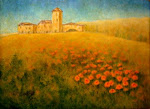
Faicchio is my favorite location for painting in the Campania region. Okay, I admit that it’s the village where my grandfather was born and raised. And it’s a definite perk to have my cousin married to the mayor. And if I run out of gas, I can rely on another cousin who owns THE gas station to fill my tank. If I get sick, another cousin who is THE doctor can tend to me and if I need surgery, his son THE SURGEON has all my confidence. Yes, the milk and cheese from another cousin’s dairy farm keeps me satiated. And the figs, tomatoes, pears, and wine at yet another cousin’s farm keep me from going hungry and thirsty while painting en plein air. But aside from all these familial perks, Faicchio is quite simply an idyllic location for artists.
Located about 45 miles northeast of Naples, Faicchio is situated at the base of Monte Monaco di Gioia in the Matese Mountain Range. To reach the village, drive over the bridge that crosses the Titerno River.
You can begin by setting up in the small, but enchanting Piazza Roma that fronts the 12th century Norman castle. The Faicchiani love art and have an irrepressible curiosity. This combination is fuel for the small crowd that will no doubt encircle you before you have time to sharpen your first pencil. Don’t be intimidated. They will treat you with no less esteem than if you were Michelangelo. In addition to the castle, the views in all directions are definitely paint-worthy. If you have, or appear to have difficulty decided what to paint, your audience will no doubt offer dozens of fingers pointing in as many different directions. The Faicchiani are immensely proud of their village and its stunning environs and well they should be.
Midway up the mountain, the 18th century Convent of San Pasquale, looms over the village. You can drive up to the convent or take the paved steps that begin in the center of town. I recommend the steps. It’s a bit of a climb, but there are broad platforms with benches along the way where you can stop and catch your breath, or even set up an easel and capture the stunning views of farmlands, orchards, and vineyards. Once you reach the convent, there are numerous lookout areas where you can set up. You might even find yourself balancing your paint box on one of the 3rd century BC Samnite walls that rise up along the esplanade. Don’t stop at the convent. Allow time to climb or drive to the summit of Monte Monaco di Gioia where the gaze is lost in the Apennines Molisano Mountains to the east and the intermingling of sky blue and the blue of the Gulf of Naples in the west.
Outside the village, on the road toward San Lorenzello, and about a mile or two out of town, on your left, you’ll find the double arched Ponte Fabio Massimo, a 3rd century BC Roman-era bridge. The bridge can be crossed on foot and at the opposite side you can set up along the riverbed, where you’ll find white limestone and dolomite whose origins date back over 60 million years. The bridge is a favorite artist’s muse. If you stare at it long enough, you can almost hear the clattering of greaves and armor as ghosts of Roman soldiers march across the bridge’s graveled surface.
Don’t leave the area without a trip up Mont Acero, which you’ll find on your left off the road toward Telese/Telesino. At the summit of this winding road you’ll be rewarded with views that you’ll swear could reach to Rome to the north and Sicily to the south. Before leaving town, stop at the market to buy water, fresh local cheese, regional wine, and bread still warm from the ovens. There are picnic tables at the summit of Mont Acero, so you can dine al fresco while you paint that next masterpiece.
BUON VIAGGIO!
Friday, December 18, 2009
PAINTING IN ITALY / CAMPANIA / FAICCHIO

Saturday, November 28, 2009
PAINTING IN ITALY / SORRENTO / VICO EQUENSE / POMPEII
Borrowing from Greek mythology, The Romans set the renowned dwelling of the “Sirens” (the naughty mermaids who lured seamen to their deaths) at Surrentum/Sorrento. Ulysses’ crew resisted the Siren’s call by stuffing their ears with wax. My advice is to get the wax out of your ears, heed the call, and go to Sorrento to paint.
Perched high on cliffs that overlook the Bay of Naples, This little jewel offers vistas for every genre of artist to enjoy. The seascapes are breathtaking, the landscaped verdant hills are luscious, and the cliff side dwellings are mind-boggling.
A visit to the cloister at Chiesa di San Francesco will not only delight floral artists with its flowering-vine studded garden, but the convent is also an art school offering exhibits that all artists will enjoy.
Pack light, bring some water, and take a walk down to Capo di Sorrento. To get there, take Via del Capo that originates in Piazza Tasso, the main square. Along the Via del Capo, after passing a sign “Cani Mordaci” (biting dogs) posted on the gate of the villa where Maxim Gorky lived, on the right is a dirt path that will take you down to the sea. The views from here, with Vesuvius in the distance, are magical. It’s an idyllic location to paint.
Between Napoli and Sorrento, Vico Equense is a beautiful spot to stop and paint. The locals boast that they have “one foot in the boat and one foot in the vineyards.” For me this translates to awesome seascapes and landscapes. This town is an often-overlooked little gem that lies in a lovely position on a tufa promontory on the north coast of the Sorrento peninsula. Set up near the Duomo where from high above the sea the views will knock your socks off. It can get fairly breezy there, so be sure to anchor down your canvas.
Spending a day to explore Pompeii and paint among the ruins is just about the most amazing experience you’ll ever have. With Vesuvius hovering in the background, there’s nowhere else I can think of where you can paint amidst the “destroyed’ and the “destroyer.” Some artists who don’t enjoy painting buildings or ruins screw up by not bringing paints or sketchpads to Pompeii. Don’t make that mistake. The views are fabulous in any direction from anywhere in the city.
BUON VIAGGIO!
Perched high on cliffs that overlook the Bay of Naples, This little jewel offers vistas for every genre of artist to enjoy. The seascapes are breathtaking, the landscaped verdant hills are luscious, and the cliff side dwellings are mind-boggling.
A visit to the cloister at Chiesa di San Francesco will not only delight floral artists with its flowering-vine studded garden, but the convent is also an art school offering exhibits that all artists will enjoy.
Pack light, bring some water, and take a walk down to Capo di Sorrento. To get there, take Via del Capo that originates in Piazza Tasso, the main square. Along the Via del Capo, after passing a sign “Cani Mordaci” (biting dogs) posted on the gate of the villa where Maxim Gorky lived, on the right is a dirt path that will take you down to the sea. The views from here, with Vesuvius in the distance, are magical. It’s an idyllic location to paint.
Between Napoli and Sorrento, Vico Equense is a beautiful spot to stop and paint. The locals boast that they have “one foot in the boat and one foot in the vineyards.” For me this translates to awesome seascapes and landscapes. This town is an often-overlooked little gem that lies in a lovely position on a tufa promontory on the north coast of the Sorrento peninsula. Set up near the Duomo where from high above the sea the views will knock your socks off. It can get fairly breezy there, so be sure to anchor down your canvas.
Spending a day to explore Pompeii and paint among the ruins is just about the most amazing experience you’ll ever have. With Vesuvius hovering in the background, there’s nowhere else I can think of where you can paint amidst the “destroyed’ and the “destroyer.” Some artists who don’t enjoy painting buildings or ruins screw up by not bringing paints or sketchpads to Pompeii. Don’t make that mistake. The views are fabulous in any direction from anywhere in the city.
BUON VIAGGIO!
Friday, November 27, 2009
ITALIAN POETRY / VOGLIO DI TENEREZZA / by LUCIANO SOMMA
Since I have been writing about painting in the Campania Region of Italy and on Tuesday I discussed painting in Napoli, I thought this would be an appropriate space to insert one of Luciano Somma’s poems. In VOGLIO DI TENEREZZA / TENDER FEELINGS, Luciano’s words about Napoli are like delicate brushstrokes that paint a rich, mental image. VOGLIO DI TENEREZZA is an excerpt from Luciano’s dual-language poetry book: “L’ALBA DI DOMANI/TOMORROW’S SUNRISE.”
You can find Luciano Somma at:
http://www.partecipiamo.it/Poesie/Luciano_Somma/1.htm
http://www.scolastica2000.it/MUSICALMENTE/somma/somma.htm
Siccome sono stato scrivendo delle località che preferisco dipingere dapertutto L’Italia, e recentamente ho scritto di Napoli, pensavo che allora sarebbe il tempo giusto mettere la poema VOGLIO DI TENEREZZA di Luciano Somma. Luciano ha abitato tutta la sua vita a Napoli e nella poema, le sue parole per quanto riguarda Napoli sono come pennellate delicate che dipingono nelle menti gli immagini intensi. VOGLIO DI TENEREZZA è un brano dal suo libro di doppia lingua: “L’ALBA DI DOMANI/TOMORROW’S SUNRISE.”
Si può trovare Luciano Somma a:
http://www.partecipiamo.it/Poesie/Luciano_Somma/1.htm
http://www.scolastica2000.it/MUSICALMENTE/somma/somma.htm
VOGLIO DI TENEREZZA
Questa sera
profuma d’estate
profuma di te
Napoli
un’aria di mare
m’inebria
e volo confuso
con la fantasia
verso lidi lontani
il ricordo mi porta
un sorriso
e cresce
come la pioggia in un fiume
questa dannata voglia
che ho dentro
d’un soffio di tenerezza
una carezza
per vivere.
Luciano Somma
TENDER FEELINGS
This evening
summer’s perfume
your perfume
Napoli
a sea air
inebriates me
and I fly confused
with fantasy
toward distant beaches
the memory brings me
a smile
and it grows
like rain in a river
this cursed desire
I have inside
of a warm whisper
a caress
to be alive.
Pamela Allegretto-Franz (translation)
You can find Luciano Somma at:
http://www.partecipiamo.it/Poesie/Luciano_Somma/1.htm
http://www.scolastica2000.it/MUSICALMENTE/somma/somma.htm
Siccome sono stato scrivendo delle località che preferisco dipingere dapertutto L’Italia, e recentamente ho scritto di Napoli, pensavo che allora sarebbe il tempo giusto mettere la poema VOGLIO DI TENEREZZA di Luciano Somma. Luciano ha abitato tutta la sua vita a Napoli e nella poema, le sue parole per quanto riguarda Napoli sono come pennellate delicate che dipingono nelle menti gli immagini intensi. VOGLIO DI TENEREZZA è un brano dal suo libro di doppia lingua: “L’ALBA DI DOMANI/TOMORROW’S SUNRISE.”
Si può trovare Luciano Somma a:
http://www.partecipiamo.it/Poesie/Luciano_Somma/1.htm
http://www.scolastica2000.it/MUSICALMENTE/somma/somma.htm
VOGLIO DI TENEREZZA
Questa sera
profuma d’estate
profuma di te
Napoli
un’aria di mare
m’inebria
e volo confuso
con la fantasia
verso lidi lontani
il ricordo mi porta
un sorriso
e cresce
come la pioggia in un fiume
questa dannata voglia
che ho dentro
d’un soffio di tenerezza
una carezza
per vivere.
Luciano Somma
TENDER FEELINGS
This evening
summer’s perfume
your perfume
Napoli
a sea air
inebriates me
and I fly confused
with fantasy
toward distant beaches
the memory brings me
a smile
and it grows
like rain in a river
this cursed desire
I have inside
of a warm whisper
a caress
to be alive.
Pamela Allegretto-Franz (translation)
Wednesday, November 25, 2009


PAINTING IN ITALY / VENETIAN TABLE
I recently completed the painting above in Elizabeth Sennett’s Fall Workshop. There are 2 reasons I chose the title “Venetian Table” / “Tavolo Veneziano”: The bowl filled with onions made me think of Venice’s celebrated “fegato con cipolle” / “liver with onions.” And the difficulty I had painting the onions made me cry enough tears to fill the Grand Canal.
Had it not been for Elizabeth’s expert guidance, laudable patience, and infectious joy of painting, I would have flown to Venice and dumped the canvas into the drink. You can view details of the painting in my Trompe L’oeil Gallery on my art website:
http://www.PamelaAllegretto-Franz.com
Ho dipinto il quadro sopra in una classe di trompe l’oeil con la maestra Elizabeth Sennett.
Il titolo del quadro è “Tavolo Veneziano” / “Venetian Table.” Ho scritto il titolo così perchè m’ha fatto pensare del famoso “fegato con cipolle di Venezia.” Anche perchè è stato così difficile dipingere le cipolle che ho pianto abbastanza lacrime a fare il pieno il Canal Grande.
Senza la guida di Elizabeth, avrei andato a Venezia e gettato il quadro nel Canal Grande. Si può vedere i particolari del quadro nella galleria di Trompe L’oeil Gallery su mio website d’arte:
http://www.PamelaAllegretto-Franz.com
Had it not been for Elizabeth’s expert guidance, laudable patience, and infectious joy of painting, I would have flown to Venice and dumped the canvas into the drink. You can view details of the painting in my Trompe L’oeil Gallery on my art website:
http://www.PamelaAllegretto-Franz.com
Ho dipinto il quadro sopra in una classe di trompe l’oeil con la maestra Elizabeth Sennett.
Il titolo del quadro è “Tavolo Veneziano” / “Venetian Table.” Ho scritto il titolo così perchè m’ha fatto pensare del famoso “fegato con cipolle di Venezia.” Anche perchè è stato così difficile dipingere le cipolle che ho pianto abbastanza lacrime a fare il pieno il Canal Grande.
Senza la guida di Elizabeth, avrei andato a Venezia e gettato il quadro nel Canal Grande. Si può vedere i particolari del quadro nella galleria di Trompe L’oeil Gallery su mio website d’arte:
http://www.PamelaAllegretto-Franz.com
Tuesday, November 24, 2009
PAINTING IN ITALY / CAMPANIA / NAPLES / NAPOLI
The Neapolitan “soul” is guaranteed to squeeze your heart into submission. “Goethe wrote: “Naples is Paradise. Everyone lives in a state of intoxicated self-forgetfulness, myself included.”
No painting excursion into the Campania region is complete without a visit to Naples. Yes, Naples is a big city and one of the most populace cities in Italy, but don’t forget that it is also the city that boasts the infamous dictum: “See Naples and die.” My only caution is: “Don’t see Naples by car, and live.” This is about painting in Naples and so I won’t discuss driving in Naples; just don’t do it. If you have a car, I suggest staying in nearby Sorrento or Vico Equense. You can leave your car at the hotel and take the Circumvesuviana, a commuter railway that also stops at the ruins of Herculaneum and Pompeii. The forty-five-minute rail trip to Naples from Sorrento is easy and scenic; most of all, it is traffic and stress free.
If you’re looking to set up in a piazza, the city offers a plethora to choose from and I’ll leave that long, detailed list to the travel writers. One of my favorite piazzas to paint in (at least for a few hours until the crush of humanity drives me away) is Piazza del Plebiscito, the city's main piazza and traffic free pedestrian zone. It is paved with black cobblestones and is among the country's grandest spaces. Clustered around the piazza are Teatro San Carlo, Italy's largest opera house; the ornate Galleria Umberto I, the 1887 shopping gallery; the vast Palazzo Reale (Royal Palace); and across from the palace, a sweeping semicircular colonnade to rival St. Peter's. Talk about artistic inspiration!
When you’re ready for a break from city noise and congestion, or if you’re a landscape artist hungry for vegetation, visit the Santa Chiara Cloisters. These cloisters are a sanctuary of hyacinth and white daffodils, small vegetable plots, and fruit trees. But for me, it’s the hand painted, blue-and-mustard-colored majolica tiles that cover every wall, pillar, and bench that make this verdant cloister a painter’s Mecca. The Monks at the cloister will let you set up an easel, but ask first. It’s also a nice idea to add a few Euros to their collection box to help defer the cost of maintaining this little jewel. Keep your workspace small and clean; the monks WILL be watching you. They have a posted notice that reads: “If you think you will be immortalized by signing your name on our walls, you are mistaken: it will be removed shortly after.”
My favorite neighborhood to paint in Naples is Spaccanapoli, in the heart of the city. There is always new inspiration in the midst of laundry flapping from overhead balconies and black-clad signoras hawking contraband cigarettes up and down the maze of narrow, zigzag, dead end streets.
A note to writers and book lovers: On the edge of Spaccanapoli, near the Archaeological Museum, is the refreshingly green and relaxed Piazza Bellini, a nexus of the city's flourishing booksellers: Naples is one of Italy's great bibliophile centers. Bookstalls like the ones along Paris' Left Bank, selling both new and used books, line the streets on and leading from the Piazza.
A sharp contrast to Spaccanapoli is the Vomero neighborhood. If the pace in the city center becomes exasperating, board one of the funiculars from the center up to Vomero in the hills above town. This city within a city is unexpectedly calm and the views of the Bay of Naples and Vesuvius are truly “paint worthy.” If you get hungry and are looking for some “finger food” so you don’t waste good light by sitting at an indoor restaurant, go to the tiny Friggitoria Vomero (via Cimarosa 44). For just a few euros you can buy brown-paper cones filled with fritters made of eggplant or cauliflower or boiled wild greens or rectangles of polenta, all of them sprinkled with coarse local sea salt. Who said artists have to “starve?”
Certainly, you will want to take time out from your own painting to view some of the heavy hitters that Naples has to offer. The guidebooks can give you the full run down; here are my picks:
Il Museo e Gallerie di Capodimonte/ among other notables, don’t miss the works here by Botticelli, Bellini, Raphael, and Caravaggio.
A church officially named Sant'Anna dei Lombardi but commonly called Monteoliveto for the square on which it sits. Inside you’ll find a sacristy frescoed by Vasari, with eye-popping trompe l'oeil marquetry panels along the walls, and also, Guido Mazzoni’s awesome life-size group of terra cotta figures.
And finally, Caravaggio fled to Naples after he killed a man in Rome and although he didn't stay long he painted several important paintings, including the "Seven Acts of Mercy" which is in Pio Monte della Misericordia in the Centro Storico. It is an amazing, complex work, commissioned as an altarpiece for the church in which it has remained for 400 years.
The Neapolitan spirit of dolce far niente (living from day to day in a devil-may-care sort of way) is instantly contagious and it reaches to the artist’s canvas. If you paint “tight” and yearn to free up your strokes, then Naples is the city to visit.
Buon Viaggio!
No painting excursion into the Campania region is complete without a visit to Naples. Yes, Naples is a big city and one of the most populace cities in Italy, but don’t forget that it is also the city that boasts the infamous dictum: “See Naples and die.” My only caution is: “Don’t see Naples by car, and live.” This is about painting in Naples and so I won’t discuss driving in Naples; just don’t do it. If you have a car, I suggest staying in nearby Sorrento or Vico Equense. You can leave your car at the hotel and take the Circumvesuviana, a commuter railway that also stops at the ruins of Herculaneum and Pompeii. The forty-five-minute rail trip to Naples from Sorrento is easy and scenic; most of all, it is traffic and stress free.
If you’re looking to set up in a piazza, the city offers a plethora to choose from and I’ll leave that long, detailed list to the travel writers. One of my favorite piazzas to paint in (at least for a few hours until the crush of humanity drives me away) is Piazza del Plebiscito, the city's main piazza and traffic free pedestrian zone. It is paved with black cobblestones and is among the country's grandest spaces. Clustered around the piazza are Teatro San Carlo, Italy's largest opera house; the ornate Galleria Umberto I, the 1887 shopping gallery; the vast Palazzo Reale (Royal Palace); and across from the palace, a sweeping semicircular colonnade to rival St. Peter's. Talk about artistic inspiration!
When you’re ready for a break from city noise and congestion, or if you’re a landscape artist hungry for vegetation, visit the Santa Chiara Cloisters. These cloisters are a sanctuary of hyacinth and white daffodils, small vegetable plots, and fruit trees. But for me, it’s the hand painted, blue-and-mustard-colored majolica tiles that cover every wall, pillar, and bench that make this verdant cloister a painter’s Mecca. The Monks at the cloister will let you set up an easel, but ask first. It’s also a nice idea to add a few Euros to their collection box to help defer the cost of maintaining this little jewel. Keep your workspace small and clean; the monks WILL be watching you. They have a posted notice that reads: “If you think you will be immortalized by signing your name on our walls, you are mistaken: it will be removed shortly after.”
My favorite neighborhood to paint in Naples is Spaccanapoli, in the heart of the city. There is always new inspiration in the midst of laundry flapping from overhead balconies and black-clad signoras hawking contraband cigarettes up and down the maze of narrow, zigzag, dead end streets.
A note to writers and book lovers: On the edge of Spaccanapoli, near the Archaeological Museum, is the refreshingly green and relaxed Piazza Bellini, a nexus of the city's flourishing booksellers: Naples is one of Italy's great bibliophile centers. Bookstalls like the ones along Paris' Left Bank, selling both new and used books, line the streets on and leading from the Piazza.
A sharp contrast to Spaccanapoli is the Vomero neighborhood. If the pace in the city center becomes exasperating, board one of the funiculars from the center up to Vomero in the hills above town. This city within a city is unexpectedly calm and the views of the Bay of Naples and Vesuvius are truly “paint worthy.” If you get hungry and are looking for some “finger food” so you don’t waste good light by sitting at an indoor restaurant, go to the tiny Friggitoria Vomero (via Cimarosa 44). For just a few euros you can buy brown-paper cones filled with fritters made of eggplant or cauliflower or boiled wild greens or rectangles of polenta, all of them sprinkled with coarse local sea salt. Who said artists have to “starve?”
Certainly, you will want to take time out from your own painting to view some of the heavy hitters that Naples has to offer. The guidebooks can give you the full run down; here are my picks:
Il Museo e Gallerie di Capodimonte/ among other notables, don’t miss the works here by Botticelli, Bellini, Raphael, and Caravaggio.
A church officially named Sant'Anna dei Lombardi but commonly called Monteoliveto for the square on which it sits. Inside you’ll find a sacristy frescoed by Vasari, with eye-popping trompe l'oeil marquetry panels along the walls, and also, Guido Mazzoni’s awesome life-size group of terra cotta figures.
And finally, Caravaggio fled to Naples after he killed a man in Rome and although he didn't stay long he painted several important paintings, including the "Seven Acts of Mercy" which is in Pio Monte della Misericordia in the Centro Storico. It is an amazing, complex work, commissioned as an altarpiece for the church in which it has remained for 400 years.
The Neapolitan spirit of dolce far niente (living from day to day in a devil-may-care sort of way) is instantly contagious and it reaches to the artist’s canvas. If you paint “tight” and yearn to free up your strokes, then Naples is the city to visit.
Buon Viaggio!
Wednesday, November 4, 2009

ITALIAN POETRY / I GABBIANI / SEAGULLS by LUCIANO SOMMA
Luciano Somma, one of Italy’s foremost poets, writes not merely with a keen sensitivity, but also with an artist’s eye. In his poem “SEAGULLS” his colorful vocabulary all but lifts the reader airborne to join in the flight of gulls.
“SEAGULLS” can be found in Luciano Somma’s dual language poetry book: L’ALBA DI DOMANI/TOMORROW'S SUNRISE. It gave me great pleasure to write the English translations in this book, as well as to paint the cover for the book and CD.
You can view more of Luciano Somma’s poetry at:
http://www.partecipiamo.it/Poesie/Luciano_Somma/1.htm
http://www.scolastica2000.it/MUSICALMENTE/somma/somma.htm
The painting above is the book and CD cover for L’ALBA DI DOMANI. You can view this and more of my paintings at my art website:
http://www.pamelaallegretto-franz.com/
Luciano Somma è un poeta molto noto in Italia che scrive non soltanto con sensibilità, ma anche con un occhio d’un artista. Nella poema “I Gabbiani” il suo vocabolario, ricco di colore, quasi solleva il lettore nell’aria ad unire nel volo dei gabbiani.
Si può trovare “I Gabbiani” nel libro di Luciano Somma: L’ALBA DI DOMANI. Mi ha fatto un grand piacere scrivere le traduzioni in questo libro ed anche dipingere il copertina.
Si può trovare Luciano Somma a:
http://www.partecipiamo.it/Poesie/Luciano_Somma/1.htm
http://www.scolastica2000.it/MUSICALMENTE/somma/somma.htm
Il quadro sopra è la copertina del libro ed il CD L’ALBA DI DOMANI. Si può vedere questo ed altri dei miei quadri sul mio website d’arte:
http://www.pamelaallegretto-franz.com/
I GABBIANI
Disordinatamente
volano nell’aria
cercando prede
per la loro fame
cercando spazio
per le loro fughe
sfiorano il mare
vanno verso il cielo
per poi scendere giù
per poi toccare
la vela giusta
mossa un po’ dal vento
i gabbiani
sanno il momento esatto
dove andare
e il loro grido spesso si confonde
con il suono dell’onde alla risacca.
Disegnano nell’aria
nel gelo d’un inverno sempre nuovo
preghiere mute per un’altra estate
la’ dove l’abbondanza d’altri cibi
placherà i morsi della loro fame
i gabbiani
lotta continua di sopravvivenza
battiti d’ali pieni di poesia
agli occhi di bambini
che additano alle mamme
quel gioco di aquiloni senza fili.
Luciano Somma
SEAGULLS
Riotously
they fly in the air
searching prey
for their hunger
searching space
for their escape
skimming the sea
they go toward heaven
then later descend
to touch
the proper sail
waving slightly from the wind
the gulls
know the exact moment
where to go
and their screams are often confused
with the sound of waves at the backwash.
Outlining in the air
in the frost of a winter forever new
silent prayers for another summer
where abundant food
will pacify the grip of their hunger
the gulls
struggle for survival
flapping wings bursting with poetry
to the eyes of children
that point up to their mothers
that game of kite flying without string.
Pamela Allegretto Franz (translation)
“SEAGULLS” can be found in Luciano Somma’s dual language poetry book: L’ALBA DI DOMANI/TOMORROW'S SUNRISE. It gave me great pleasure to write the English translations in this book, as well as to paint the cover for the book and CD.
You can view more of Luciano Somma’s poetry at:
http://www.partecipiamo.it/Poesie/Luciano_Somma/1.htm
http://www.scolastica2000.it/MUSICALMENTE/somma/somma.htm
The painting above is the book and CD cover for L’ALBA DI DOMANI. You can view this and more of my paintings at my art website:
http://www.pamelaallegretto-franz.com/
Luciano Somma è un poeta molto noto in Italia che scrive non soltanto con sensibilità, ma anche con un occhio d’un artista. Nella poema “I Gabbiani” il suo vocabolario, ricco di colore, quasi solleva il lettore nell’aria ad unire nel volo dei gabbiani.
Si può trovare “I Gabbiani” nel libro di Luciano Somma: L’ALBA DI DOMANI. Mi ha fatto un grand piacere scrivere le traduzioni in questo libro ed anche dipingere il copertina.
Si può trovare Luciano Somma a:
http://www.partecipiamo.it/Poesie/Luciano_Somma/1.htm
http://www.scolastica2000.it/MUSICALMENTE/somma/somma.htm
Il quadro sopra è la copertina del libro ed il CD L’ALBA DI DOMANI. Si può vedere questo ed altri dei miei quadri sul mio website d’arte:
http://www.pamelaallegretto-franz.com/
I GABBIANI
Disordinatamente
volano nell’aria
cercando prede
per la loro fame
cercando spazio
per le loro fughe
sfiorano il mare
vanno verso il cielo
per poi scendere giù
per poi toccare
la vela giusta
mossa un po’ dal vento
i gabbiani
sanno il momento esatto
dove andare
e il loro grido spesso si confonde
con il suono dell’onde alla risacca.
Disegnano nell’aria
nel gelo d’un inverno sempre nuovo
preghiere mute per un’altra estate
la’ dove l’abbondanza d’altri cibi
placherà i morsi della loro fame
i gabbiani
lotta continua di sopravvivenza
battiti d’ali pieni di poesia
agli occhi di bambini
che additano alle mamme
quel gioco di aquiloni senza fili.
Luciano Somma
SEAGULLS
Riotously
they fly in the air
searching prey
for their hunger
searching space
for their escape
skimming the sea
they go toward heaven
then later descend
to touch
the proper sail
waving slightly from the wind
the gulls
know the exact moment
where to go
and their screams are often confused
with the sound of waves at the backwash.
Outlining in the air
in the frost of a winter forever new
silent prayers for another summer
where abundant food
will pacify the grip of their hunger
the gulls
struggle for survival
flapping wings bursting with poetry
to the eyes of children
that point up to their mothers
that game of kite flying without string.
Pamela Allegretto Franz (translation)
Saturday, October 31, 2009

PAINTING IN ITALY / CAMPANIA / AMALFI
The diverse villages along the Amalfi Coast have been compared to a constellation, if this is the case, then the town of Amalfi is unquestionably the brightest star. The Amalfitani like to boast: “The sun, the moon, the stars, and - Amalfi.” You’ll get no argument from me.
Sandwiched between verdant and craggy mountains and the intense blue of the Mediterranean Sea, the town’s vibrantly tiled cupolas and pastel-washed houses beg the artist to capture their pose.
Landscape artists shouldn’t miss the Valle dei Mulini (The Valley of the Mills). To get there, start at Piazza del Duomo (By the way, Architectural artists take note: The Duomo, with a façade inlaid with glazed and colored tiles, is one of the more beautiful religious monuments in Southern Italy). Head up Via Genova where you’ll pass fragrant gardens, citrus groves, and waterfalls that feed the oldest paper mills in Europe. There are numerous places to stop and set up sketchpad or easel along this route, and believe me, you’ll want to do just that. When you reach the Museo Della Carta, I recommend taking time out from painting to tour this Paper Museum. Amalfi was among the first cities in Europe to manufacture hand-made paper and it continues this highly specialized art to this day. What watercolor artist or journalist hasn’t dreamed of going to Amalfi to select a few prize sheets of handmade Amalfi paper?
If you’re hungry, but don’t want to stop painting, take a patio table at the Conca Azzura Ristorante that over looks the Cape Conca Dei Marini. This scenic bay is the natural entrance to the Emerald Grotto. The colors and view from this belvedere are unparalleled. It’s a great place to sip wine, swirl forkfuls of pasta, and paint. Does it get any better than that? I don’t think so.
For centuries, poets and writers have sung Amalfi’s praises, but it’s not easy to find the right words to do justice to its beauty. For artists, I think Margaret Drabble said it best: “Amalfi clusters, the cliffs aspire, the sea extends. It is a living view, of living rock and living light. It changes minute by minute of an evening as the light changes. Like a moving painting, like a wall of slowly evolving time, a perfectly composed combination of safety and danger, distanced, marginally landscaped by man, inviting the artist.”
BUON VIAGGIO!!!
The painting above: La Veduta D'Amalfi is an original acrylic on canvas and can be purchased on my art website:
http://www.pamelaallegretto-franz.com/
Si può comprare il quadro in sopra, La Veduta D'Amalfi al mio website d’arte:
http://www.pamelaallegretto-franz.com/
Sandwiched between verdant and craggy mountains and the intense blue of the Mediterranean Sea, the town’s vibrantly tiled cupolas and pastel-washed houses beg the artist to capture their pose.
Landscape artists shouldn’t miss the Valle dei Mulini (The Valley of the Mills). To get there, start at Piazza del Duomo (By the way, Architectural artists take note: The Duomo, with a façade inlaid with glazed and colored tiles, is one of the more beautiful religious monuments in Southern Italy). Head up Via Genova where you’ll pass fragrant gardens, citrus groves, and waterfalls that feed the oldest paper mills in Europe. There are numerous places to stop and set up sketchpad or easel along this route, and believe me, you’ll want to do just that. When you reach the Museo Della Carta, I recommend taking time out from painting to tour this Paper Museum. Amalfi was among the first cities in Europe to manufacture hand-made paper and it continues this highly specialized art to this day. What watercolor artist or journalist hasn’t dreamed of going to Amalfi to select a few prize sheets of handmade Amalfi paper?
If you’re hungry, but don’t want to stop painting, take a patio table at the Conca Azzura Ristorante that over looks the Cape Conca Dei Marini. This scenic bay is the natural entrance to the Emerald Grotto. The colors and view from this belvedere are unparalleled. It’s a great place to sip wine, swirl forkfuls of pasta, and paint. Does it get any better than that? I don’t think so.
For centuries, poets and writers have sung Amalfi’s praises, but it’s not easy to find the right words to do justice to its beauty. For artists, I think Margaret Drabble said it best: “Amalfi clusters, the cliffs aspire, the sea extends. It is a living view, of living rock and living light. It changes minute by minute of an evening as the light changes. Like a moving painting, like a wall of slowly evolving time, a perfectly composed combination of safety and danger, distanced, marginally landscaped by man, inviting the artist.”
BUON VIAGGIO!!!
The painting above: La Veduta D'Amalfi is an original acrylic on canvas and can be purchased on my art website:
http://www.pamelaallegretto-franz.com/
Si può comprare il quadro in sopra, La Veduta D'Amalfi al mio website d’arte:
http://www.pamelaallegretto-franz.com/
Saturday, October 24, 2009
PAINTING IN ITALY / CAMPANIA / AMALFI COAST / SANT'AGATA SUI DUE GOLFI
If you’re driving on the Strada di Capodimonte, the breathtakingly scenic coastal road, stop at Sant’Agata Sui Due Golfi. This charming mountain village is settled on hillside dripping with bougainvillea and terraced with vineyards and fruit orchards.
The name of the town is derived from its location that commands excellent views of the two gulfs of Salerno and Naples. There are numerous locations throughout the village to set up and look out over the Mediterranean. This should keep landscape and seascape artists happy for several hours. If you want to plop a cherry on top of this stunning confection, take the narrow, uphill road behind the Bar Orland to the Deserto. From this Franciscan monastery you not only survey the two bays, but you can enjoy the bonus of an excellent view of Capri. Architectural artists should enjoy painting the monastery and its bell-tower on which is inscribed: TEMPUS BREVE EST. Time is short; use it wisely by spending some of it painting at Sant’Agata Sui Due Golfi.
BUON VIAGGIO!
The name of the town is derived from its location that commands excellent views of the two gulfs of Salerno and Naples. There are numerous locations throughout the village to set up and look out over the Mediterranean. This should keep landscape and seascape artists happy for several hours. If you want to plop a cherry on top of this stunning confection, take the narrow, uphill road behind the Bar Orland to the Deserto. From this Franciscan monastery you not only survey the two bays, but you can enjoy the bonus of an excellent view of Capri. Architectural artists should enjoy painting the monastery and its bell-tower on which is inscribed: TEMPUS BREVE EST. Time is short; use it wisely by spending some of it painting at Sant’Agata Sui Due Golfi.
BUON VIAGGIO!
Wednesday, October 21, 2009
PAINTING IN ITALY / CAMPANIA / POSITANO
Positano is a hillside town on the southern strip of the Amalfi Drive. This Moorish-style village overlooks a small bay washed by the emerald Mediterranean and is backed by mountain buttresses that offer views of the Sirenuse Islands, Homer’s siren islands in the Odyssey. The white and pink houses perch from terraces submerged under bougainvilleas that drip down to the sea. Now that’s my idea of an excellent location to paint.
John Steinbeck wrote: “Positano bites deep. It is a dream that isn’t quite real when you are there and becomes beckoningly real after you have gone.” What artist wouldn’t be lured to Positano after having read those words? And when you add Artist Paul Klee to the Positano devotees, then it’s an inescapable conclusion to spend time painting in Positano. Paul Klee once said: “I like to take a line for a walk.” Klee took great pleasure in “walking his lines” in Positano, and so should you.
There’s no driving in the town: you park up top and walk down, and down, and down. At times, the streets seem almost impossibly steep. My advice: don’t lug heavy paint boxes or cumbersome easels. Always remember: what goes down, must come up.
BUON VIAGGIO!
John Steinbeck wrote: “Positano bites deep. It is a dream that isn’t quite real when you are there and becomes beckoningly real after you have gone.” What artist wouldn’t be lured to Positano after having read those words? And when you add Artist Paul Klee to the Positano devotees, then it’s an inescapable conclusion to spend time painting in Positano. Paul Klee once said: “I like to take a line for a walk.” Klee took great pleasure in “walking his lines” in Positano, and so should you.
There’s no driving in the town: you park up top and walk down, and down, and down. At times, the streets seem almost impossibly steep. My advice: don’t lug heavy paint boxes or cumbersome easels. Always remember: what goes down, must come up.
BUON VIAGGIO!
Tuesday, October 20, 2009
PAINTING IN ITALY / APULIA / LECCE
The Apulia (Puglia in Italian) region forms Italy’s “heel.” Although somewhat off the beaten track, this region is a “must-see” for artists. If time is not on your side, at least in addition to the Trulli in Alberobello of which I’ve previously written (see March 17th entry), a trip to Lecce is not to be missed.
Referred to by some as the “Florence of the Italian South,” Lecce is a city of Baroque run wild. The palaces, churches, balconies, courtyards, and even modest side-street houses are embellished with gargoyles, eagles, monkeys, dragons, saints, fruit, and flowers. But unlike the Baroque style found elsewhere in Europe, Lecce Baroque isn’t massive or imposing; quite the opposite, it’s airy and joyful. This ornamental explosion is mostly due to the “Pietra di Lecce,” the honey-colored stone quarried in the region that is so malleable it can be cut with a knife. Nothing was too intricate or delicate that it couldn’t be carved from this stone. It would have been impossible to achieve the Lecce Baroque out of marble.
Piazza Sant’Oronzo is an excellent location for setting up your easel. When you feel the need to take a break so as not to suffer a Baroque overload, visit the below ground-level remains of the 1st century BC Roman amphitheater that Adjoins Piazza Sant’Oronzo. It’s most remarkable for it’s illustrations of chiseled gladiators fighting back lions with spears and less successful gladiators being gored by bulls.
Artists who like detailed paintings will delight in painting the Church of the Rosario on Via G. Libertini. The entire façade is a riot of carved birds and flora. At one time the monks at this cloister, which now houses a tobacco company, manufactured “polvere Leccese,” (Lecce dust) the famous snuff that Napoleon used throughout his career until his last days on St. Helena. Maybe that explains the pose with his hand inside his jacket: he was reaching for his snuffbox.
BUON VIAGGIO!
Referred to by some as the “Florence of the Italian South,” Lecce is a city of Baroque run wild. The palaces, churches, balconies, courtyards, and even modest side-street houses are embellished with gargoyles, eagles, monkeys, dragons, saints, fruit, and flowers. But unlike the Baroque style found elsewhere in Europe, Lecce Baroque isn’t massive or imposing; quite the opposite, it’s airy and joyful. This ornamental explosion is mostly due to the “Pietra di Lecce,” the honey-colored stone quarried in the region that is so malleable it can be cut with a knife. Nothing was too intricate or delicate that it couldn’t be carved from this stone. It would have been impossible to achieve the Lecce Baroque out of marble.
Piazza Sant’Oronzo is an excellent location for setting up your easel. When you feel the need to take a break so as not to suffer a Baroque overload, visit the below ground-level remains of the 1st century BC Roman amphitheater that Adjoins Piazza Sant’Oronzo. It’s most remarkable for it’s illustrations of chiseled gladiators fighting back lions with spears and less successful gladiators being gored by bulls.
Artists who like detailed paintings will delight in painting the Church of the Rosario on Via G. Libertini. The entire façade is a riot of carved birds and flora. At one time the monks at this cloister, which now houses a tobacco company, manufactured “polvere Leccese,” (Lecce dust) the famous snuff that Napoleon used throughout his career until his last days on St. Helena. Maybe that explains the pose with his hand inside his jacket: he was reaching for his snuffbox.
BUON VIAGGIO!
Monday, October 19, 2009
PAINTING IN ITALY / CALABRIA
Calabria forms the toe of the Italian “boot.” Most travelers consider the region of Calabria to be uncivilized and dangerous, and to be used only as a stepping block to and from Sicily. That’s a gross error in judgment, and these folks need to get their heads out of their Mario Puzzo novels.
First of all, the Calabrian people are as warm and inviting as the June sun that splashes across their tiled rooftops. If you’re an artist, you’re really in for a treat. Artists at any level are venerated and fussed over. If you’re sitting in the piazza barely doodling, you’ll get the “Look” (the nod and the smile) that says: “I’m honored to be in the presence of such artistic genius.”
Seascape artists can enjoy the beaches, pristine, golden, and aquamarine, around the Tropea Peninsula, while plein air artists may prefer the scenic hinterland. The charming village of Tropea huddled on a cliff above the sea, won’t disappoint artists who are drawn to architecture. The Calabrians call the town: “Nobile Tropea,” as it is considered to be one of the most picturesque in all of Southern Italy.
The only uncivilized and dangerous things I’ve ever encountered in Calabria are the two unexploded American bombs, left over from WW2, that hang in the back of the Cathedral in Tropea.
BUON VIAGGIO!
First of all, the Calabrian people are as warm and inviting as the June sun that splashes across their tiled rooftops. If you’re an artist, you’re really in for a treat. Artists at any level are venerated and fussed over. If you’re sitting in the piazza barely doodling, you’ll get the “Look” (the nod and the smile) that says: “I’m honored to be in the presence of such artistic genius.”
Seascape artists can enjoy the beaches, pristine, golden, and aquamarine, around the Tropea Peninsula, while plein air artists may prefer the scenic hinterland. The charming village of Tropea huddled on a cliff above the sea, won’t disappoint artists who are drawn to architecture. The Calabrians call the town: “Nobile Tropea,” as it is considered to be one of the most picturesque in all of Southern Italy.
The only uncivilized and dangerous things I’ve ever encountered in Calabria are the two unexploded American bombs, left over from WW2, that hang in the back of the Cathedral in Tropea.
BUON VIAGGIO!
Sunday, October 18, 2009
PAINTING & WRITING IN SICILY
For artists and writers (or anyone for that matter) who hesitate to travel to Sicily because of the Mafia “Thing”, get over it. Not everyone who lives in Las Vegas is a gambler nor is every New Yorker a mugger; and likewise, not every Sicilian belongs to the Mafia. If you ignore Sicily, you miss Italy. If you don’t want to take my advice, take the advice of Goethe who wrote: “To have seen Italy without seeing Sicily, is not to have seen Italy at all. For Sicily is the key to everything.”
Writers doing research on the Italian consciousness would do well to spend time in Sicily. For as Luigi Barzini wrote in The Italians: “Sicily is the schoolroom model of Italy for beginners, with every Italian quality and defect magnified, exasperated, and brightly colored...Everywhere in Italy, life is more or less slowed down by the exuberant intelligence of the inhabitants: In Sicily it is practically paralyzed by it.”
I consider the Sicilian sensitivity to be a fascinating subject to research. I mean, come on, here’s a land where, in the local dialects, there is no future tense for the verb “to be”, and where a distinctly joyful expression states: “Finchè c’è morte c’è speranza.” (Where there’s death there’s hope.) Say what? Lay that one out on Freud’s couch!
For artists, Sicily’s unique natural beauty challenges your brain to make that seemingly impossible decision of what to paint first: rugged mountains, vine and olive-clad slopes, fields of daisies and sunflowers, countless lemon, lime, and orange orchards, craggy sea-cliffs, sandy coves, Mount Etna. If Sicily’s natural beauty doesn’t totally thrust your brain into overdrive, certainly Sicily’s man-made wonders will finish the job: The Baroque façades on Campania’s churches, Apulia’s Romanesque cathedrals, the ancient Greek ruins in Calabria, the castles, palaces, and churches built all over Southern Italy by Norman, Aragonese, and Spanish invaders – all of these are found on the microcosm island of Sicily.
BUON VIAGGIO!
Writers doing research on the Italian consciousness would do well to spend time in Sicily. For as Luigi Barzini wrote in The Italians: “Sicily is the schoolroom model of Italy for beginners, with every Italian quality and defect magnified, exasperated, and brightly colored...Everywhere in Italy, life is more or less slowed down by the exuberant intelligence of the inhabitants: In Sicily it is practically paralyzed by it.”
I consider the Sicilian sensitivity to be a fascinating subject to research. I mean, come on, here’s a land where, in the local dialects, there is no future tense for the verb “to be”, and where a distinctly joyful expression states: “Finchè c’è morte c’è speranza.” (Where there’s death there’s hope.) Say what? Lay that one out on Freud’s couch!
For artists, Sicily’s unique natural beauty challenges your brain to make that seemingly impossible decision of what to paint first: rugged mountains, vine and olive-clad slopes, fields of daisies and sunflowers, countless lemon, lime, and orange orchards, craggy sea-cliffs, sandy coves, Mount Etna. If Sicily’s natural beauty doesn’t totally thrust your brain into overdrive, certainly Sicily’s man-made wonders will finish the job: The Baroque façades on Campania’s churches, Apulia’s Romanesque cathedrals, the ancient Greek ruins in Calabria, the castles, palaces, and churches built all over Southern Italy by Norman, Aragonese, and Spanish invaders – all of these are found on the microcosm island of Sicily.
BUON VIAGGIO!
Friday, October 9, 2009
ITALIAN POETRY / I COLORI DELL'AUTUNNO by LUCIANO SOMMA
In THE COLORS OF AUTUMN, Luciano Somma’s words are like delicate brushstrokes that paint a rich, mental image. THE COLORS OF AUTUMN is an excerpt from Luciano’s dual-language poetry book: “L’ALBA DI DOMANI/TOMORROW’S SUNRISE” You can find Luciano Somma at:
http://www.partecipiamo.it/Poesie/Luciano_Somma/1.htm http://www.scolastica2000.it/MUSICALMENTE/somma/somma.htm
Nella poema: I COLORI DELL’AUTUNNO le parole di Luciano Somma sono come pennellate delicate che dipingono nelle menti gli immagini intensi. I COLORI DELL’AUTUNNO è un brano dal suo libro di doppia lingua: “L’ALBA DI DOMANI/TOMORROW’S SUNRISE.”
Si può trovare Luciano Somma a: http://www.partecipiamo.it/Poesie/Luciano_Somma/1.htm
http://www.scolastica2000.it/MUSICALMENTE/somma/somma.htm
I COLORI DELL’AUTUNNO
L’ultimo palpitare
delle foglie
che qui in montagna
assumono colori
dai toni accesi
vivi come lampe
portano l’eco assurda
della tua voce padre
duro come una roccia
muscoloso
tu da generazioni taglialegna
sembravi senza tempo.
Ero legato a te
come un ramo alla quercia
ed ora sono solo
nella foresta
del tuo ieri vissuto
in questo immenso.
Ma parleremo ancora
ti sentirò
nell’aria immacolata
presente
tra i colori dell’autunno
nel nostro paradiso
di silenzio.
Luciano Somma
THE COLORS OF AUTUMN
The last fluttering
of leaves
that here in the mountains
assume colors
in vivid tones
alive like lightening
they carry the absurd echo
of your voice father
hard like a rock
muscular
you from woodcutter
seemed timeless.
I was bound to you
like a branch to the oak
and now I’m alone
in the forest
of your yesterdays lived
in this vastness.
But we will speak again
I will feel you
in the pure air
present
among the colors of autumn
in our paradise
of silence.
Pamela Allegretto Franz (Translation)
http://www.partecipiamo.it/Poesie/Luciano_Somma/1.htm http://www.scolastica2000.it/MUSICALMENTE/somma/somma.htm
Nella poema: I COLORI DELL’AUTUNNO le parole di Luciano Somma sono come pennellate delicate che dipingono nelle menti gli immagini intensi. I COLORI DELL’AUTUNNO è un brano dal suo libro di doppia lingua: “L’ALBA DI DOMANI/TOMORROW’S SUNRISE.”
Si può trovare Luciano Somma a: http://www.partecipiamo.it/Poesie/Luciano_Somma/1.htm
http://www.scolastica2000.it/MUSICALMENTE/somma/somma.htm
I COLORI DELL’AUTUNNO
L’ultimo palpitare
delle foglie
che qui in montagna
assumono colori
dai toni accesi
vivi come lampe
portano l’eco assurda
della tua voce padre
duro come una roccia
muscoloso
tu da generazioni taglialegna
sembravi senza tempo.
Ero legato a te
come un ramo alla quercia
ed ora sono solo
nella foresta
del tuo ieri vissuto
in questo immenso.
Ma parleremo ancora
ti sentirò
nell’aria immacolata
presente
tra i colori dell’autunno
nel nostro paradiso
di silenzio.
Luciano Somma
THE COLORS OF AUTUMN
The last fluttering
of leaves
that here in the mountains
assume colors
in vivid tones
alive like lightening
they carry the absurd echo
of your voice father
hard like a rock
muscular
you from woodcutter
seemed timeless.
I was bound to you
like a branch to the oak
and now I’m alone
in the forest
of your yesterdays lived
in this vastness.
But we will speak again
I will feel you
in the pure air
present
among the colors of autumn
in our paradise
of silence.
Pamela Allegretto Franz (Translation)
Saturday, October 3, 2009
PAINTING IN SICILY / CATANIA
Situated at the foot of Mount Etna, Catania’s fate has always been at the mercy of the Volcano. The eruption in April 1983 lasted seven weeks, with the lava flow licking at the heels and toes of the city. Some refer to Catania as the Pompeii of modern times. Should this fiery threat stop you from painting in the Catania region? Not at all. Just wear good running shoes, keep your ears peeled, eyes opened, and paint fast.
A nice place to set up your easel is in the Piazza del Duomo, one of the most beautiful squares in Sicily. In the center, is the Fontana dell’Elefante: the Elephant Fountain. It’s carved from black volcanic rock and is surmounted by an Egyptian obelisk of granite. The magnificent Duomo looms at one end of the piazza. Six of the granite columns that adorn its Baroque façade were stolen from a Roman theatre: I never could “get” vandalism in the name of Christianity.
The remains of the Roman Amphitheatre, made entirely out of black lava, are absolutely sketch-worthy. The theatre dates from the 2nd century AD and its arena is one of the largest after the Colosseum in Rome.
Botanical and plein air artists should enjoy painting in the Giardino Bellini. In addition to a myriad variety of flowering vegetation, these public gardens are filled with palm, banana, and Ficus trees. From the heights of this luscious garden you are provided an outstanding panorama of Mount Etna.
3 kilometers south of town, seascape artists can set up on the Lido Plaia, a long, sandy beach lined with pine trees. For non-seascape artists, you may still want to keep this Ionian Sea beach destination in mind should Mount Etna decide to wake up.
Buon Viaggio!
A nice place to set up your easel is in the Piazza del Duomo, one of the most beautiful squares in Sicily. In the center, is the Fontana dell’Elefante: the Elephant Fountain. It’s carved from black volcanic rock and is surmounted by an Egyptian obelisk of granite. The magnificent Duomo looms at one end of the piazza. Six of the granite columns that adorn its Baroque façade were stolen from a Roman theatre: I never could “get” vandalism in the name of Christianity.
The remains of the Roman Amphitheatre, made entirely out of black lava, are absolutely sketch-worthy. The theatre dates from the 2nd century AD and its arena is one of the largest after the Colosseum in Rome.
Botanical and plein air artists should enjoy painting in the Giardino Bellini. In addition to a myriad variety of flowering vegetation, these public gardens are filled with palm, banana, and Ficus trees. From the heights of this luscious garden you are provided an outstanding panorama of Mount Etna.
3 kilometers south of town, seascape artists can set up on the Lido Plaia, a long, sandy beach lined with pine trees. For non-seascape artists, you may still want to keep this Ionian Sea beach destination in mind should Mount Etna decide to wake up.
Buon Viaggio!
Friday, October 2, 2009
PAINTING IN SICILY / SYRACUSE
If you happen to be an artist/history buff, you won’t want to miss painting for a few hours in Syracuse and it’s environs. En route to the Greek Theater you’ll pass the 3rd century BC, Hieron’s Altar, which is said to be the largest man-made altar. They say (whoever “they” are) that up to 450 bulls were sacrificed on these stones every day. In my mind, that’s a lot of bulls and a lot of bull, but nevertheless, worthy of a visit and at least a quick sketch.
This Greek Theater is hewn entirely out of rock and considered to be the largest Greek Theater in Europe. The view from the theater, (the town, the harbor, the Ionian Sea) especially at sunset, is magnificent.
If you’re a fan of Caravaggio, (and what artist isn’t and if you’re an artist and you’re not, you should be) visit the grotto, Orrechio di Dionisi. Caravaggio was struck by the cave’s resemblance to an ear and gave it this name. (In Italian, Orrechio=ear)
If you’re a plein air artist, you might enjoy the southern stretch between Syracuse and Noto. This stretch of citrus groves and olive trees passes the scenic Anapo and Ciane Rivers. If you don’t speak Italian, be sure to have a good dual-language dictionary handy in case you get lost. Americans who “assume” everyone in the world speaks English always amaze me.
Buon Viaggio!
This Greek Theater is hewn entirely out of rock and considered to be the largest Greek Theater in Europe. The view from the theater, (the town, the harbor, the Ionian Sea) especially at sunset, is magnificent.
If you’re a fan of Caravaggio, (and what artist isn’t and if you’re an artist and you’re not, you should be) visit the grotto, Orrechio di Dionisi. Caravaggio was struck by the cave’s resemblance to an ear and gave it this name. (In Italian, Orrechio=ear)
If you’re a plein air artist, you might enjoy the southern stretch between Syracuse and Noto. This stretch of citrus groves and olive trees passes the scenic Anapo and Ciane Rivers. If you don’t speak Italian, be sure to have a good dual-language dictionary handy in case you get lost. Americans who “assume” everyone in the world speaks English always amaze me.
Buon Viaggio!
Saturday, September 26, 2009
PAINTING IN SICILY / AGRIGENTO
No painting excursion in Sicily is complete without a visit to Agrigento. Don’t ignore the modern city; But if your time is limited, at least focus on The Valley of the Temples, which is the most important archaeological site on the island. The site is best viewed in the early morning, not only because of the light, but also, it’s before the crowds descend and impede your artistic concentration. The site boasts no fewer than twenty temples, each worthy of a painting.
The surrounding landscape is replete with grain farms and there are few trees in sight. The colors range from green or yellow, depending on the season. Poets of ancient times, like Pindar and Virgil have praised the beauty of the region. And modern poets, like Salvatore Quasimodo deemed it “idyllic.” Pindar wrote: “Agrigento, loveliest of mortal cites.” Pirandello, A native of Agrigento wrote: “Agrigento is where people eat as if they were having their last meal on earth and they build their houses as if they were going to live in them forever. In other cities, between December and February you have fog, ice, and at best, a pale ray of sunshine; here the almond trees are in full bloom, warmed by the breath of the African Sea.”
Okay, so tell me you’re not interested in painting this region!
Buon Viaggio!
The surrounding landscape is replete with grain farms and there are few trees in sight. The colors range from green or yellow, depending on the season. Poets of ancient times, like Pindar and Virgil have praised the beauty of the region. And modern poets, like Salvatore Quasimodo deemed it “idyllic.” Pindar wrote: “Agrigento, loveliest of mortal cites.” Pirandello, A native of Agrigento wrote: “Agrigento is where people eat as if they were having their last meal on earth and they build their houses as if they were going to live in them forever. In other cities, between December and February you have fog, ice, and at best, a pale ray of sunshine; here the almond trees are in full bloom, warmed by the breath of the African Sea.”
Okay, so tell me you’re not interested in painting this region!
Buon Viaggio!
Saturday, September 5, 2009

Subscribe to:
Comments (Atom)